Print Story
X




From Room 616 to Lakshmi Chowk: A journey of belonging through food, thanks to Lahore ka Ravi
“In Lahore, a food tour reveals how shared meals can dissolve social barriers that often feel unbreakable.”
— Anonymous
| S |
even years ago, when I was a graduate student in Germany, I decided to cook my first proper meal. A meal for which I had bought the groceries myself, to be prepared in the tiny kitchenette of my dorm room. The recipe was my mother’s, yet I remember clearly that I didn’t need to call her, nor scroll through my phone in search of a picture of the recipe from her volumes of handwritten cookbooks. The steps lived in my heart. I simply did what I had watched her do for years. I have never felt prouder.
None of my mother’s three children ever formally learned how to cook by standing beside her in the kitchen; somehow, we absorbed it through observation and instinct. We are a family that treats good cooking with a small, harmless degree of snobbery. My mother, along with my paternal and maternal aunts and both grandmothers, has never hesitated to critique the culinary skills of relatives and acquaintances. On car rides home from dinners, the gossip would flow freely: who had under-seasoned their food, who had overcooked their meat, and perhaps the greatest sin of all, who had served the meal embarrassingly late.
I don’t endorse this behaviour, of course. But I also won’t pretend that I’m completely immune to irritation when subjected to bland food or habitual tardiness.
My mother’s recipe books remain legendary, stained and endlessly borrowed by friends and family. My biggest frustration with her is that, despite being among the most respected cooks in her circle; despite offering sought-after cooking classes in Lahore and judging numerous cooking competitions at Air Force bases; she never tried to publish those books or turn them into something profitable. Her explanation is always the same: not everything needs to generate income; some things exist as sadqa jariyah (perpetual charity).
I’m not entirely convinced by her argument, but in those early years in Germany, I carried her recipes with me like an anchor. The nearly three years I spent there became a period defined by cooking hearty meals and inviting friends over. Room 616 quickly became campus folklore, known for always having something warm, fragrant and comforting on the induction stove. Looking back, I often wonder what drove me to spend so much time (and hard earned money as an international student) in that cramped kitchen. The answer always comes back to the same thing: community. I was a young, international student in a foreign country, and food gave me the sense of belonging I desperately needed.
I developed small rituals like ushing to the Edeka or NP which were the local grocery stores after class, comparing halal shops until one became my shop, thanking my fortune for the desi store that supplied my endless cravings for fresh hari mirch. Slowly, cooking became a way of grounding myself. It connected me to home while helping me build a new home among strangers.
Through that experience, I realised with certainty that food possesses a unique power to bring people together. My classmates who represented nearly eight different countries, would gather in my room, crowding around, sharing stories of their own food traditions while tasting the flavours I would create. I secretly basked in their praise, gradually understanding the subtle pride mothers feel when their cooking is appreciated by the people they love. Sometimes, when invited to meals at my friends’ apartments, I caught myself judging their hospitality, convinced very much like the women in my family that they hadn’t done it ‘right.’
| R |
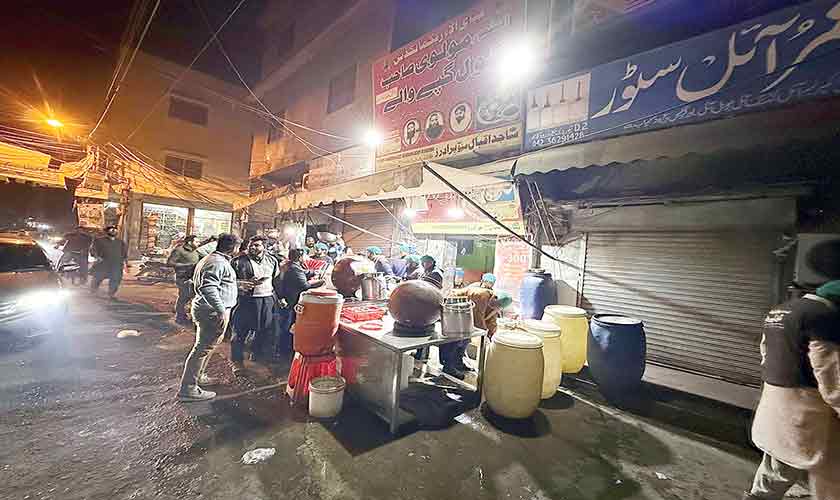
Recently, I experienced something in Lahore that took me back to those days in Germany. I had signed up for a food tour with my favourite group, Lahore ka Ravi, for an evening exploration of the gastronomic treasures of Gowalmandi, Lakshmi Chowk and the surrounding neighbourhoods.
As a dedicated foodie, I was excited to try the local eateries. I was equally curious to see whether such an outing could cultivate the same sense of community that I had once found in a foreign land.
As a Lahori, I can testify that while our hospitality is renowned, our social circles can be notoriously difficult to break into. There is an unspoken but unmistakable “you can’t sit with us” energy that defines many Lahori groups. Yet Lahore ka Ravi’s Ghazi Taimoor and his team managed to break through that barrier. They ‘forced’ us, in the best possible way, to enjoy one another’s company as we squeezed into Qing-qis, exchanged food stories and laughed our way through the chaotic streets of Old Lahore.
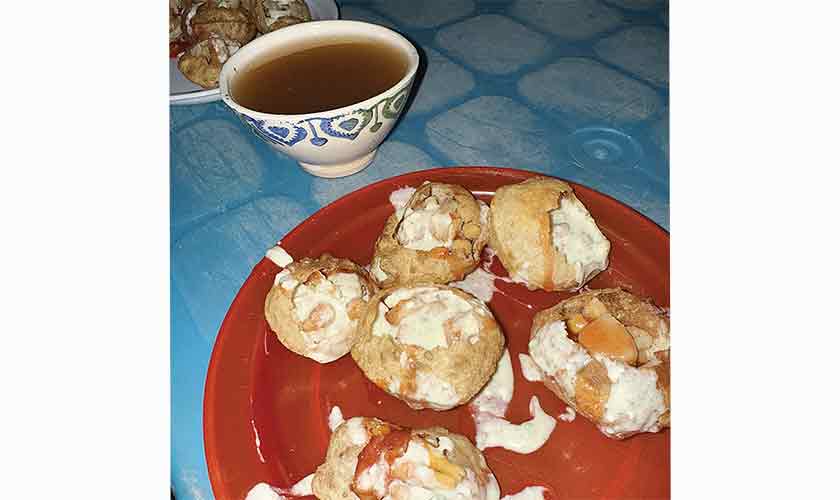
Outside Maulvi kay Gol Gappay near Lakshmi Chowk, while seated in a quintessentially Lahori environment, loud, crowded and bursting with character; the non-Lahoris in our group began bragging about how the gol gappay in Bahawalpur or Multan were superior. The Lahoris, naturally, refused to accept such nonsense. And when the gol gappay arrived; crisp, tangy, bursting with flavour, we felt vindicated.
From the same joint came their famous laddu peethi, a rich culinary experience with its own contested history. Some claim that it originated in Delhi under the name Raj Laddu, while others insist it was born in Lahore as Laddu Peethi. Whatever the truth, the debate reflects something essential about South Asian culture: food is deeply intertwined with identity, belonging and memory; and people defend it fiercely.
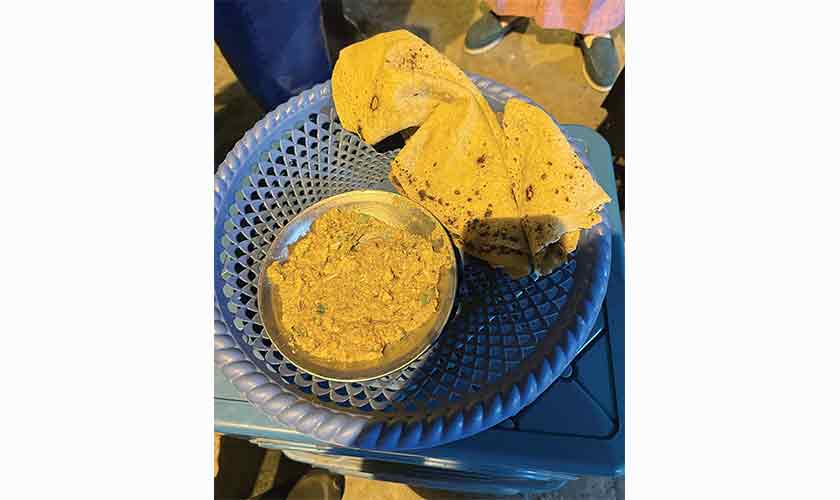
As we made our way through Amritsari Hareesa, Kashmiri Daal Chawal, Amritsari Dahi Bhallay, and my personal favourite Lakshmi ka Anda Tikki, the conversations grew livelier.
The anda tikki, a decadent mix of mashed lentils, eggs, tomatoes, onions, spices and an unapologetic amount of butter, leaves both the stomach and the soul full, even as it threatens to leave your arteries in peril. It is best enjoyed with rumali roti, known to some as ultay tawway ki roti. It tastes like equal parts nostalgia and indulgence.
The Kashmiri Daal Chawal stall, advertised boldly with a picture of Sultan Rahi, served as a reminder of how well-targeted marketing can speak directly to a community. Situated in the heart of Lakshmi Chowk, the shop feeds hundreds daily. Our trip organiser quietly slipped away, greeted someone warmly in the street and brought him over to us. Moments later, we found ourselves in the midst of an impromptu mehfil, eating daal chawal while he sang Nusrat Fateh Ali Khan’s Tairay bin nai jeena with a voice so soulful it felt like a blessing. There is a kind of magic that the streets of Lahore conjure effortlessly that cannot be replicated elsewhere.
Just when we thought we couldn’t eat another bite, the next stop proved otherwise. Dr BBQ welcomed us with char-grilled meat which was spicy, tender, smoky and irresistible. Finally, we ended our tour with shadiyon wali firni and doodh jalebi; though, in my heart, the night concluded not with dessert but with the new friendships and shared perspectives we had gathered along the way.
By the time we dispersed, it felt as though Ghazi Taimoor and his team of young storytellers had achieved exactly what they intended: they fed us, yes, but more importantly, they connected us. In a city that often feels divided by invisible social boundaries, food once again created the community I first discovered in a dorm room thousands of miles away.
Faaria Khan is a lecturer at LUMS and a human rights researcher. Her research interests lie at the intersection of education, gender and South Asian minorities