Print Story
X

| K |
abul has begun to vanish from Lahore. The sign that announced Muhammad Sadiq’s well-established shop in Liberty Market has been torn down, now reading: Handicrafts; the word that preceded it, Kabul, is gone.
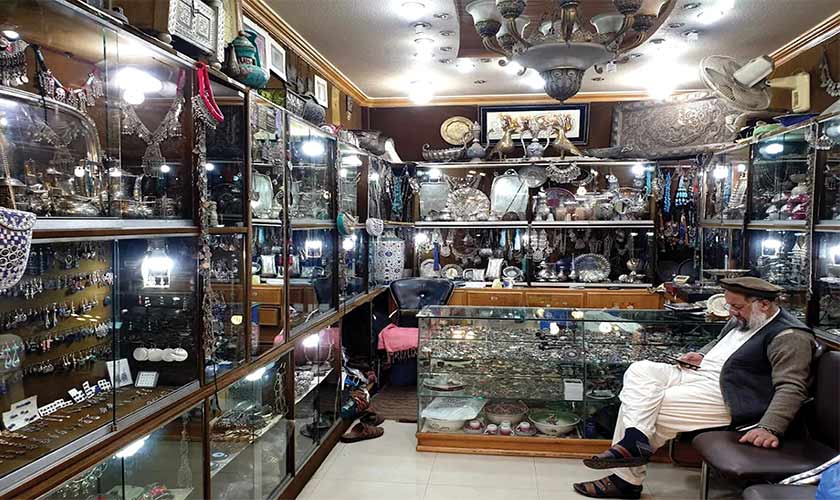
Within days of Sadiq — or Khan Sahib, as generations of customers knew him — leaving Lahore, the shop was taken over by a new tenant. Heaps of shawls now lie where there had once been a carefully curated collection of antique silver and brass jewellery and decorative pieces with their array of typically Afghan semi-precious stones in colours ranging from bright red to the familiar blue of lapis lazuli.
Sadiq ran Kabul Handicrafts for nearly 40 years, building a life, a business and a community around it. Last Saturday, amid Pakistan’s ongoing efforts to send Afghans back to a country they may never have stepped foot in, Sadiq was forced to leave.
“I had lived a dignified life in Lahore since 1988. Recently, the police had been coming to the market every day in search of Afghans, harassing or arresting even those who had valid visas. So, I decided to leave rather than lose my self-respect and be dragged out under arrest,” he said, speaking to this scribe over a crackly telephone line from Kabul where he and four of his children — all born and raised in Pakistan — are now trying to set up home.
A young man from Peshawar who runs a neighbouring shop said, “The government had been cracking down on anyone renting to Afghans. Our landlord was threatened with fines if he continued to rent to Lala Ji. When the police came, we would all tell them, “There are no Afghans here.”
“But Sadiq knew that if he stayed, his shop would soon be sealed. He tried everything he could to secure stable paperwork, including appealing to the ambassadors and politicians that had been visiting his shop for years, but to no avail.”
Sadiq was left with no option but to leave the shop he had so carefully built into a place known and loved by thousands.
| S |
adiq’s story is far from an isolated one. Since late 2023, Pakistan’s Illegal Foreigners’ Repatriation Plan has effectively forced millions of Afghans, including those who once held long-standing residency documents, out of the country. Under this policy, Afghan Citizen Cards and UN-backed Proof of Registration cards — for long the primary legal recognition of Afghan refugees in Pakistan — were allowed to lapse, most recently in June 2025.
Human rights groups have condemned the campaign, warning that it has left millions, effectively without any formal status, rendering them invisible under the law and highly vulnerable to harassment, arbitrary detention and forced return in violation of international protections.
“After they blocked PoR cards, I obtained a visit visa to be able to remain here,” said Sadiq. “But each visa costs $800 for only three months of validity. I have four children in Pakistan. How can I spend thousands of dollars every few months?”
While the official government schedule lists minimal costs for Pakistani visit visas for Afghan nationals, many report a different reality. Salaam Watandar and other Afghan media outlets claim that it is near impossible to obtain a visa through formal channels, with long delays and frequent rejections pushing people towards agents who charge hundreds or thousands of dollars.
For families like Sadiq’s, the cost is more than financial; it also takes an emotional toll. Every visa application is a reminder of how precarious the life they have built in Pakistan is. After decades of community and contribution, there remains no clear pathway to stay beyond temporary paperwork that can be withdrawn without warning.
In the days before leaving, Sadiq sold his carefully maintained wares by weight, letting them go for a fraction of what the intricate pieces were worth. But though Kabul Handicrafts may be gone, Muhammad Sadiq is still remembered by all those who worked alongside him or visited his shop.
A young boy who runs a nearby business shows me the chrysocolla ring he wears, telling me that it was a gift from Sadiq. “He was like a father to me,” the boy said. “I grew up alongside his son, who also helped him run the shop. He always welcomed me into his home.”
Others speak about Sadiq’s integrity and the pride he took in his work. Even as it became increasingly difficult to bring in goods from Afghanistan, Sadiq remained meticulous about what he sold, insisting on pieces whose workmanship and materials he could stand by.
They describe how heartbroken he was to leave, and his sense of betrayal by a country that once offered refuge and then withdrew it. “I had no choice,” Sadiq said, simply.
In Liberty Market, the new tenant of 162-G says that since last Saturday, at least four or five people come every day to ask what happened, some of them crying when they hear the story. As the government continues to narrow the definition of who is allowed to belong, Kabul is disappearing from Lahore. What is erased is not just shops or signboards, but lives that were deeply embedded in the city. What replaces them may fill the space, but cannot make up for the loss.
Mishael Hyat Ayub is a researcher and writer from Lahore, currently based in Singapore. Her work focuses on marginalisation and inequality. She holds an anthropology degree from Yale-NUS College
Every new visa application is a reminder of how precarious the life they have built in Pakistan is. After decades of community and contribution, there remains no clear pathway to stay beyond temporary paperwork that can be withdrawn without warning.