Print Story
X




Ghulam Rasool Mehr’s book restores a lost chapter of Sindh’s past
| I |
n the literary and historical landscape of Sindh, the name Maulana Ghulam Rasool Mehr carries considerable weight. A distinguished writer and journalist, Mehr devoted much of his intellectual life to reviving neglected strands of Indo-Muslim history. Born in 1895 in Phulpur village near Jalandhar, he was educated in Lahore and soon immersed himself in the vibrant journalistic culture of the early 20th Century.
His career began under the influence of Maulana Abul Kalam Azad, and through his association with newspapers like Al-Hilal, Zamindar, and later his own Inqilab, Mehr set a precedent for bold, principled journalism. His dedication to history, literature and Islamic thought was unwavering. Over the course of his life, he authored nearly fifty books, translated key historical texts and produced authoritative studies on Ghalib and Iqbal.
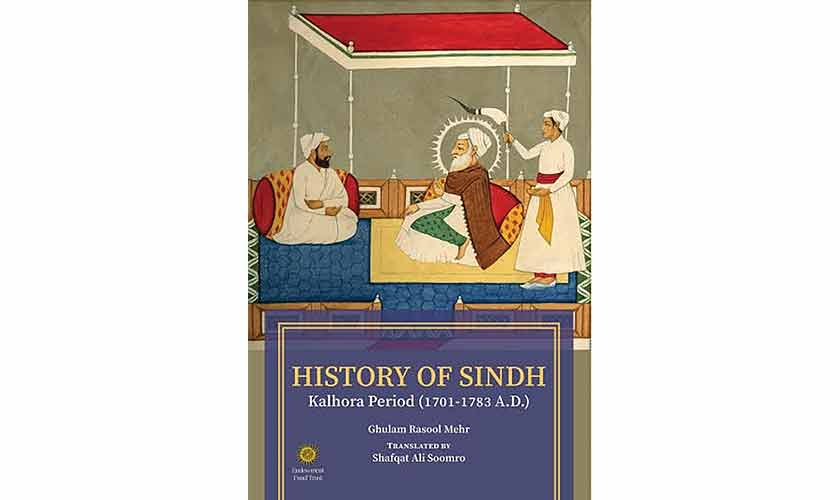
Until his death in Lahore, Mehr embodied a rare blend of scholarship and moral courage. His two-volume History of Sindh: Kalhora Period, first written in Urdu as Kalhora Daur and now presented in English translation by the Endowment Fund Trust, stands as a testament to his commitment to recording Sindh’s past with depth and authenticity.
The translation comes from Shafqat Ali Soomro, a scholar with more than three decades of experience in journalism and literature. His rendering of Mehr’s History of Sindh: Kalhora Period is marked by fidelity to the original text, preserving both its factual density and its literary cadence. In this edition, Shafqat Ali Soomro and Khaula Qureshi have done justice to the work: the Persian couplets have been retained in their original form, while their meanings have been carefully conveyed in English.
Mehr anchors his narrative in a broad documentary base. He draws on Persian and Sindhi chronicles and reinforces them with the same primary and secondary sources that orientalist scholars and later PhD researchers consulted: provincial gazetteers, travellers’ accounts, British administrative memoirs and specialised studies on Sindh’s social and irrigation history. Works such as the Gazetteer of the Sindh Province, James Burnes’ travel narrative, the Imperial Gazetteer, archaeological surveys and early studies on Sindh’s geography and tribes provide the scaffolding for Mehr’s reconstruction. Together, these sources form an archival chorus that strengthens Mehr’s chronology, geographical descriptions and many of the events he narrates.
The first volume lays the foundation. Mehr traces the family lineage of the Kalhoras, beginning with their spiritual roots and tribal affiliations and guides the reader through the rise of Mian Adam Shah Kalhoro and his successors. The narrative does more than record events; it evokes the political, cultural and spiritual soil of Sindh. We encounter figures such as Shah Inayat of Jhok, the Sufi whose defiance of feudal and imperial powers became a symbolic marker of Sindh’s yearning for justice. Mehr’s account of Shah Inayat’s confrontation with local power structures echoes the version preserved in Sindhi hagiographies and is reinforced by colonial-era reports that documented the social influence of regional saints.
Reading Mehr today is like listening to an elder who refuses to let memory die.
Mehr is not content with bare chronology. He writes with a journalist’s urgency, frequently pausing to analyse motives, betrayals and the human frailties of rulers. His chapter on Nadir Shah’s invasion is particularly compelling. Here, Sindh emerges not as a passive province but as a trembling frontier of empires, exposed to the shocks of Central Asian campaigns and Mughal decline. Orientalist histories — including detailed treatments of Nadir Shah in South Asian historiography — and Mughal-period Persian records, both cited in Mehr’s bibliography, confirm the broad outlines of these incursions and provide independent testimony to the upheaval they caused across the Indus region.
The second volume is about climax and fall of the dynasty. Mehr paints the reigns of Mian Noor Muhammad and Mian Ghulam Shah Kalhoro with rich detail. Ghulam Shah, in particular, emerges as a statesman who strengthened Sindh’s military defences and sought to balance relations with Afghans, Marathas and the rising power of the British. Colonial dispatches and district gazetteers — often compiled by British administrators who recorded local successions and battles — align with Mehr’s account of diplomatic manoeuvring and military reorganisation under Ghulam Shah.
Power is never eternal. The second volume leads the reader into the turbulence of succession disputes, betrayals among nobles, Afghan raids and internecine conflicts that weakened Kalhora authority. The dramatic Battle of Halani (1783), which sealed the dynasty’s fate at the hands of the Talpurs, is narrated with a pathos that reminds us that dynasties, like individuals, carry within them the seeds of their own decline. Contemporary notices in regional records and later studies of Sindh’s political transition corroborate the general course of events that Mehr outlines.
What distinguishes Mehr’s work is his rigorous use of sources. He does not depend on a single archive. Instead, he draws upon Persian chronicles, Sindhi oral memory, British gazetteers, the writings of 19th-Century travellers and archaeological surveys — building a composite picture that is both local and comparative. Many of the orientalist and administrative works he cites remain the best available documentary cross-checks for several of his claims, especially regarding chronology, place names and troop movements. For the reader, the practical implication is clear: Mehr’s documentation stands not as a mere recollection but as a synthesis resting on the bedrock of archival and published testimony.
When Mehr describes the irrigation ambitions of a Kalhora ruler, the same canal alignments and survey notes appear in gazetteers and archaeological records. When he recounts the entry of Afghan horsemen or diplomatic exchanges with Maratha envoys, those movements can be traced in Persian dispatches and colonial foreign-office summaries.
To conclude, reading Mehr today is like listening to an elder who refuses to let memory die. His authentic documentation of the Kalhora dynasty is not only about the past — it speaks to our present hunger for rootedness. As Lachman Komal once wrote, “History is not in dates, but in the sighs of the land.” Mehr captured those sighs with diligence. His Kalhora epoch remains an essential gateway into the story of Sindh.
History of Sindh
Kalhora Period
(1701-1783 A.D)
Author: Ghulam Rasool Mehr, (translated by: Shafqat Ali Soomro)
Publisher: Endowment Fund Trust, 2024
Pages: 547
Price: Rs 4,000/-
The reviewer is a graduate from NUML, Islamabad, and the author of Song of the Soul. He may be reached at [email protected].