Print Story
X




A traveller wanders through Samarkand’s legends, discovering a city that refuses to let the heart go
| W |
hile modern devices offer immersive experiences, they can never replicate the feeling of being physically present in a place. No v-log can prepare you for the scale of Samarkand’s architecture as you stand on the steps of Registan Square. My wife and I felt truly transported, taking in the beauty of Emir Taimur’s city. That is the real charm of travel: meeting new people, absorbing the atmosphere and simply breathing the air.
For anyone interested in photography, early mornings matter. You can see the structures without crowds, enjoy the best light and soak up the calm. With that in mind, I set out at dawn, leaving my wife to rest after a busy previous day. The city was silent except for the occasional birdsong. The minarets and the azure dome of Gur-i-Amir glowed in the first light. The whole structure gleamed softly and I found myself imagining the early mornings of the 15th Century, when these buildings stood without any other prominent structures around them. Samarkand must have been astonishing.
Walking and thinking aloud, I reached the grassy lawn on the eastern side of Registan Square. Dewdrops glittered like pearls. Standing before the statue of Uzbekistan’s first president, Islam Karimov, I reflected on the country’s independence from the Soviet Union in 1991, and his leadership until his death in 2016. About ninety minutes later, I returned to the hotel. My wife was awake and immediately asked about my morning exploration. She was eager for us to set out together. After breakfast, we began our walk through the city.
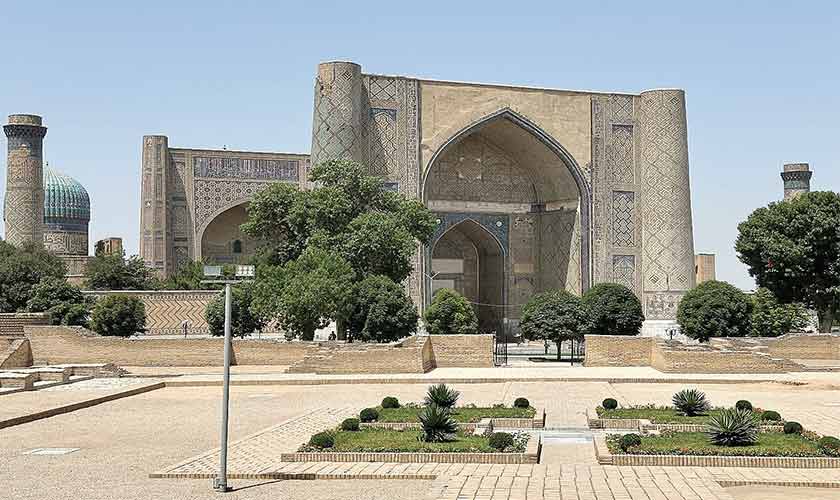
Our first stop was the Bibi Khanum Mosque. Named after Taimur’s wife, Saray Mulk Khanum, it is one of Samarkand’s most significant monuments. A masterpiece of the Timurid Renaissance, it was one of the largest and most magnificent mosques of the 15th-Century Islamic world. Structural weaknesses meant that only a grand ruin survived by the mid-20th Century. Much of what stands today was restored during the Soviet period. The soaring pointed arch and thick, blue-and-white tiled columns dominate the façade, with “Allah” and Muhammad” inscribed in decorative script. The entire frontage shone in the sun.
The wind was strong that morning, and we joked about using an umbrella as a parachute just to take in an aerial view. After paying the 75,000 som entry fee per person, we entered the main courtyard. Another grand arch stood ahead, with a glass casket between the structures holding a giant replica of the Holy Quran on a carved stone base. Only a handful of tourists were present, so the space was quiet. Large parts of the mosque were under renovation; plaster had eroded from walls and domes, cracks were visible and it was clear the mosque needed substantial conservation. Old photographs on display showed the site in a far worse state — almost no minarets and a collapsed façade. “The restorers must be incredibly talented,” my wife remarked, comparing those images to what we were seeing now.
We walked towards the main hall where pieces of marble columns lay on the ground — a painful sight. It reminded me of the Mosque of Córdoba, whose courtyard once also had many columns. Here, the roof and walls have collapsed, leaving only remnants. Across from the mosque stands the Bibi Khanum Mausoleum. The entry fee was 50,000 som. Seeing my wife hesitate, the woman at the counter kindly allowed both of us to enter on one ticket. We appreciated the gesture.
Next, we walked to Khizir Mosque, associated with the legendary prophet. Built on a hill, its history dates back to the 8th Century. The original structure was destroyed in the Mongol invasion of 1220. The present mosque was built in 1864. After crossing a pedestrian bridge over the highway, we climbed the path towards the wooden-columned mosque decorated with green and blue tiles. A small fountain outside provided welcome relief from the heat. Nearby stood an elegant structure with no signboard. A mosque keeper informed us that it was the mausoleum of Islam Karimov — the person whose statue I had seen earlier. The absence of signage struck us as unusual; perhaps he had wished the grave to be left unmarked.
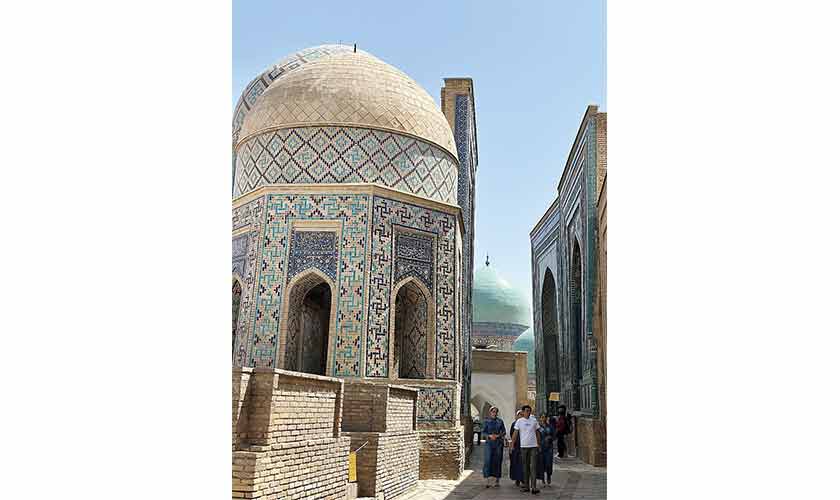
We then made our way to a place we had heard so much about: Shah-i-Zinda — The Living King — a necropolis famed for those buried there. The white, pointed-arch entrance and tiled staircase seemed ordinary and we wondered whether the site was overhyped. Once we were inside, everything changed. Formed over eight centuries, the complex now includes more than twenty structures. According to tradition, Qutham ibn Abbas, a cousin of the Holy Prophet (peace be upon him), is buried here. He came to Samarkand in the 7th Century to preach Islam and was martyred.
As we climbed the stairs after buying our tickets, we saw a small commotion. A woman, possibly in her forties, had slipped and fallen, injuring her chin. Blood trickled onto the steps as her companions helped her. My wife suggested the heat might have overwhelmed her; I wondered if she had become lost in the architecture.
Samarkand is not just a place you visit; it is a city that quietly steals your heart.
At the top, we stepped into a narrow street framed by dazzling blue and turquoise tiles. It was breathtaking — like walking into a scene from One Thousand and One Nights. No camera could fully capture it. Everywhere we looked, there were intricate patterns and designs. Mausoleums lined the street, their interiors cool and calm, offering respite from the brightness outside. Graveyards, in their own way, remind us of life’s truths. We entered several chambers, reading the plaques and reflecting on why humans seek such grandeur even in burial places — a tradition stretching from Egypt to India.
A small shop displayed painted plates. Beyond it, a covered passage led to the Mausoleum of Qutham ibn Abbas. Inside, silence prevailed except for the hum of a fan. We sat, prayed and felt a deep sense of peace. We reflected on the courage required to travel from the Arab world to this distant land, in an age when journeys were perilous. He was martyred for preaching Islam — a noble end.
Back outside, the sun illuminated the blue tiles, turning them golden. I photographed the three buildings at the end of the street. In one chamber, the restored muqarnas and dome ceiling resembled an emerald blossom. Eventually, we retraced our steps down the staircase — carefully, remembering the injured woman — and crossed the bridge to a nearby restaurant for lunch. A shashlik bowl revived us. A few Japanese travellers played cards nearby.
We returned to our hotel exhausted but deeply satisfied after visiting Shah-i-Zinda.
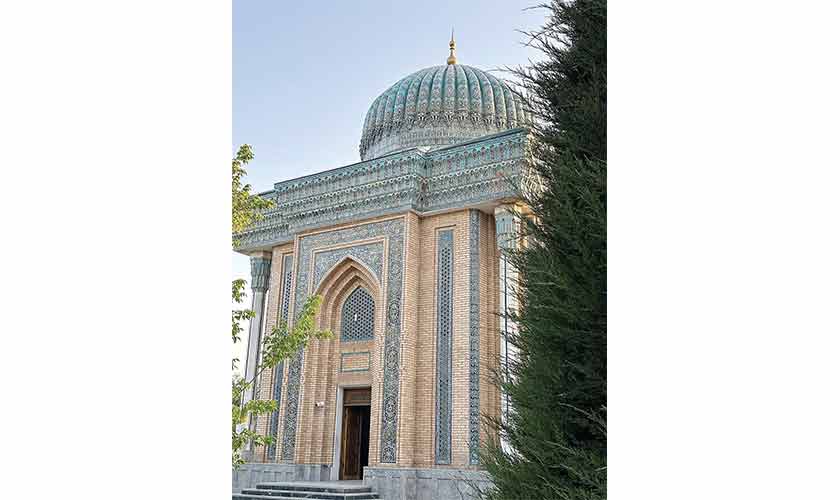
After about two hours, we set out again and headed to one of Samarkand’s most renowned sites: the Mausoleum of Imam Abu Mansur al-Maturidi (853-944 AD). A Hanafi jurist and theologian, he is the eponym of the Maturidi school of kalam in Sunni Islam.
There was an entry fee, so I approached the ticket booth, where a gracious man with a long beard was seated. I casually remarked that it seemed unfair to charge visitors for entering this mausoleum. Although his English was limited, he appeared to understand and invited us to go inside without buying a ticket. I was moved by his kindness and thanked him.
Inside, we entered the chamber, sat on one of the benches and offered our prayers. The space was calm and peaceful. After spending some time there, we stepped out again, wanting to thank the man for his generosity. I had a 500-rupee note in my wallet and offered it to him as a small token. He smiled and thanked us in return. We left feeling uplifted.
The next day in Samarkand was our last. We were already beginning to miss the atmosphere of the city. We planned to visit one final, important site: the Tomb of Prophet Daniel, located on the outskirts. Using the Yandex Go taxi app, we arrived at around 11am.
According to local legend, Emir Taimur’s repeated attempts to conquer Syria failed because a saint from biblical times, Daniel, was buried there. One of his ministers advised that this was the reason for his lack of success. Taimur then sent his army to retrieve Daniel’s remains from Syria and, after a fierce battle, brought part of those to Uzbekistan. It is also said that the day Daniel was re-buried, a natural spring emerged at the site. Locals believe that its water has healing properties. We saw several people filling bottles from the tap at the entrance.
The grave itself is unusually long—no one seems to know why—but the surrounding area is beautifully maintained. Benches are placed for pilgrims. A young imam sat quietly in one corner, reciting verses and offering prayers whenever visitors approached him. The atmosphere was deeply peaceful. We sat for a while, taking in the serenity.
Nearby stood a tree said to be around six hundred years old. It looked surprisingly youthful—more like sixty. Its vitality was taken as a good omen, a sign of the care given to the site. We stood beneath it for a moment, appreciating its quiet presence.
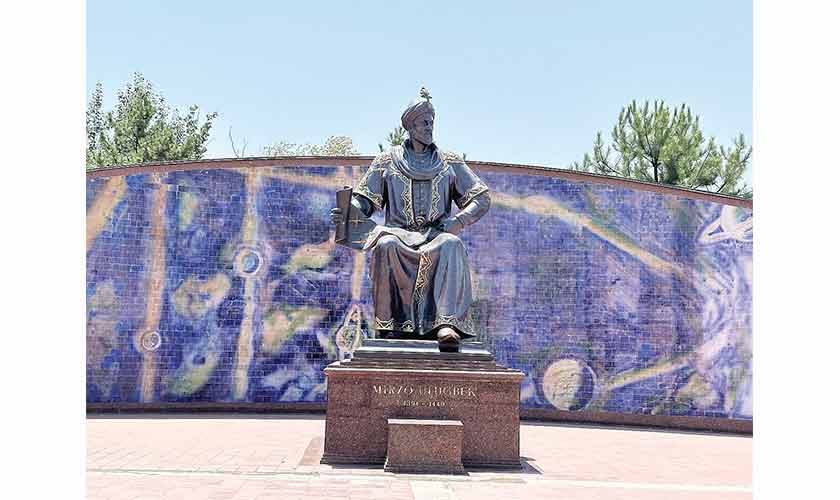
Our next destination was the Ulugh Beg Observatory, built in the 1420s by the Timurid astronomer Ulugh Beg, about a kilometre from the tomb. We walked there under an umbrella to shield ourselves from the heat. Ulugh Beg was a fascinating figure: a governor, statesman, scientist, mathematician and astronomer, whose life was ultimately marked by court intrigue and tragedy. A large statue greets visitors at the entrance, depicting him with a scroll in his hand and a tall turban with a plume.
Though he lived from 1394 to 1449, his name and achievements are visible throughout Samarkand and Bukhara. Only the doorway to his observatory survives today, leading to a narrow underground tunnel used to track the movement of stars. The museum nearby displays a scale model of the entire structure as it once stood. Walking through, I found myself thinking of the golden age of Islam, when Muslim scientists were among the leading minds of the world, while Europe was still in its dark ages.
Next, it was time to try one of the most highly recommended spots for authentic Uzbek plov: a place called Oshqand. We took a taxi there and asked for the menu. A young boy, who spoke a little English, simply said, “We have no menu, just plov.” This caught us by surprise. A few moments later, he arrived with a trolley filled with salad bowls. We chose raita and a fresh salad, and ordered a single serving of plov — more than enough for both of us. The taste was exceptional. We found ourselves absorbed in the warm, bustling atmosphere of the restaurant.
After lunch, we returned to our hostel, passing through the famous Siyoub Bazaar. As we were due to travel out of the city early the next morning, we set out again after an hour’s rest. Passing a signboard that read, in golden letters, “Samarkand is the pearl of the earth,” we could not have agreed more.
With the sun beginning to set, we made our way back to Registan Square. There was still enough light for photographs, and we took full advantage of the gentle, late-evening glow. The nightly light show was about to begin so we positioned ourselves in the middle of the amphitheatre steps. The show started on time — a modern pulse set against an ancient stage. We watched it knowing that the thought of leaving the next morning already made us feel wistful.
Samarkand is not just a place you visit; it is a city that quietly steals your heart.
The writer is a professor at the National University of Sciences and Technology.
CAPTION
Shah-i-Zinda Complex. Mausoleum of Imam Abu Mansur al-Moturidi.
Statue of Ulugh Beg in front of the Observatory.