Print Story
X

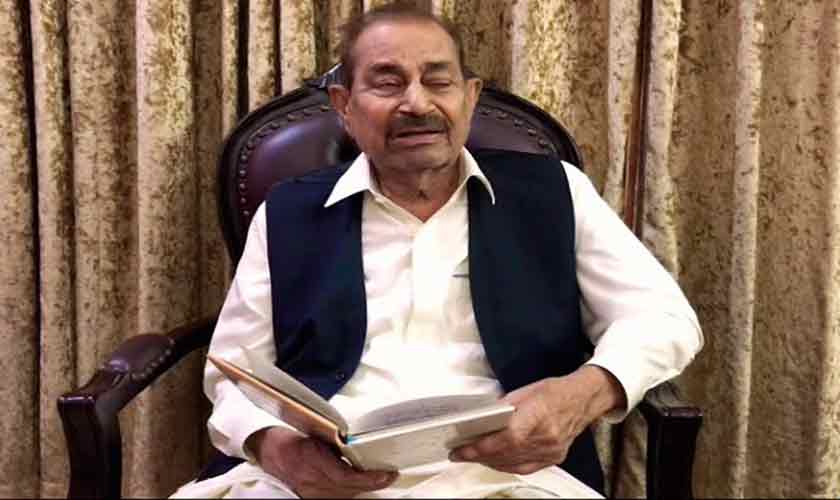
Prof Razi Abedi, one of Pakistan’s most distinguished literary minds and a towering humanist, has passed away at the remarkable age of 93. With his departure, an era of intellectual generosity, literary depth and humane scholarship draws to a gentle close. Down-to-earth in demeanor yet erudite beyond measure, he was a poet par excellence, a critic of uncommon clarity, and above all, a teacher whose devotion shaped generations.
Born with a natural inclination toward literature, Abedi’s life nonetheless began with detours imposed by circumstance. Made to study science and compelled to work after the early death of his father, he entered professional life young—first in the AG Office in 1946 and later as a telephone operator. Even during those years, books never left his hands. He read voraciously—Russian, French, Urdu, English—absorbing a world of ideas that would later infuse his scholarship.
His academic ascent was as extraordinary as it was hard-won. Abedi earned an MA in English from the University of the Punjab before traveling to England in 1968, where he completed an MA and Tripos from Cambridge University within a year—an achievement that testified to his brilliance and uncompromising dedication to learning. Returning home, he became one of Pakistan’s most prominent literary figures, eventually serving as chairman of the English Department at Punjab University, Lahore. He played a pivotal role in establishing the department in 1963, an institutional contribution that alone would have secured his legacy.
But Abedi was far more than an administrator or academic—he was a bridge between worlds. His scholarship illuminated the literatures of both East and West, and he was among the earliest to situate Urdu literature within the wider canvas of Third World writing and global intellectual currents. His critiques, essays and bilingual writings demonstrated a mind equally comfortable discussing Romanticism, structuralism or the progressive movement, all while remaining rooted in the lived realities of South Asia.
His books—The Tragic Vision, Maghribi Drama aur Jadeed Adabi Tehreekein, and the widely acclaimed Achhoot Logon ka Adab (co-authored with Dr Mubarak Ali)—stand as testaments to his analytical rigour and moral clarity. A lifelong advocate of social justice, Abedi wrote courageously against exploitation and oppression. His stance during the Zia era, when he critiqued authoritarianism in English to escape censorship, reflected both his strategic acumen and steadfast principles.
A progressive at heart, he believed deeply in empathy for the oppressed, in the power of literature to humanise and in the inevitability of the “looted” rising to reclaim dignity. Yet he remained intellectually independent—a critic of dogma, whether political, linguistic or literary. His views on Urdu, Hindi, translation and cultural hybridity were marked by nuance rather than orthodoxy. Abedi rejected divisiveness, championing instead the transmission of ideas across languages and regions to cultivate collective human understanding.
As a teacher, he was unforgettable. His students often recall his humility and generosity of spirit—embodied in his constant refrain: “I always tell my students that they should be better than me.” For him, teaching and travel were life’s two great passions. He he embraced both with gratitude, curiosity and wonder. His range of erudition was extraordinarily wide—so wide, in fact, that it is difficult to confine it within any conventional scholarly category. He moved effortlessly from Romanticism to modern critical theory, from Urdu fiction to Western drama, from structuralism to Marxist thought, weaving connections that many specialists would hesitate even to attempt. His study Teen Novel Nigar, in which he examined the works of Qurratulain Hyder, Abdullah Hussain and Intezar Hussain, remains a brilliant example of the breadth of his knowledge and the subtlety of his critical insight. Few critics could engage with these three novelists—each representing a different sensibility, historical experience and linguistic register—with the same level of sympathy and analytical precision, but Abedi sahib had that rare gift: a capacious intellect that embraced complexity rather than shying away from it.
His circle of friends, too, reflected the catholicity of his mind. Writers, poets, historians, journalists, teachers, actors, political activists—one could find all of them in his company. His friendships were wide and variegated, nourished not by ideological conformity but by a shared love of ideas and humane curiosity. He could converse with equal ease with the avant-garde poet restless for innovation; the traditionalist steeped in classical forms; the progressive intellectual committed to social justice; and the young student just discovering the world of literature. Wherever he stood, he created a space for dialogue, for nuance, for thoughtfulness—and that was perhaps the deepest measure of his scholarship and humanity.
When he was rather unceremoniously denied an extension of his contract by Government College, Lahore, it came as a shock to many. The decision seemed baffling, even unjust, for he was among the very few teachers of English literature who possessed the rare capacity to teach virtually any subject in the master’s curriculum—be it Shakespeare, modern drama, critical theory, romantic poetry or the vast terrains of comparative literature. His command over the discipline was encyclopedic; his teaching, luminous. To deprive the students of such a mind was, for many, nothing short of an intellectual loss.
Nor was this the only instance of institutional neglect he endured. Because of his left-leaning ideological commitments—his sympathy for the progressive movement, his stand against authoritarianism and his unwavering critique of exploitation—the Punjab University administration often viewed him with suspicion. Despite his unmatched merit and seniority, he was denied the rightful position of chairman of the department, a role he had more than earned through decades of service, scholarship and leadership. It was an omission widely recognised as deliberate. He bore these slights with characteristic dignity, never allowing bitterness to overshadow his commitment to teaching, writing or intellectual openness.
Such was the measure of the man: a scholar of vast learning, a teacher of uncommon depth, a friend to many and a humanist who never compromised on principle—even when the price was paid in institutional injustice.
I, too, was fortunate to experience his mentorship in a deeply personal way. Despite the considerable difference in our ages, he treated me with a rare equality of respect. When he served as visiting faculty in the English Department at Government College, Lahore, we spent long afternoons in sustained conversation—debating the nature of poetry, the uses of literature and the hierarchy of disciplines. I often challenged poetry as an obfuscated path to truth, but Razi Sahib, with characteristic calm and conviction, would insist that the highest forms of intellect reveal themselves in poetry. Our discussions were spirited yet affectionate. He never allowed disagreement to diminish warmth.
The depth of his magnanimity became evident when he dedicated his poetry collection, Kuchh Ghazlain, Kuchh Nazmein, to me—a gesture that moved me profoundly, for it showed how graciously he could honour even those who held opposing views. Our debates extended to history and literature as well; I argued that history possessed greater value, while he defended literature as the deeper reservoir of human experience. These exchanges remain among the most enriching intellectual encounters of my life, and they stand as testament to his capacious intellect and generous heart.
His writing life was equally rich. A poet and essayist, he engaged with ideas not as abstractions but as living forces connected to real human circumstances. Even in old age, he remained intellectually vibrant, working on his autobiography Bazaar Ki Raunaq—a travelogue-infused memoir that promised the same warmth, candour and clarity that defined his life.
Lahore’s cultural and academic life was deeply enriched by his presence. He served in numerous organisations, mentored scholars, guided writers and remained an accessible, grounded figure despite his immense stature. His optimism for the future of Urdu literature and his belief in young writers’ potential reflected his enduring faith in creativity and human resilience.
Prof Razi Abedi leaves behind an incomparable legacy—of scholarship that bridged continents; of poetry that touched hearts; of criticism that challenged complacency; and of a humanity that inspired all who knew him. His life reaffirmed the timeless truth that greatness lies not only in brilliance but in humility, empathy and the courage to stand with the oppressed.
In his passing, Pakistan has lost a scholar of rare caliber; a teacher of immense love; and a humanist whose moral clarity shone steadfastly across decades. But his words, his ideas and his example will continue to illuminate minds and awaken consciences for generations to come. May he rest in eternal peace.
The writer is Professor in the faculty of Liberal Arts at the Beaconhouse National University, Lahore