Print Story
X

| T |
he season for discovering the hidden gems and untold stories of Lahore is back with Taimoor Ghazi’s Lahore ka Ravi. This time, we set out to explore the havelis tucked away in the narrow lanes of Androon Shehar, each with its own language, culture and traditions, alongside the history behind the names these places carry.
Before starting the walk, we had a traditional Lahori breakfast, naan chholay from Yaseen in Gowalmandi, an area once known for the milk business. Our walk began at Mochi Gate and continued towards Lal Haveli. As we entered the narrow streets of Khilona Bazaar, I couldn’t help but notice that the toys, though of lower quality than those sold in some posh areas of Lahore, were still the ones children here grow up with, forming cherished memories despite their simplicity.
Because the homes were close by, with narrow streets and little room to expand, the structures grew vertically, built around a central courtyard with rooms arranged along its edges. This design not only kept the homes ventilated but also cooler in the summer heat.
Lal Haveli was a name I had heard often during Muharram. What we saw was a simple building with a green-and-white door, nothing like what I had imagined. In my mind, havelis were grand spaces with traditional décor, intricate tile work and carved details. Yet this one, modest and unadorned, stood tall with a quiet dignity, carrying its own grief in silence. During Muharram, it opens itself, and its people, to communal mourning in memory of Karbala.
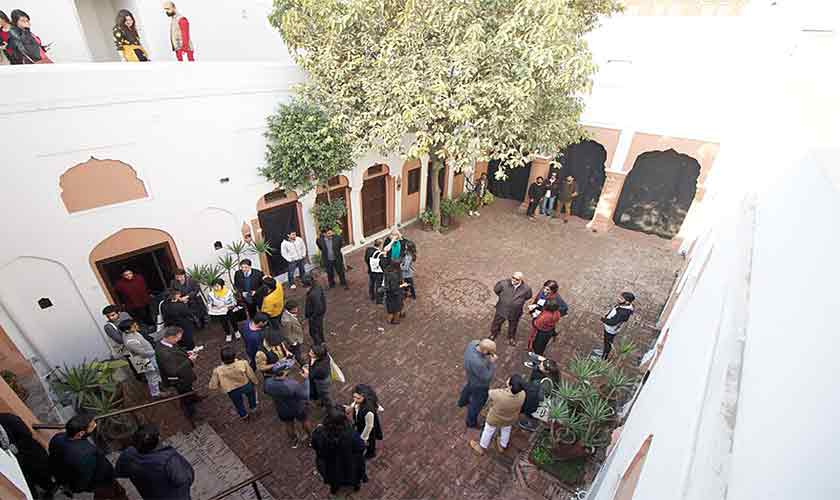
With heavy hearts and a shared silence, we walked on towards Mubarak Haveli and Nisar Haveli. I expected them to be similar in character, but they greeted us differently. Beyond the entrance lay a large courtyard, bordered by rooms and watched over by a patch of relatively clear sky, a rare sight in the smog season. We stepped into a long hall, and once seated, began to take in the space around us. The walls were lined with frames holding, with great tenderness, the names of the holy prophet’s family and his companions (peace be upon them).
Despite the stillness, the place felt dense, almost chaotic, perhaps because of the stories held in the dungeon beneath our feet.
The haveli, around 300 years old, has architectural elements that reflect an amalgamation of various eras. It was attacked numerous times and eventually taken over by Ranjit Singh, who used it as a guest house. Later, Shah Shuja Durrani, the deposed Afghan king, was kept under house arrest here by Ranjit Singh after he learnt that Shah Shuja possessed the Koh-i-Noor diamond. The diamond was eventually taken from him and he was detained in the dungeon. Later on, the Koh-i-Noor was presen ted to the British queen and set into the royal crown.
Today, Mubarak Haveli is the starting point of the oldest Muharram procession in Lahore, and across Pakistan, established nearly 170 years ago. For about a century, the procession began here, before it shifted to Nisar Haveli, which was built on a part of Mubarak Haveli’s original land.
The visit to the dungeon was an experience in itself, particularly because of the steep stairs and the roshandans. Looking up at the sky through the narrow ventilator window, I wondered how the prisoners had survived with almost no connection to the outside world.
With these thoughts in mind, we stepped back into the streets, cluttered with rubbish and marked by unpleasant smells, pulling me abruptly back into the reality of the present day. Seeing the lack of cleanliness in the area, I made a mental note to call the government helpline later.
We then headed towards our next haveli in Churi Bazaar, but that is a tale for another time.
The writer is a freelance journalist