Print Story
X




Nusra Latif Qureshi and Talha Rathore explore the charged lines that bind past to present
| T |
he path of art history can be compared to the maps printed in the promotional material one browses mid-air while flying on busy airlines that operate across continents. Arches, arrows, lines and dots indicate cities far from one another in every sense of the word. Yet the airlines schedule a plane to take off from Dubai, land in Miami; then arrive in Bogotá. Or an aircraft departs from Heathrow, stops in Mumbai and finally reaches Sydney. These are not one-way flights either, as they return along the same routes.
The passage of art is a multi-directional traffic across regions and time. Unlike air travel, the duration and location of these sojourns are not fixed. A backward journey may take ages; a short distance may require far more time and effort to cover. Like corporate jet-setters, visual artists are perpetual travellers, but for them their home addresses, temporary identities, passports, immigration permits, residence certificates and nationality cards are all contained in a single document: their art practice. Living at a distance from one another in both time and place, they find common connections through observation, imagination and expression.
Nusra Latif Qureshi and Talha Rathore are among the artists who share several significant segments of their lives. Both studied miniature painting in the mid-nineties at the National College of Arts, and both now live outside Pakistan; Qureshi in Australia and Rathore in North America. It seems logical, then, for their pictorial dialogue to meet on a middle ground; hence their two-person exhibition being held in Lahore (A Thousand Rose Petals, 28 October-29 November, at Rohtas 2).

Their work, which retains a trace of traditional miniature, has acquired new identities. They explore narratives of women rooted in society, tradition and terrain, while simultaneously attempting to break free. As is often the case, what is not acquired personally cannot be abandoned consciously. Across their work on paper, symbols suggest the condition of a woman, not necessarily negative, despite how easily that label is applied, in situations of estrangement. With one artist based in Melbourne and the other in New York, the imagery moves beyond mere reminiscence; it becomes an account of living away from one’s homeland.
Art, like one’s mother tongue, is a link to identity. As surroundings shift, the accent changes, the structure expands, the subject widens; yet it remains an amalgamation of private emotion and shared concern. This is especially true for someone who is both a woman and a displaced person. Unsurprisingly, both painters approach this aspect from the perspective of individuals who conceal more than they reveal; yet the viewer can still read the content between the lines and behind the forms.
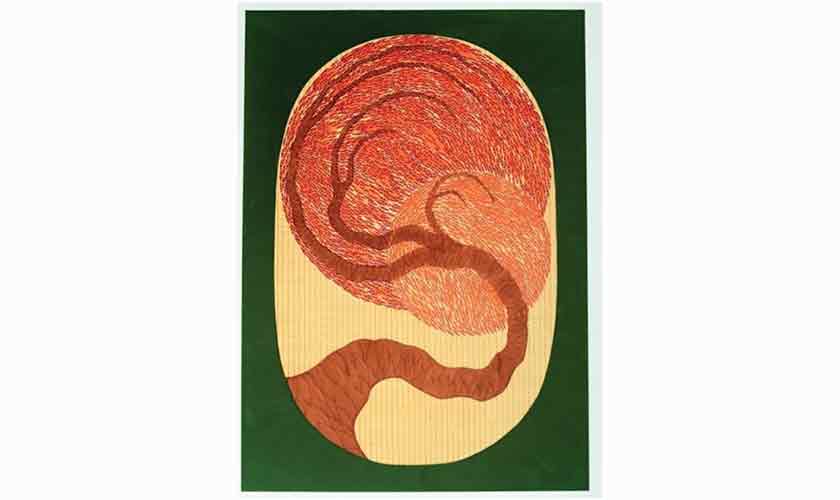
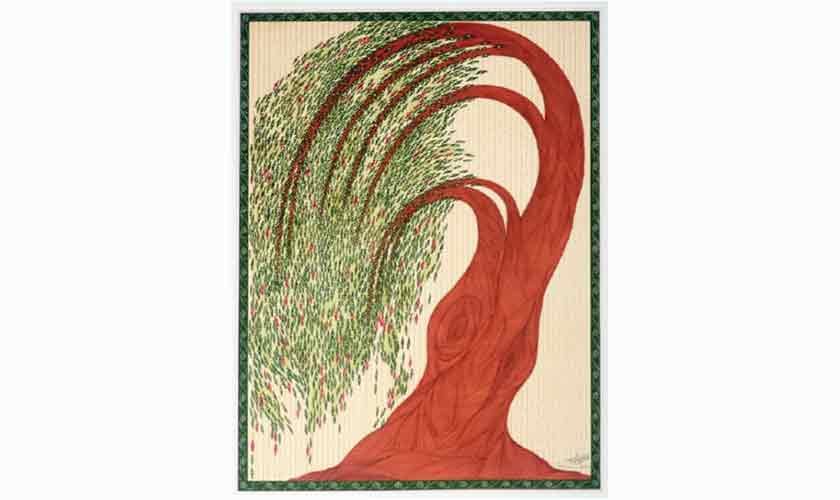
It is difficult to define the practice of these two painters. Their work is rooted in the tradition of Indian miniature painting while also engaging with contemporary art that cannot be confined to a single nation or culture. Talha Rathore builds her imagery around a tree, or a cluster of two or three. Whether cypresses or local wood, the forms are twisted, inverted, whirling, swaying, almost dancing, their trunks and branches surrounded by leaves of an unfamiliar kind. What appears real at first glance slowly begins to unravel in Rathore’s paintings. In Solace III, the tops of two cypresses intertwine; in Solace I, three trees meet in a similar embrace, with a suggestion of steady rain conveyed through dotted lines.
Art, like one’s mother tongue, is a link to identity.
The cypress, in its iconography, is connected to Persian miniature painting. It has appeared in much of Rathore’s earlier work. But in her recent show at Rohtas 2, much of her imagery has shifted to the shisham (Indian rosewood), recognisable by its thick base. That width reflects a deep-rooted connection to the soil. In many ways, the trees in Rathore’s work resemble portraits of the artist herself, someone who inhabits two hemispheres. The upper section, its branches, leaves and clouds, belongs to her present surroundings, while the lower half is embedded in her personal history. It’s a tree that stretches from Lahore to New York.
The tree turns into her character. Its leaves, earthy green and light brown, are arranged not to follow botanical order but to evoke an element of intimacy. The spread of leaves, like buzzing bumblebees, contains eyes at their centres and is composed in a variety of formats. One recognises that these are not trees that could be cut and used to make beds, chairs or tables; they are human beings, particularly women. The head is full of, and filled with, eyes. The lines of each tree trunk resemble the strands of a woman’s braids (interestingly, or ironically, traditional miniature brushes were made with squirrel hair). A supporting plait for a girl in a society like ours means more than simply having long hair; it is perceived as a social norm or a burden. Unsurprisingly, several female miniature painters from Pakistan have treated hair as a metaphor: Ambreen Butt encroached upon by the winding lines of her hair; Nusra Latif Qureshi’s self-portrait with cropped hair; and Saira Sheikh cutting her own long hair and exhibiting the severed braid, to name a few.
A hint of self-representation is evident in Nusra Latif Qureshi’s recent paintings, too. In 2009 she had produced a digital print, Did You Come Here to Find History, which blends her face with the profile of a Mughal emperor. In the present exhibition, her paintings explore the complex relationship between a woman and the manifestations of male power. Using a range of techniques, mixed media, acrylic and gouache, her figures, both women and men, are rendered in outline on planes that are either flat or punctured with stains, sprinkles, undefinable circular bodies (extra-terrestrial masses?), fragments of furniture and one or two marks of calligraphic script.
Alongside these, a number of other visual elements participate in communicating Qureshi’s concerns: the presence of conventional weapons such as swords and daggers; human figures engaged in various acts and pursuits; gloved hands and strings; and diagrams of vegetation, a recurring motif in Qureshi’s aesthetic. A girl reaches towards a glowing red ball (She Finds the Sun – I, 2024), while two dark round shapes drift across the same horizon; only the third, the largest, is tethered by strings and controlled by several gloved hands. Whether it is a nude female figure resurrected from conventional miniature imagery; a king composed of colourful patterns; the silhouette of a solitary woman positioned beneath the fully rendered form of a huge dagger; or the outlines of a royal couple drawn, or manipulated, by hands concealed in gloves, each of Qureshi’s works becomes a story of power and the ways it subjugates women through secret, overt and seductive strategies.
The two artists exhibiting at Rohtas 2 live 16,730 kilometres apart. Their work was presumably produced without any contact; yet one finds several points of connection. Admirably, both represent womanhood not through clichéd routes but in creative and often surprising ways. The line, a student’s first lesson at art school and an essential element of miniature painting, becomes their shared language. Talha Rathore expands the line into the strands of a woman’s hair; Nusra Latif Qureshi introduces strings, linking the two through these delicate, sensitive yet meaningful and charged marks, lines that stretch between past and present, and between two distant contemporaries working in the resonance of a shared tongue.
The writer is a visual artist, an art critic, a curator and a professor at the School of Visual Arts and Design, Beaconhouse National University, Lahore. He can be contacted at [email protected].