Print Story
X




A study of Uzma Aslam Khan’s works shows how contemporary writing from Pakistan challenges Western eco-critical narratives
| S |
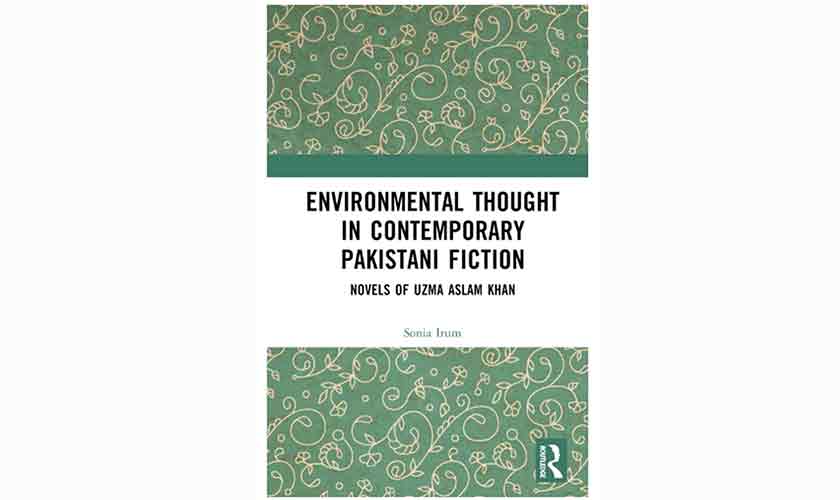
onia Irum’s Environmental Thought in Contemporary Pakistani Fiction: Novels of Uzma Aslam Khan offers a timely and intellectually rigorous intervention in the field of environmental humanities. It seeks to situate Pakistani fiction within global eco-critical discourse. In an era marked by ecological precarity and the accelerating effects of climate change, this book examines the role of contemporary Pakistani writers in addressing the moral, cultural and existential questions surrounding humanity’s relationship with the natural world.
Centred on the fictional works of Uzma Aslam Khan, the author explores how literature can act as both a pedagogical and ethical tool in cultivating ecological consciousness.
“If the species is to survive, man must recognise his dependence on nature and live in cooperation with her as her friend.” (Fredrick Morgan)
Structurally, the book is divided into six substantive chapters. It opens with a theoretical overview of the concept of ecology from the perspectives of numerous established environmentalists. Each of the four subsequent chapters focuses on one of Khan’s major works, The Story of Noble Rot, Trespassing, The Geometry of God and Thinner Than Skin, followed by a conclusion. This organisation ensures a balance between conceptual framing and close textual analysis.
Sonia Irum comments on the intersectional socio-political developments in Pakistan, coupled with attention to its geopolitical, climate and state security policies. To name a few prominent examples: the Ten Billion Tree Tsunami Programme, the ban on polythene bags and the National Clean Air Policy. The introduction establishes the philosophical and political coordinates of Pakistani environmental thought, distinguishing it from the predominantly Western trajectories of eco-criticism.
Drawing on foundational eco-critical theorists such as Lawrence Buell and Greg Garrard, the author foregrounds the ways in which literature reflects and refracts ecological imagination. The first chapter situates Pakistani fiction within what Buell calls the “environmental imagination,” a literary mode that recognises the environment not as a static backdrop but as an active participant in narrative meaning.
The author rightly notes that Pakistan has distinct socio-historical contexts, marked by colonial exploitation, uneven development and gendered marginalisation. Thus, Pakistani fiction writers need to adopt a particular sensitivity when addressing these contexts. In recent years, Pakistani literature has often served the mainstream representation of a nation that is “lawless, conservative, reactionary anti-woman,” and more.
My master’s research explored the dangers of such a submissive attitude: “Representation emerged as an important underlying factor in the trending themes of writings from South Asia… [hence] decolonisation of Western narrative holds immense weight for emerging writers from Pakistan.” (Khalil et al.)
It teaches readers to see ecological interdependence as an ethical practice.
Similarly, and importantly, Sonia Irum positions Pakistani fiction as a counter-narrative to the dominant environmental imaginaries of the Global North.
My personal favourite passage from the book discusses the environmental elements embedded in poetry written in Pakistan’s regional languages. A few key comparisons drawn are stated here: “a beloved’s lips are rose petals, while a lake represents her eyes and dark clouds her hair.” (p.20) The writer alludes to the works of prominent Pakistani poets such as Faiz Ahmed Faiz, Daud Kamal and Taufiq Raf’at, whose creative expression plays an integral role in preserving indigenous flora and fauna while promoting the Pakistani cultural idiom.
The chapter on The Story of Noble Rot engages deeply with the motif of decay as both metaphor and ecological condition. The author reads Khan’s use of “rot” as emblematic of what Rob Nixon might term “ecological violence,” the slow poisoning of both environment and human ethics. The story’s urban setting, suffused with corruption and industrial toxicity, becomes a microcosm of post-colonial modernity’s environmental contradictions.
Here, the writer’s argument is most persuasive: that Khan’s use of the aesthetics of decomposition critiques the moral bankruptcy underlying consumer culture and environmental neglect.
The subsequent chapter on Trespassing expands the discussion towards the politics of borders and transgression. The author connects Khan’s narrative of intrusion, both literal and ecological, to the Anthropocene’s erasure of boundaries between the human and the non-human. It reveals how Khan’s fiction exposes the colonial and capitalist roots of environmental exploitation.
In the fourth chapter, on The Geometry of God, the author interlaces an eco-critical reading with feminist theory, arguing that Khan’s protagonist, Amal, embodies a decolonial and gendered rethinking of science and spirituality. The author convincingly interprets Amal’s scientific pursuit as an act of ecological reclamation, a symbolic excavation of suppressed histories of coexistence between humans and the earth.
The fifth chapter, on Thinner Than Skin, explores Khan’s lyrical portrayal of glaciers, rivers and mountainous terrains, read through the prism of material eco-criticism and post-humanism. The author argues that the novel’s central image, “the melting glacier,” functions as both an ecological and emotional metaphor, reflecting the fragility of human relationships and the planet’s endangered equilibrium. Sonia Irum’s reading of landscape as a sentient, memory-bearing space underscores how Pakistani fiction contributes to global ecological thought by localising it within specific terrains of loss, belonging and resistance.
A notable strength of Environmental Thought in Contemporary Pakistani Fiction is its formal structure and methodological coherence. Each chapter contributes to the accumulation, allowing the argument to develop organically from theoretical framing to textual insight. It teaches readers to see ecological interdependence as an ethical practice.
I recommend the book to all students and scholars of literature and environmental studies who are interested in learning more about South Asian cultural thought or wish to pursue research on eco-criticism.
Environmental Thought in Contemporary Pakistani Fiction
Novels of Uzma Aslam Khan
Author: Sonia Irum
Publisher: Routledge, 2025
Pages: 182
Price: £145
The reviewer is currently pursuing a post-graduate degree in education at the University of Sussex.