Print Story
X




A new selection of stories introduces Punjabi readers in Pakistan to the understated power of Prem Prakash
| I |
met Prem Prakash for the only time in New Delhi in 1998 during the Katha Prize Stories award ceremony. I had co-translated Naiyer Masud’s Sheesha Ghat and accepted the invitation to visit India. While I shared a room with a fellow translator from Tamil Nadu, Prem Prakash shared his room with Naiyer Masud. One evening, the Urdu writer Khalid Javed and I spent a few hours with Naiyer Masud and Prem Prakash in their room talking about writing, writers and other things.
Prem Prakash’s story Mohdi, translated by Reema Anand, was included in Katha Prize Stories, Volume 7, which also included my translation. I remember liking Premji’s story because it reminded me of some of the feelings and issues Intezar Husain had explored in stories such as Kata Hua Dabba and Hamsafar.
I returned to San Francisco and sadly forgot about him until, as the story goes, a Punjabi writer from Lahore visited India and befriended Premji, introducing him to my father-in-law, Col Nadir Ali’s stories. Premji is supposed to have exclaimed, “No one is writing these kinds of stories,” and their friendship was sealed.
Later, Prem Prakash visited Lahore and, if memory serves me right, stayed with my family. Down the road, thanks to Maqsood Saqib, I was lucky to read one or two short stories of his, such as MaDa Banda, in one of the issues of Pancham, the finest Punjabi-language literary magazine. And now Rishum Jameel Paul, an untiring daughter of the Punjabi language, has made a very slim yet fine selection of Prem Saheb’s stories available to Punjabi readers in Pakistan.
Although his story, Mohdi, is not included in this collection, it is very similar to the opening story, GaDhi and confirms, after reading several other stories as well, his central issues: roots, limits of one’s power to make decisions, and class tensions. Who or where does a person belong to? Story after story, Prem Prakash questions and seeks to demolish one’s belief in permanence with regard to belonging.
Both in Mohdi and GaDhi, the demolition of emotionally important structures is central to the stories and the protagonist’s sense of being alive. In GaDhi, he goes a step further to suggest that sometimes blood relations are not enough to tie one down to another person or one place.
The second story, Eh Oh Jasbir NaeeN, again takes up the issue of impermanence of institutions, such as a friendship between the story’s Hindu protagonist and his dearest friend Jasbir, who has become a Sikh freedom fighter for the cause of Khalistan and, due to a state-sponsored manhunt, has gone underground. The story skilfully plays up the protagonist’s fear of trying to live a normal life, to ride a bus, go to work and be home alive at the end of the day.
Jasbir, travelling in disguise, gets hold of his friend and spends a few hours at his house, leaving only when darkness has deepened outside, as he cautions his host to stay indoors as much as possible for the next couple of days due to a planned retaliation against Hindus in the neighbourhood. When his wife inquires about the guest, having suspected that it was indeed Jasbir, the protagonist responds that that man wasn’t the Jasbir she had in mind.
The story explores the reasons that change a person fundamentally, sometimes against her or his own deeply held principles. Stories of such a nature, written with nuance and patience, help readers understand why a people, having a refined culture and old history, can succumb to madness, participating in a genocide, killing and raping their neighbours and loved ones.
The third story, titled Shvitambar Nay Kya Si, explores sexual attraction and romantic unfulfilment between two married colleagues and friends. It is perhaps Prem Prakash’s most complex if somewhat baffling story. As is obvious from the title, the author has invoked an aspect of Jainism, where Shvitambar, one of the two main sects of the religion Mahavira initiated, takes on an allegorical appearance in direct communication with Sharda, the female protagonist, and acts as a morally patriarchal guide to dissuade Sharda from having a realistic bond.
Story after story, Prem Prakash question s and seeks to demolish one’s belief in permanence with regard to belonging.
The tragic ending of the story brought to mind Mehboob Khan’s trend-setting classic Hindi movie Andaz, starring Dilip Kumar, Raj Kapoor and Nargis. Whereas the film, despite its complex treatment of female independence and the psychological paradigms of romantic attraction within a newly developing nation state and modernity, ends up establishing the supremacy of male dominance and defining the limits of female transgression, Prem Prakash’s story succeeds in highlighting the forces of patriarchy persisting in modern times as a form of sickness.
Bapu and Goi read like love letters to the narrator’s father, or to a metaphorical father figure, and lament the cruel distance that creeps in when love and loyalty are split by marriage and the constraints that follow. Even in these two stories, the class issue remains central. The fathers in both find themselves economically dependent on their sons, who are beholden to the whims and wishes of their spouses and affluent in-laws – a curse worse than poverty.
Thematically, Bapu and Goi are linked to another story, MaRa Banda, about a rickshaw-walla who refuses to accept the fare offered by the narrator’s wife because he deems the amount insulting – unworthy of his labour. The story builds on stubbornness on both sides, a clash of ego and self-respect, and ends up revealing the moral weakness of the powerful.
The story Shoulder Bag makes a somewhat clumsy yet interesting attempt at entering the French Zone –call it ménage à trois, Indian style – where the narrator-protagonist, a fiction writer, falls for Vandana, a liberated married woman who happens to have his books in her white shoulder bag when she meets him for the first time in a café. Soon, Mir Chandani enters to complicate their friendship, as Vandana ends up spending more and more time with him and later acts in the play he is directing. A smaller part of the story, disguised as a character in his story appears, as a response in the form of a letter to the writer and his foolish assumptions about her.
The last story in the collection, Dr Shakuntala, looks at the psychological scars of unrequited love and longing as one ages, despite having lived a fulfilling married life. On one hand, Dr Shakuntala is the polar opposite of her legendary namesake in Kalidasa’s play; on the other, the same Dr Shakuntala, a memory from his youth, reappearing via a close friend as a psychiatrist who is able to heal him somewhat, feels forced, if not awkward.
Rishum’s selection is a good one. It gives the reader a fair insight into Prem Prakash’s range and concerns as a modern writer. As a reader, I can only hope that she has kept the original text intact as much as possible, resisting the urge to replace unfamiliar Sanskrit-based words with their more familiar Farsi/ Arabic-based words. The Punjabi reader and writer in Pakistan need to broaden their vocabulary.
Rishum’s introduction is also well written. It offers an insight into the writer’s mental world and its evolution within the modern Punjabi prose tradition. The only thing I would take exception to is the description of Prem Prakash’s work as flirting with surrealism. If anything, at times, his text flows in and out of psychological realism. His syntax is simple and straightforward, lacking the complexity of the postmodern text. There is very little sarcasm and no dark humour. But it is subtle, smooth and nuanced, sometimes daring.
Although it lacks Nain Sukh’s density, it has Zubair Ahmed’s meditative quality. Prem Prakash’s women are strong and vocal, but their concerns, for the most part, revolve around men. There’s very little attempt at trying to engage an independent woman’s independent mind. For that reason alone, I wish Rishum had included a few more stories that tried to do that.
I hope Rishum will continue to make more of Prem Prakash’s fiction available, especially his novels, to readers in Pakistan and beyond who can read him in Shahmukhi script.
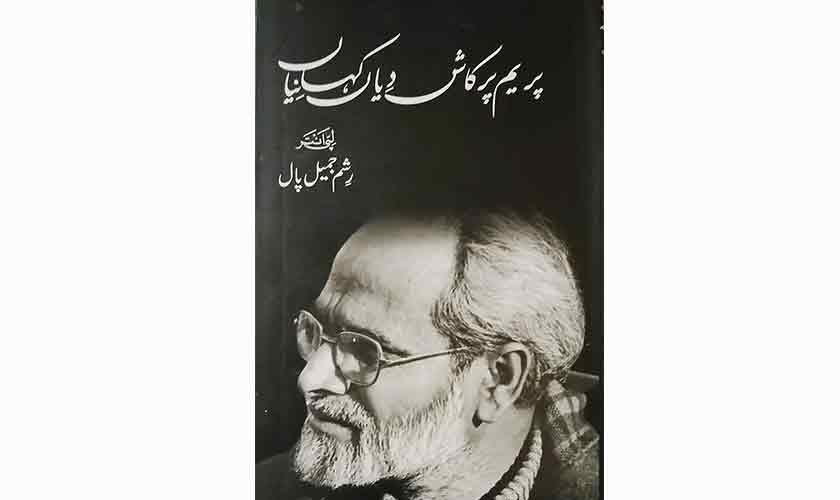
Prem Prakash diyaaN kahaaniyaaN
Compiled by: Rishum Jameel Paul
Publisher: Sulekh Publishersn
Pages: 111
Price: Rs 300
The reviewer is a librarian and a writer based in San Francisco. His last two novellas were A Footbridge to Hell Called Love and Unsolaced Faces We Meet In Our Dreams. The third novella, We Don’t Love Here Anymore, has just been released.