Print Story
X




A crumbling 19th-Century gateway reveals a lost chapter of Lahore’s past and an urgent call for preservation
| I |
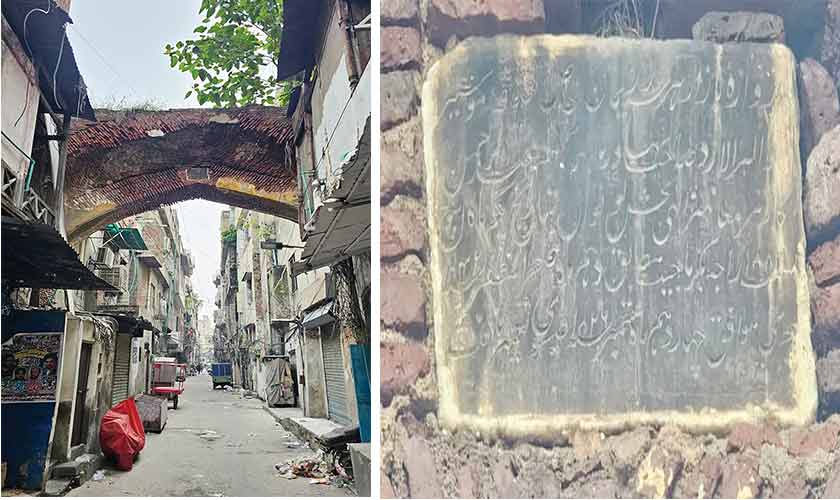
In Old Anarkali Bazaar stands the shop named Yousuf Falooda. In the gali (street) immediately behind it, an old arch of small bricks survives, with a plaque above its entrance.
An initial photographic examination suggested the arch might date from the British era. Yet the small bricks, coarse mortar and Persian plaque pointed to a different story, adding to its distinctive historical value.
The Persian plaque translates as:
“Gate of Harsa Raziman Bazaar, located in the region of Moshir, was built under the supervision of Mir Abdul Rahman, with the assistance of Elahi Bakhsh Kotwal, by the order of Allard Sahib Bahadur on the 1st of the month of Asuj, 1883 Raja Bakrmajit, according to the 10th of the month of Safar 1242 Hijri, equal to September 14, 1826.”
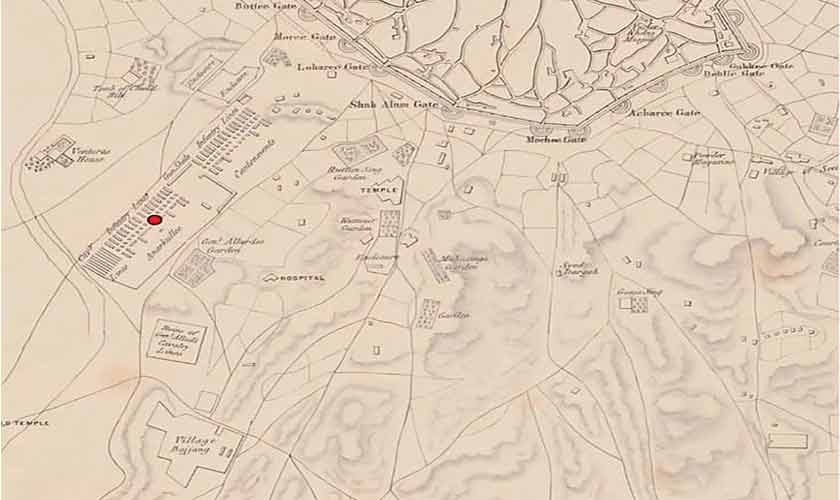
This gate, with its stone plaque inscribed with dates in the Samvat, Hijri and Julian calendars, is a rare discovery. It stands as a testament to a bygone era, dating back nearly 200 years. According to the plaque, in 1826 AD, the area was known as Bazaar Raziman. Today it is called Risala Bazaar. In Arabic, risala means cavalry.
Listed on the plaque as overseeing the repairs of the gate is Elahi Baksh Kotwal, a renowned Muslim officer who served in the Khalsa Fauj for more than 40 years. He was regarded as one of the finest artillery officers during the reign of Maharaja Ranjit Singh. The repairs were carried out on the orders of Gen Jean-Baptiste Allard, commander of the Khalsa cavalry forces.
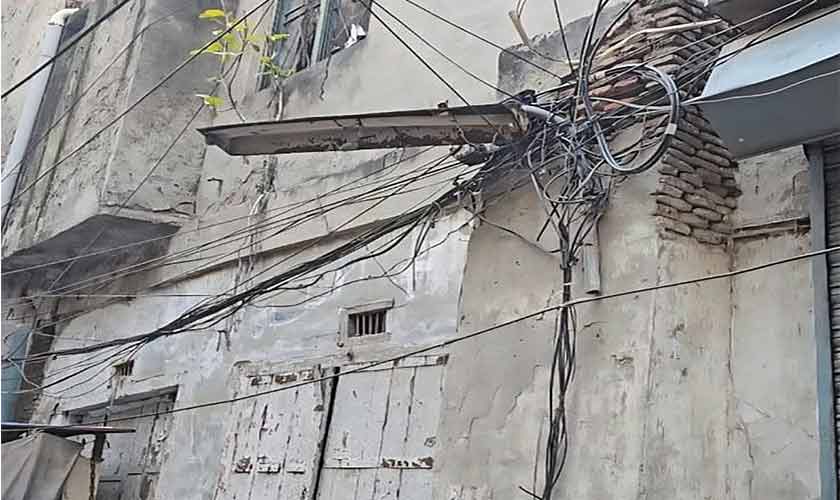
The area was known as the infantry hub of the Sikh army, under the command of Gen Jean-Baptiste Ventura. This has led historians to suspect that the archway may once have formed the gateway to the Anarkali Infantry Cantonment, established by Maharaja Ranjit Singh in the early 19th Century and demolished by British occupation forces in Lahore in 1847.
To build a promising future, we must first preserve our past.
This required a study of old maps of Lahore from both the British and Sikh periods. The site was first geo-located using Google Maps. It was then traced on an April 1868 map of Lahore, published under the British Empire.
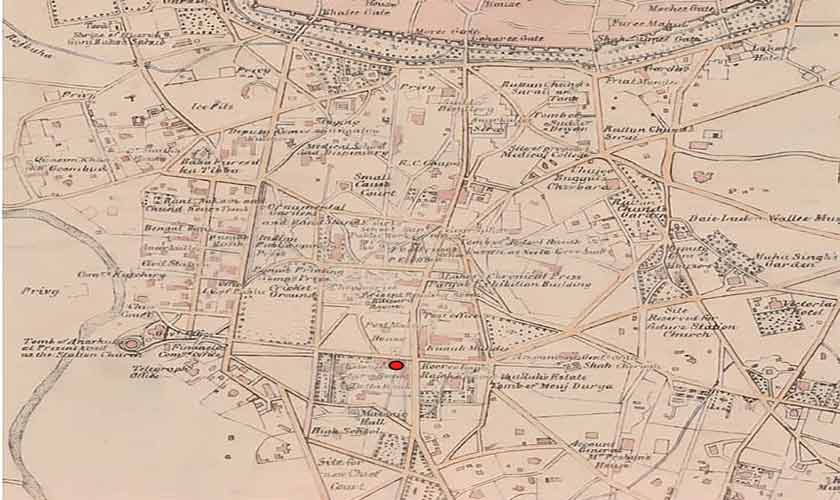
The 1868 map makes clear that the Sikh-era barracks in the area had already been demolished by the time it was drawn up, with the British redeveloping the site. Umdat ut Tawarikh, the Persian court chronicles, records orders issued in 1847 by the British occupation forces to demolish the Anarkali cantonment.
To push the research further, it became necessary to locate a map of Lahore dating from before 1847. The co-authors identified a March 1846 map of Lahore, prepared by A Frazer, titled Lahore and its Vicinity (scale: four inches to one mile). The map marks Sikh-era havelis, gardens and the camps of various generals, a treasure trove of information on 19th-Century Lahore.
The position of the arch was geo-located on the 1846 map. Remarkably, it stood within the South Infantry Barracks of the Anarkali Cantonment, at its eastern entrance. These barracks were under the command of Gen Ventura, whose residence is marked just east of those. Immediately south lay the Cavalry Lines commanded by Gen Jean-Baptiste Allard. The ruins of Allard’s old cavalry lines are shown to the south-west of the South Infantry Barracks. Opposite the barracks, his garden is marked, the place where his daughter was buried.
It was ultimately confirmed that the 1826 arch had once formed part of the Sikh-era Anarkali Infantry complex. Yet something about it seemed incomplete.
In July 2025, the co-authors visited the site behind the Yousuf Falooda shop in Old Anarkali Bazaar. The arch, which had stood for more than two centuries, was found crumbling, brick by brick.
During this visit, a striking detail emerged: the remains of columns on both sides of the street, around 15 feet from the arch. The arch that once spanned these columns had disappeared. This suggested that what survives today was not simply an arch but part of a much larger gate, about 15 to 20 feet long, marking the eastern entrance to the Anarkali South Infantry Barracks.
A comparison of the 1846 and 1868 maps shows that the British kept the original alignment of the road from Lohari Gate to the Anarkali Cantonment, while redeveloping the surrounding area and retaining much of the old Anarkali layout.
Today, this historic gate, a significant part of Lahore’s heritage, is in urgent need of preservation. Without intervention, it risks crumbling beyond repair. The Walled City of Lahore Authority must act swiftly to restore and safeguard the site, and a historical marker should be installed to commemorate both its past and the efforts made to preserve it.
The discovery of this historic gate raises another question: how many more undocumented sites still stand in the Anarkali Bazaar area? A systematic survey is essential if Lahore’s rich history is to be preserved.
Such documentation is a collective responsibility. It could be carried out by history interns, volunteers from heritage societies and with the support of universities, government bodies and private organisations. Only through such collaboration can the city’s historic fabric be safeguarded.
To build a promising future, we must first preserve our past.
Dr Adnan Tariq is an assistant professor at Government College University, Lahore.
Dr Tarunjit Singh Butalia is at The Ohio State University, USA