Print Story
X




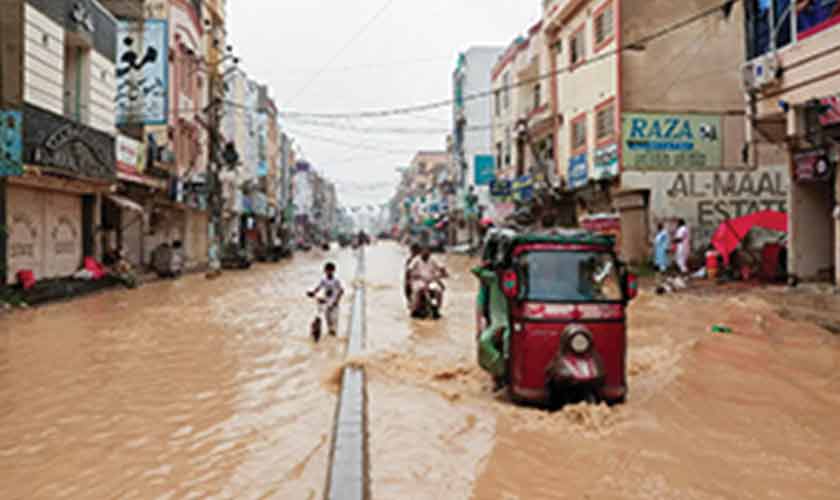
The country is once again facing devastating floods. Has the mainstream media done justice to the tragedy?
| P |
akistanis are famously good at jugaar. I tend to agree. Look at the media coverage of the recent rains and floods. We try to find cheap and quick ways of telling a story rather than having an in-depth 360-degree perspective. We did not do justice to the devastating floods in 2022; nor are we doing justice now. We ranted away then; we are ranting away now.
According to a post-disaster needs assessment report, prepared by the government of Pakistan with the support of the Asian Development Bank, the European Union and the United Nations agencies with technical facilitation by the United Nations Development Programme and the World Bank, the 2022 floods affected 33 million people—8 million of those were displaced; one-third of the country was under water.
This year, too, UN figures vouch for a similar disaster. The Punjab continues to endure its worst flood in history, with almost 3.9 million people affected and over 1.9 million people evacuated, as per September 4 official figures. Sindh is bracing for a deluge, unnervingly too. Let’s hope it’s not a repeat of past years.
In terms of airtime, the media coverage of rains and floods has been overdone; quality wise, it has not been anywhere near satisfactory. The electronic media is running predominantly on official pressers and live and as-live beepers by reporters. The PDMAs and other departments issue almost hourly figures in cusecs of water in rivers. The numbers make little sense to ordinary people.
On social media, content creators are seen rushing to the affected areas in large numbers, sometimes hampering relief work. Many relief workers have complained and appealed to the people not to visit the affected areas as mere spectators. Many content creators, in desperate pursuit of views, have decided to poke fun at a serious crisis.
Quality content is expensive and time consuming. Most of these individuals probably wonder why they should bother with quality when advertisements and views are not based on it. In fact, as far as news and current affairs are concerned, business models of some of the mainstream media outlets too are not designed to incentivise quality.
A comparison with the observations in a 2022 report by Media Matters for Democracy hardly offers any difference from the current situation, except that social media is more active now; some say, even ‘out of control.’ Little has been learnt in the years since.
The study analysed 654 bulletins of three Urdu news channels between June 15 and August 31, 2022. The following were its key findings:
• Live reporting was most common: Reporters giving beepers from the flood site, areas and those showing the situation on ground were featured more frequently than statistics, side stories or in-depth reporting. Such reporting featured 39.3 percent of the studied bulletin time.
• Flood-related news in headlines: Such news did not make it to the top five headlines in 57.7 percent of the bulletins even as it was broadcast in 85.9 percent of the bulletins.
• Lack of coverage on talk shows: Topics related to floods, climate change and urban flooding were scarce in talks shows aired on the studied news channels. Talk shows featured a segment on flood only 14.5 percent of the studied time.
• Strong urban bias: Karachi was the most mentioned city in bulletins. The city was mentioned in 52.5 percent of the studied time.
Karachi was flooded twice during the 2022 monsoon season—once in July and then, in August. We have a similar situation today. The so-called media bias towards Karachi has painfully pinched the Sindh government this year. It recently complained that the country’s biggest city was unfairly given more airtime than the devastated northern regions such as Buner and Swat.
The so-called media bias towards Karachi has painfully pinched the Sindh government this year. It recently complained that the country’s biggest city was unfairly given more airtime than the devastated northern regions such as Buner and Swat.
Of course, there are reasons for Karachi getting the limelight. One being that it has the biggest urban concentration in Pakistan. It also houses the biggest concentration of national mainstream media. Being conveniently close to home, it is a less costly story for national news channels to cover. Presenters standing on their office rooftops can beam live visuals reflecting the situation of the inundated Shahrae Faisal.
While viewers felt sorry for the affected communities in Buner and Swat, the natural reaction for Karachi was always anger over an ‘obvious’ failure of civic order. There are no two opinions about the need for the media to highlight the city authorities’ failure to cope with rain. However, the same was not done regarding the mountainous areas of northern Pakistan. There were mostly stories on continued encroachment on riverbeds. The general understanding among ordinary citizens and officials alike is that rules rarely apply in rural areas.
The Khyber Pakhtunkhwa River Protection Ordinance of 2002 bans construction or any physical works of any commercial or non-commercial building or developmental work within 200 feet, beyond high water limit on either side of the rivers or their tributaries. Pictures from devastated areas showed only 200 feet of a river or its tributaries. The media needed to highlight the lack of law enforcement in such far-off areas.
In some areas, flood victims alleged discrimination in relief efforts. Areas visited by ministers, high officials and prominent political figures got more aid than other similarly affected areas. In some places, media people were taken along for favourable coverage—embedding of sorts.
The media also failed to draw attention to the distribution of aid based on politics. Distribution of aid also got delayed for some time in certain areas since most available boats were allegedly allocated for VIP movement and political visits instead of relief operations.
The debate around the blame for climate change also remained skewed. Government ministers and opposition leaders seemed to agree on the role of climate change and much airtime was devoted to it. Is lashing out at the alleged perpetrators of harmful practices (developed countries) on the media while seeking their support to finance relief and rehabilitation the best way to deal with the crisis?
Every day we hear our ministers and some experts telling us that Pakistan is one of the countries most affected by the ‘climate change sins’ of others. This assertion is justified, too. But should we hold only developed nations responsible for most greenhouse gas emissions and not do anything ourselves?
The intention behind the strategy seems to deflect attention from our own shortcomings. Politicians seem to use climate change as a focal point to divert attention from domestic issues or governance failure. The idea is to hide our own failures behind regulations and enforcement and delays in coming up with policies to encourage the use of renewable energy.
In 2023, Pakistan said 15 percent of its efforts to tackle emissions will be met from its own resources; 35 percent were subject to receiving $101 billion in financial assistance. Is this the only way to deal with the problem? Do we have a plan in place if we receive this money from developed countries?
Climate change is a global issue that resonates with a wide audience, allowing politicians to align themselves with a cause that garners popular support. But that should not allow them to hide their own mistakes.
While addressing climate change is undeniably crucial, the way politicians leverage this issue can sometimes overshadow substantive action. It is essential for the media to critically evaluate statements against actual policies and actions and question whether those policies effectively address the environmental challenges we face.
The writer, a journalist for 33 years, has been an editor at the BBC in Pakistan for over two decades. Currently, he is the managing editor at Independent Urdu.