Print Story
X




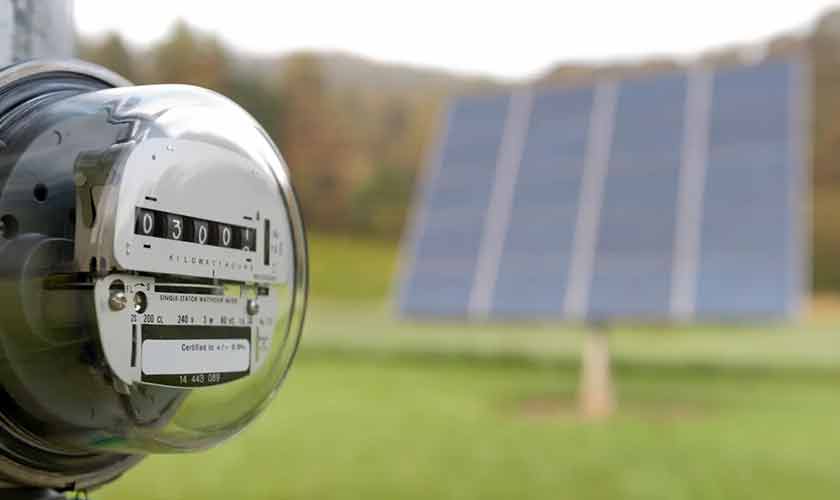
There should be a clear policy on net metering
| A |
bird’s eye view of an elite housing society in Lahore shows rooftops making the most efficient use of the sun. The number of net metering customers in the LESCO territory now exceeds 40,000.
A change of policy signalling a reduction in the rate at which distribution companies purchased electricity from private solar power producers was announced in March. The announcement was understandably unwelcome.
The Power Division says policy chaos has resulted in raising the effective tariff for the consumers not producing solar electricity by Rs 1.5 per unit. It says these consumers are paying for the high purchase tariff granted to 283,000 net metering power producers/ customers. Over the next ten years, it says, the impact could rise to Rs 3.18 per unit. The attempted change of policy was so unpopular, it had to be withdrawn.
According to the Economic Survey of Pakistan 2024-25, the solar net metering capacity has surged to 2,813 MW, marking a 12 percent increase over the first nine months of the last fiscal year (300 MW).
In recent years, Pakistan has imported solar equipment capable of generating 20,000-22,000 MW. Most of the installation has been off-grid, particularly in agriculture and industrial sectors.
“Net metering, as it stands today, is disproportionately benefiting the rich. Solar for self-consumption is perfectly fine — no one is against that. But when wealthy households offset their consumption unit-for-unit at the retail rate, and then sell their surplus to the grid at Rs 27 per unit, it creates a gross imbalance,” said Rehan Jawed, an industrialist from Karachi.
“People living in flats — with no rooftops and no way to benefit from net metering or solar production are paying the price. This isn’t equity; it’s reverse subsidy. With 5.3 GW already installed, the cost burden spreading across every electricity unit, roughly Rs 2 extra per unit — paid by ordinary consumers for the benefit of a few net metering license holders. Those using only grid electricity are paying for those feeding into it. This cannot continue. Net metering must be transitioned to a fairer feed-in tariff model. End unit-to-unit net-off at retail rates. Let everyone use solar and batteries for self-reliance. The rid must not be a free backup for the privileged. If we want the grid to survive, net metering — in its current form — must end,” he said.
Pakistan risks becoming a dumping ground for substandard solar panels. Last year, the Pakistan Solar Association raised an alarm about the rising import of low-quality solar panels.
The surge in solar electric generation has continued into 2025. In the first four months of 2025, Pakistan imported just over 10,000 MW of solar components from China, compared to around 8,500 MW during the same period in 2024. This nearly 18 percent increase also boosted Pakistan’s share of China’s solar exports to approximately 12 percent.
There is another worry. The Pakistan Solar Association raised alarm last year that low-quality solar panels were being imported by some ‘unauthorised’ traders. It said substandard products caused inefficiencies and increased maintenance costs.
Tahir Basharat Cheema, a former PEPCO managing director, said the government was encouraging investment in solar energy. He said there was a huge demand for net metering connections. In Pakistan, he said, consumers having net metering connections were allowed to export up to 1.5 times their sanctioned load. However, some of them were known to have installed more.
He said low-quality equipment could affect the power system. He said such equipment created dangerous ‘harmonics’ that could cause frequent tripping and affect other consumers in the neighbourhood.
Cheema said Pakistan should learn from the international best practices. He said net metering need not be a permanent arrangement. Once the objective of encouraging people to install renewable power was achieved, the tariffs could change.
“The solar sector, booming in terms of imports and installations, faces a critical issue: a lack of robust indigenous solar panel manufacturing,”said Asad Mahmood, who calls himself an adaptation and mitigation expert.
“The country remains heavily reliant on imported panels, primarily sourced from China. This dependence could drains foreign exchange reserves, limits job creation in high-value manufacturing and expose Pakistan to global supply chain vulnerabilities and price fluctuation,” he said.
“Facilitating local traders is vital. They are at the forefront of solar adoption but inconsistent net metering policies, declining electricity rates for surplus energy and financing challenges create significant market uncertainty. A holistic approach is needed, one that not only promotes local production through sustained investment in research and development, skilled labour and an uninterrupted power supply for manufacturing facilities, but also provides a stable, transparent and favourable regulatory environment for solar traders,” he said.
The writer is a reporter at The News International.