Print Story
X




Major political actors have chosen too often to avoid or manipulate elections
| T |
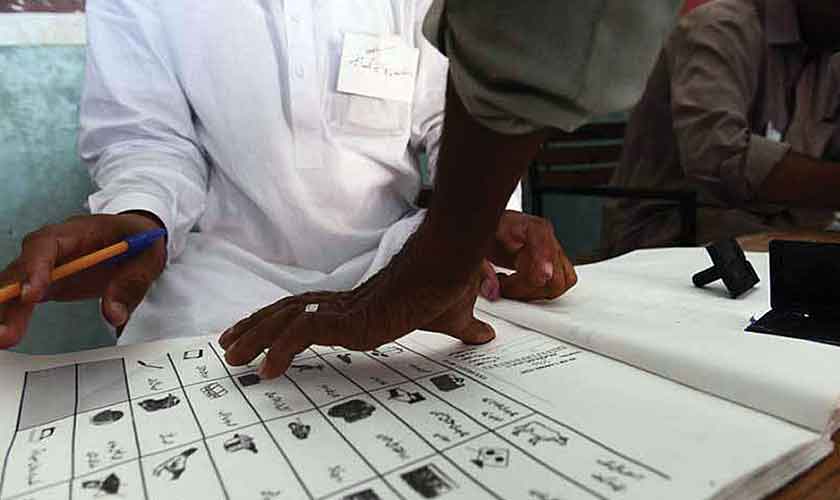
hrough a unanimous vote on March 22, the Election Comission of Pakistan (ECP) decided to withdraw the schedule it had issued earlier for elections to the provincial assembly of the Punjab and set a new date: October 8, 2023.
The comission said it was unable to perform its constitutional responsibility of holding free, fair and transparent elections under the prevailing circumstances. It had been informed earlier by the law enforcement agencies and the Ministries of Interior and Defence about some serious security threats and the unavailability of security personnel for election duty. The Ministry of Finance had also conveyed that given the economic conditions, the provision of funds for staggered elections would be difficult.
The Khyber Pakhtunkhwa governor, who had been reluctant to set a date for elections in that province, also took the opportunity to announce that those could be held on October 8.
The postponement of the elections has stirred a heated debate in the country, particularly on the media. The Pakistan Tehreek-i-Insaf (PTI) has filed a petition in the Supreme Court and the court has constituted a full bench to hear and examine the question of whether the ECP can withdraw an election schedule it has announced.
Unfortunately, Pakistan has failed to maintain a democratic tradition. Too often, governments have sought to avoid or manipulate elections. Immediately after the creation of Pakistan, Dr Khan Sahib’s ministry in KP was dissolved in August 1947. Ayub Khuhro’s Sindh ministry met the same fate in 1948. The Liaquat regime imposed the governor’s rule in the Punjab in January 1949. Instead of holding fresh elections and securing a fresh mandate from the electorate, the regime tried to manage the provincial governments through undemocratic means. In the KP, Qayyum Khan formed a ministry without a majority and avoided an assembly session till March 1948. A majority was created through switching of loyalties and the opposition was reduced to a numerical minority. Although the Muslim League had won a convincing victory in the July referendum on KP, the Qayyum ministry did not seek a fresh mandate.
The first provincial elections in Pakistan were held in the Punjab in March 1951 - 14 months after the imposition of the governor’s rule. Massive rigging by the Daultana faction, supported by the federal government, was alleged. In November 1951, the NWFP followed suit with similarly tainted polls. The NWFP Assembly had been dissolved in March 1951. The Qayyum ministry retained office for the interim period. The elections were widely seen to have been managed through the strong arm of the bureaucracy. 31 candidates from the opposition parties were disqualified on frivolous charges. Later, 112 candidates from various parties withdrew their nominations in protest. The Qayyum faction secured a landslide victory without any democratic legitimacy. The opposition secured only four seats out of 85.
Sindh witnessed many episodes of political instability and shifting loyalties. Several ministries were formed before governor’s rule was imposed on December 29, 1951. After 15 months of governor’s rule, elections were held in March 1953. Results were managed in favour of the official League faction. After these provincial elections, elections were called in East Pakistan on February 16, 1954. In view of the surging popularity of the United Front, these were postponed till March 10. The League requested Ms Fatima Jinnah’s help; however, she failed to reverse the tide. The results were a crushing defeat for the League and a thumping victory for the United Front.
Most elections were delayed to diffuse a popular surge favouring the political opponents of a government or in the hope of getting desired results. The delays always proved counterproductive.
No direct elections were held thereafter till 1970. The strategies adopted to avoid direct elections ranged from abrogation of the constitution and imposition of martial law to holding local government elections and indirect elections through an electoral college consisting of the ‘basic democrats’. In stark contrast, free and fair elections were held regularly in India and provided political legitimacy to the governments for assertion of their authority and the establishment of civilian supremacy.
The Yahya regime assumed power in March 1969, promising to hold elections and transfer power to the elected representatives. It finally announced elections in January 1970. These were originally announced for October 1970 but due to a postponement on account of floods in East Pakistan were eventually held in December 1970. The transitional regime thus took almost 20 months to hold elections. The establishment’s reluctance to transfer power to the majority party took another catastrophic year. This resulted in a civil war and dismemberment of Pakistan in December 1971. After the breakup of the state, power was transferred to the leader of the second-largest political party in the National Assembly. Thus, the delay in holding elections and the refusal to recognise the popular mandate had disastrous consequences.
In July 1977, Zia imposed a martial law and announced that elections would be held on October 18. Those were postponed on October 1 in view of the rising popularity of ZA Bhutto. The regime announced elections again on March 23, 1979, before the execution of ZA Bhutto. The schedule was apparently meant to restrain agitation. The ECP next announced a schedule in September to hold elections in November 1979. It also started a process of registration of political parties. Results of the local government elections of 1979, particularly the victory of the pro-PPP elements, unnerved the regime. Elections were postponed again and a ban was imposed on political parties and activities. Ultimately, partyless elections were held in February 1985.
Pakistan witnessed rather frequent general elections from 1985 to 1997 – five in twelve years. Zia dismissed Junejo’s regime on May 29, 1988 and announced elections. After Zia’s assassination, elections were finally held on November 16, 1988, five months after the dissolution of the assemblies. Zia’s repressive rule failed to eliminate the PPP’s support base.
In April 1993, after Nawaz Sharif’s government was dismissed, a regime change followed in the Punjab. Manzoor Wattoo, with the support of the defecting PML-N members, formed a new ministry. After the restoration of Nawaz’s regime at the Centre, his party launched a no-confidence move against Wattoo, who decided to dissolve the assembly. The assembly was restored following a writ petition by Parvez Elahi. But Wattoo again advised dissolution, within a few minutes of its restoration on June 28, 1993. Mir Afzal Khan, the NWFP chief minister, too, dissolved the assembly on May 30, 1993. The political deadlock was finally resolved when the prime minister dissolved the National Assembly on July 18. Sindh and Balochistan assemblies were dissolved too. Although provincial and national assemblies were dissolved at different times, elections were held on October 6, 1993, for national, and, three days later, for provincial assemblies.
In October 2007, Musharraf decided to seek re-election as president – for a second term from the same assemblies. The opposition decided to resist that move and 86 members of the opposition submitted their resignations from the National Assembly. These included members from the MMA, the PML-N, some nationalist parties and Imran Khan. It was also suggested that the KP assembly be dissolved to render the electoral college incomplete.
The Jamiat-i-Ulema-i-Islam’s (JUI) reluctance provided an opportunity for the opposition to submit a no confidence motion, which blocked the dissolution of the assembly. Despite the opposition’s boycott and resignation, Musharraf won the presidential elections with 671 votes out of 685 polled votes. The full strength of the electoral college was 1,170. General elections were proposed to be held on January 8, 2008. Due to the assassination of Benazir Bhutto on December 27, 2007, these elections were postponed. Democratic forces, including the Pakistan Peoples Party (PPP), insisted that the elections be held without undue delay. The ECP finally decided to hold the elections on February 18, 40 days after the original schedule. Political parties welcomed that move and elections finally facilitated the democratic transition in 2008.
Pakistan has had a history of postponement of elections. The unmistakable lesson is that postponements do not serve the purpose. Postponement of most elections to diffuse a popular surge in the hope of desired results proved counterproductive. Sustainable democracies require free, fair and transparent elections without electoral engineerings and judicial/ military interventions.
The writer has a PhD in history from Quaid-i-Azam University, Islamabad. He is currently an assistant professor at the Allama Iqbal Open University, Islamabad. His areas of interest include electoral politics in Pakistan. He can be reached at s[email protected]