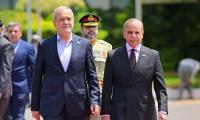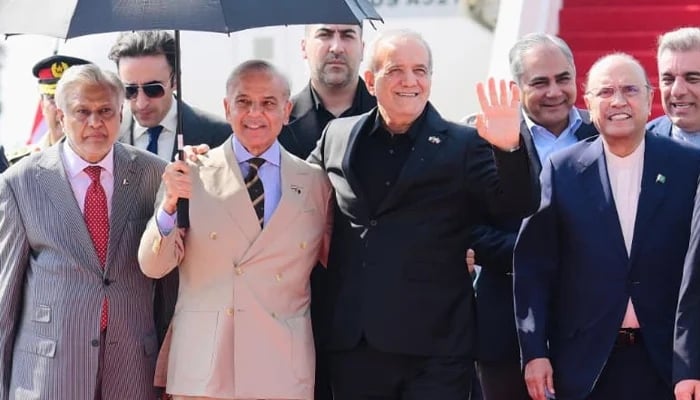
Iranian President Masoud Pezeshkian arrived in Pakistan on Tuesday for a one-day visit following successful talks between Tehran and Washington in Switzerland, mediated by Islamabad. Coming immediately after the signing of the Islamabad Memorandum of Understanding (MoU), the visit has been widely interpreted as an acknowledgement of Islamabad’s role in facilitating dialogue amid heightened regional tensions. The fact that President Pezeshkian chose Pakistan as his first foreign destination after the ceasefire should also clarify the importance Tehran attaches to bilateral relations and to Pakistan’s diplomatic efforts. During his visit, the Iranian president met President Asif Ali Zardari, Prime Minister Shehbaz Sharif, COAS-CDF Field Marshal Asim Munir and other senior officials. Discussions reportedly focused on regional peace and security, economic cooperation, connectivity and matters of mutual interest. Particularly noteworthy was President Pezeshkian’s appreciation of Pakistan’s role in promoting dialogue, de-escalation and regional stability at a time when geopolitical tensions had threatened to engulf the wider region.
The US-Israel war on Iran showed the world once again how quickly instability in the Middle East can reverberate across the globe. Beyond the humanitarian and security consequences, the war created uncertainty in international markets and heightened concerns about energy supplies and economic disruption. In such circumstances, efforts to reduce tensions and encourage negotiations deserve recognition. Diplomacy remains the most effective path to resolving disputes that carry potentially catastrophic consequences for regional and global peace. Pakistan’s geographical location and longstanding relations with multiple regional actors place it in a unique position to facilitate dialogue. Such a role is neither easy nor risk-free. Engaging in efforts to bridge divides between rival states inevitably carries diplomatic and political costs. Yet constructive diplomacy that seeks to prevent conflict and encourage negotiations serves both national interests and broader regional stability. The visit also provides an opportunity to refocus attention on the untapped potential of Pakistan-Iran relations. The two countries share a long border, deep historical links, cultural affinities and close people-to-people connections. As President Pezeshkian observed, the people of Pakistan and Iran share a common future and destiny. These ties should translate into stronger economic cooperation, greater trade and enhanced regional connectivity. Particular attention should be given to long-delayed projects capable of transforming bilateral economic relations. The Iran-Pakistan gas pipeline remains one such project with the potential to address Pakistan’s energy needs while deepening economic interdependence between the two neighbours. If international conditions permit greater economic engagement with Iran, both countries should proactively explore new avenues of cooperation in energy, trade, infrastructure and investment.
Security cooperation must also remain a priority. The border regions of Pakistan’s Balochistan province and Iran’s Sistan-Balochistan province have long faced challenges from militant and criminal networks. Both countries have a shared interest in ensuring that cross-border terrorism and instability do not undermine regional peace. Greater intelligence sharing, coordinated border management and sustained security cooperation are essential to preventing hostile actors from exploiting vulnerabilities along the frontier. At a broader level, the current moment presents an opportunity for greater regional engagement. A stable and cooperative relationship between Pakistan and Iran can contribute positively to broader efforts to foster dialogue among regional states. The pursuit of peace, economic integration and collective security should remain the guiding principles of regional diplomacy at a time when conflict and confrontation continue to threaten stability across the Middle East and South Asia. If both countries can translate diplomatic goodwill into practical cooperation, the future of Pakistan-Iran relations could indeed be brighter.