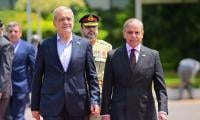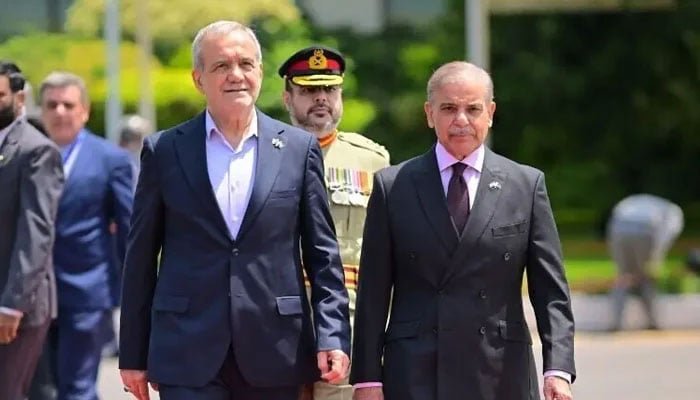
Iranian President Masoud Pezeshkian will arrive in Pakistan today following talks between Tehran and Washington in Switzerland, which were mediated by Islamabad. His visit follows talks between Iran and the US in Switzerland, mediated by Pakistan with support from Qatar, and serves as an acknowledgement of Islamabad’s successful role in helping to bring two bitter adversaries to the negotiating table. The significance of Pakistan’s mediation cannot be overstated. The first round of talks between senior US and Iranian officials concluded after an especially tense opening. Tehran had announced the closure of the Strait of Hormuz once again, while US President Donald Trump repeated threats to resume attacks on Iran. These statements nearly derailed the talks before Pakistan and Qatar intervened and convinced Tehran to remain engaged. Regardless of eventual success in engagement, Washington’s internal coherence remains in question, with Trump acting as a leading spoiler, undermining even members of his own administration who are attempting to advance diplomacy.
Despite these difficulties, the talks produced meaningful progress. A joint statement by Pakistan and Qatar has announced that the US and Iran have agreed on a roadmap towards a final deal within 60 days, while technical discussions are set to continue in Buergenstock throughout the week. More importantly, both sides have agreed to establish a de-confliction cell involving the parties and the Lebanese Republic, facilitated by the mediators, to ensure adherence to the termination of military operations in Lebanon. This addresses one of Iran’s most important demands. Since the first temporary ceasefire announced in April, Tehran has insisted that a durable arrangement in Lebanon is essential to any broader understanding. The responsibility now rests heavily on Washington. If the US is serious about preventing another regional war, it must ensure that Israel adheres to the ceasefire arrangements and refrains from sabotaging the peace process. The only reason Israel has been able to continue violating understandings in Lebanon is because of continued American backing. Without US weapons and financial support, Israel would be unable to sustain its genocide in Gaza or its relentless attacks on Lebanon. The US must also ensure that Israel withdraws from the territory it has occupied in southern Lebanon. Observers note that Israel may have believed Hezbollah was significantly weakened following the assassination of Hezbollah leader Hassan Nasrallah and other senior figures in 2024. However, Hezbollah’s continued responses to Israeli attacks suggest a more complex reality. This makes a durable ceasefire all the more important.
The talks have also produced tangible economic outcomes, with Iran saying it has secured waivers for oil and petrochemical exports, the release of some frozen assets and the launch of a reconstruction and development plan. On Monday, the US Treasury Department issued a general licence authorising the production, delivery and sale of Iranian-origin crude oil, petrochemical and petroleum products through August 21. US Vice President JD Vance also announced that Iran had committed to maintaining free and open transit through the Strait of Hormuz and to permitting inspections by the International Atomic Energy Agency. He further indicated that Washington could agree to unfreeze Iranian assets for the purchase of American agricultural products, including soybeans, corn and wheat. These developments suggest that diplomacy can still produce results even after months of confrontation and threats. However, the process remains fragile. Observers warn that both President Trump and Israel are unpredictable and must not be allowed to undermine a process that is finally showing signs of progress. The world has already witnessed the enormous costs of conflict in the Middle East. Another US-Iran confrontation would endanger regional stability, disrupt global energy markets and inflict suffering on millions. The breakthrough achieved in Switzerland offers a rare opportunity to move in a different direction. Pakistan deserves credit for helping create that opening. Now all that remains is for the US to make sure Israel doesn’t continue its spoiler role.