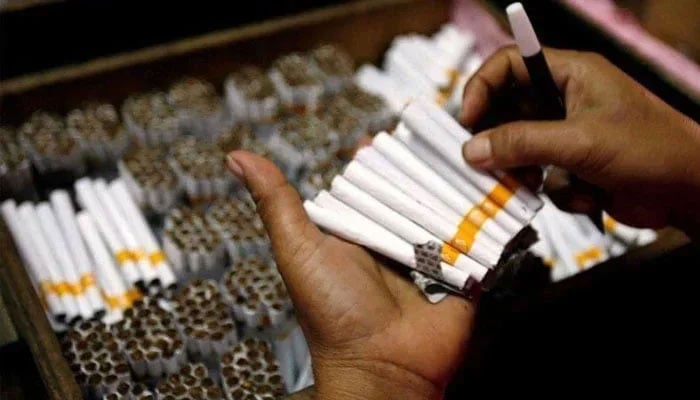
Pakistan consumes about 80 billion cigarette sticks a year. Of the 80 billion, an estimated 43.5 billion sticks are outside the full tax net. That’s 54 per cent of total consumption. That is not a market failure. That is enforcement failure. That is a failure of fiscal governance. That is a parallel economy in plain sight. That is Rs300 billion going up in smoke every year.
Consider this: The government now wants to bring millions of small retailers into the tax net. The expected collection is around Rs50 billion a year. No objection: every sector must pay. To collect Rs50 billion, the state would need roughly 2.5 million retailers paying Rs20,000 each.
Here’s the paradox: The illegal cigarette market is costing Pakistan nearly Rs300 billion a year, six times the expected collection from the retailer scheme. The government is chasing the shop counter while losing the warehouse.
Italy dismantled illicit domestic manufacturing by targeting the source – licensing every machine, production line and warehouse, not just the finished packet. Pakistan can capture Rs300 billion the same way: track the factory, and the fraud has nowhere to hide.
The UK built a dedicated tobacco enforcement unit with a separate budget, mandate and accountability. Pakistan can capture Rs300 billion by building a permanent anti-illicit tobacco cell within FBR, Customs, FIA and provincial police – with targets, published data and prosecutions.
Spain reduced cigarette smuggling sharply by interrupting the supply chain: intelligence-led customs action. Pakistan can capture Rs300 billion by choking supply routes rather than raiding small retailers after the damage is done.
Cold truth: Pakistan’s illegal cigarette problem is not only a tax problem; it is an enforcement problem. It is a border problem. It is a production-control problem. It is also a governance problem.
Red alert: A cigarette without duty is not just cheap tobacco; it is stolen revenue.
Look closer: The illegal cigarette is not just a cheap packet. It is unpaid FED. Unpaid sales tax. Unpaid income tax. Unpaid documentation. It is a parallel economy in a packet.
Consider this: Pakistan borrows to pay interest. Pakistan taxes salaried workers at source. Pakistan raises electricity tariffs. Pakistan increases petroleum levy. Pakistan negotiates with the IMF. Pakistan asks compliant businesses to pay more.
Now imagine: Billions of cigarette sticks move through the economy without paying duty.
Rs300 billion is not a leakage. Rs300 billion is a tax heist. Rs300 billion is not an abstract number. It is schools not built. Clinics not opened. Roads not repaired. Water schemes not completed. It is development spending lost to tax evasion. It is revenue stolen from a state already drowning in debt.
Rs300 billion is not leakage. Rs300 billion is a tax heist. Rs300 billion is not an abstract number. At Rs100 million per school, it could build 3,000 schools. At Rs150 million per clinic, it could build 2,000 clinics. At Rs25 million per kilometre, it could build 12,000 kilometres of roads. At Rs250 million per water and sanitation scheme, it could finance 1,200 schemes. This is development spending lost to tax evasion. This is revenue stolen from a government already drowning in debt.
Remember: A government that cannot tax a cigarette cannot finance a school.
The writer is a columnist based in Islamabad. He tweets/posts @saleemfarrukh and can be reached at: [email protected]