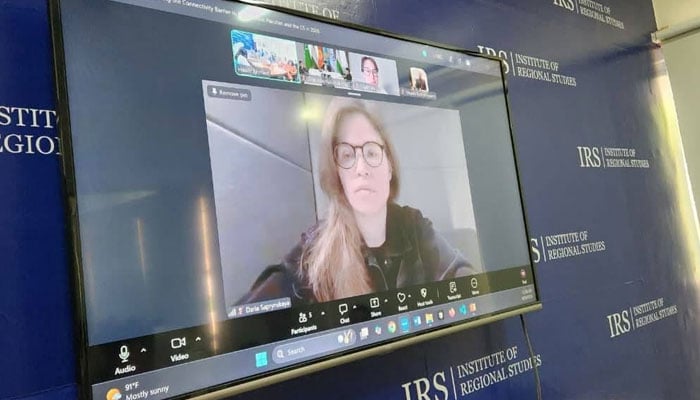
Islamabad:Policy analyst from Valdai Discussion Club in Russia Dr Daria Saprynskaya has highlighted that connectivity encompasses trade, logistics, investment and security, all of which are deeply interlinked.
Saprynskaya was addressing Eminent Speaker Series on “Breaking the connectivity barrier to Central Asia: Pakistan and the C5 in 2026” organised here by Institute of Regional Studies. She outlined Russia’s evolving strategic vision centred on the concept of “integration of integrations” linking major regional initiatives such as the Eurasian Economic Union (EAEU) and China’s Belt and Road Initiative (BRI) to build a flexible and interconnected Eurasian architecture rather than a single unified bloc. Connectivity hence, operates on two inseparable dimensions: economic (infrastructure, trade corridors) and politico-institutional (regulatory and multilateral frameworks) with Central Asia serving as a critical bridge linking Russia with South Asia, the Middle East and beyond.
She also noted that while all projects contribute to regional development, some could reshape geopolitical balances. Salomov Bakhtiyor Ravshan from International Institute for Central Asia (IICA) in Tashkent emphasised on how connectivity is not a zero-sum game but a shared platform for mutual economic gain.
Highlighting impressive growth in Uzbekistan-Pakistan trade from $36 million in 2017 to over $400 million in 2024, he spoke of vast, untapped potential with bilateral trade projected to reach $2 billion in the coming years. The session concluded with a consensus that Eurasian connectivity is no longer a theoretical ambition but an urgent strategic necessity.