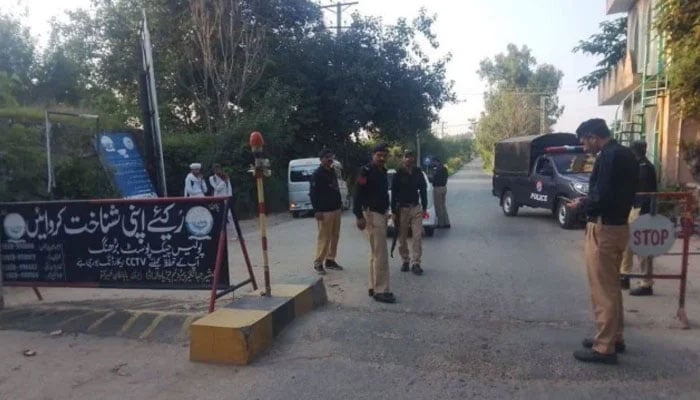
The latest unrest in Azad Jammu and Kashmir (AJK) is a reminder that political grievances left unresolved for too long can eventually produce consequences that serve no one. While the immediate focus has understandably been on the tragic violence in Rawalakot, where four law-enforcement personnel lost their lives and more than 20 officials were injured, policymakers must also reflect on the broader circumstances that allowed tensions to reach such a dangerous point. That said, there can be no justification for attacks on state personnel and those responsible for the killings must be identified and brought to justice through due process. No democratic society can permit violence against law enforcement officers or attempts to challenge the writ of the state through force. The right to protest is fundamental, but that right ends where violence begins.
At the same time, it is important to distinguish between individuals accused of criminal acts and the wider population that has been expressing legitimate concerns for years. The Joint Awami Action Committee (JAAC) emerged from public frustration over issues such as electricity tariffs, wheat subsidies, taxation, and governance. Observers have repeatedly pointed out that successive governments, both in Islamabad and Muzaffarabad, have often delayed engagement with protest leaders until tensions have already escalated. Even if the government has accepted most of the JAAC’s demands, the pattern of reactive rather than proactive governance remains a problem. The decision to declare the JAAC a proscribed organisation also raises important questions. States must act firmly against violence, but proscription is an extraordinary measure that should be used with caution. And it may be better to initially see that accountability is directed at those responsible for crimes, and not applied indiscriminately.
Particular attention must be given to the controversy surrounding the reserved seats for refugees in the AJK Legislative Assembly. The issue has become increasingly contentious and cannot simply be wished away. These seats have historical significance and represent families displaced from Indian-occupied Jammu and Kashmir. However, concerns about their role in local politics and their potential impact on electoral outcomes deserve a serious and transparent discussion. Dialogue among all stakeholders remains the only sustainable way forward. The stakes are especially high because AJK occupies a sensitive political and diplomatic position. Any instability is quickly exploited by hostile actors seeking to draw false equivalences between AJK and the situation across the Line of Control. Such comparisons ignore a fundamental reality. Pakistan’s support for the Kashmiri cause has long been based on the principles of self-determination and political representation. Nevertheless, the strongest response to external propaganda is effective governance and peaceful conflict resolution. The federal government and the AJK administration must therefore prioritise engagement over confrontation. Citizens must be allowed to express their views peacefully, while the state must enforce the law against those who resort to violence. AJK cannot afford a cycle of escalating tensions. This is something that AJK’s people would know well, and something the JAAC should understand. Sympathy flies away when violence becomes an outfit’s mainstay.