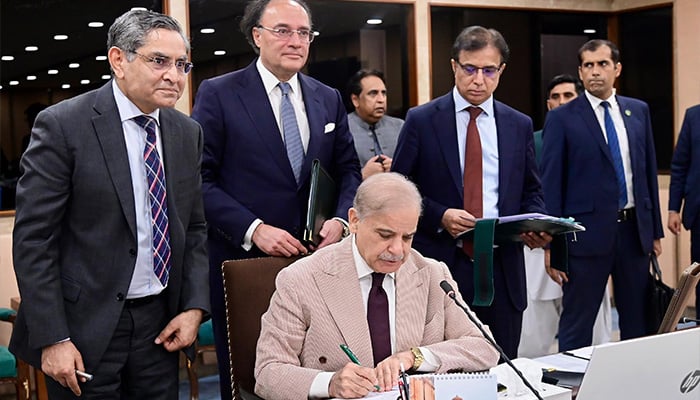
The long-awaited budget for FY2026-27 is finally out and it seems to have gone better than many would have thought. Overall, the budget has a total outlay of Rs18,771 billion, a significant increase from the Rs17,573 billion outlay in the previous budget. The largest share of this outlay – Rs8,054 billion – has been earmarked for mark-up/interest payments, followed by Rs3,000 billion for defence and Rs1,000 billion for the federal development programme. To pay for all of this, the government has set net revenue receipts, the primary funding source after accounting for the provincial share of gross tax and non-tax revenue, at Rs11,751 billion while borrowing and privatisation will bring in Rs7,020 billion, indicating a significant reliance on borrowing and privatisation to meet revenue needs. After failing to achieve the growth target of 4.2 per cent during the outgoing fiscal, with the country netting just 3.7 per cent growth during FY2025-26, the government has set a slightly more modest target of 4.0 per cent growth for the upcoming fiscal while inflation is expected to remain at 8.2 per cent. The total Public Sector Development Programme (PSDP) has been budgeted at Rs3675 billion, a noticeable decrease from last year’s Rs4223.8 billion, with the provincial PSDP taking the hit while the federal PSDP remains at the same level.
The budget proposes income tax relief in four slabs for salaried individuals and the abolition of surcharge on the salaried class. Salaried individuals earning between Rs2.2 million and Rs3.2 million from 23 per cent to 20 per cent and a reduction from 30 per cent to 25 per cent has been proposed for those earning between Rs3.2 million and Rs4.1 million annually. For salaried individuals earning between Rs4.1 million and Rs5.6 million, the applicable marginal tax rate is proposed to be reduced from 35 per cent to 29 per cent and for those earning between Rs5.6 million and Rs7 million, the applicable marginal tax rate is proposed to be reduced from 35 per cent to 32 per cent. It is fair to say that the incomes of most of Pakistan’s salaried will mean that they do not get this relief, but even some relief is better than the tax hikes that many had feared. The government has also decided to completely abolish the super tax, which ranged from 1.0 per cent to 7.5 per cent, across six slabs of business income between Rs150 million to Rs500 million. Similarly, for income exceeding Rs500 million, it is proposed to reduce the super tax rate from 10 per cent to 8.0 per cent. The aim over here is to promote small businesses and industries and improve the ease of doing business. The existing surcharge on banks, oil and gas exploration companies and fertiliser companies will, however, remain intact. While it would have been nice to see some major cuts on indirect taxation, which can be particularly painful for the lower income groups, that does not seem to have been the case.
However, it is not as though the budget has nothing for those of humbler means. The budget also proposes the abolition of the surcharge on the salaried class, previously set at 9.0 per cent, and hiking the minimum wage by 10 per cent. A 7.0 per cent increase in the salaries of government employees and a 7.0 per cent increase in the pensions of retired employees have also been proposed. Property buyers and sellers are also in line for some relief. The withholding tax on the purchase of property by filers is proposed to be reduced from 2.5 per cent to 1.5 per cent, while the tax on property sales is proposed to be cut from 5.5 per cent to 2.75 per cent. The concessional Final Tax Regime (FTR) rate of 0.25 per cent available to IT companies, an increasingly important part of the economy, was proposed to be extended for another three years until June 30, 2029. Public health has also featured prominently in this budget, with the government reportedly abolishing the tax on sanitary pads, something that the government had attempted last year but was stopped from doing by the IMF. The tax on contraceptives has also been removed.
As such, the government looks to have made a serious effort to offer people and businesses some much-needed relief. But bigger questions still remain. Pakistan’s main problem has been how narrow the tax base is and some experts have put this down to the fact that there is very little incentive for those in the informal sector, estimated to account for as much as 40 per cent of GDP, to enter the tax net. It is hoped that the lower rates for small businesses and industries and the government’s new voluntary retail tax efforts, which taxes shopkeepers at a rate of 1.0 per cent on turnover tax, will actually help bring people into the net. It is also important to note the country’s formidable development challenges, with the poverty rate surging and education spending dropping to just 0.8 per cent of GDP. However, there is only so much a budget can do. It is not, after all, a reform plan. The government is right to tout its record on fiscal consolidation and debt management and the fact that there are so many relief items in this budget despite the clouds of the Middle East conflict also deserves praise. One must hope that this budget contributes towards actually helping the reform agenda and that, as the government becomes more adept at taxation and fiscal consolidation, it can also become smarter and learn to get more out of the money that it actually spends. Pakistan now finally needs to move towards real growth.