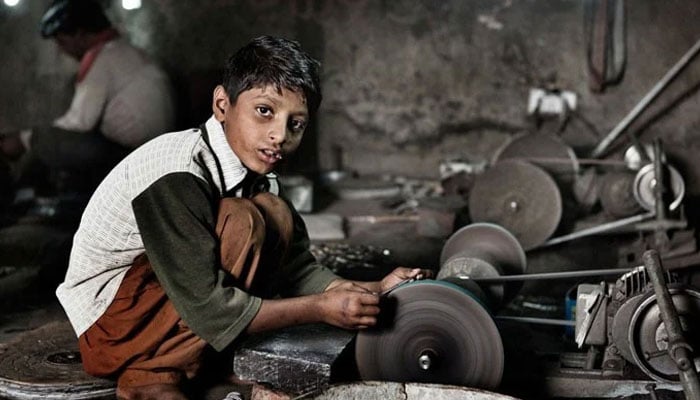
It is an uncomfortable truth of our society that instead of enjoying their childhood to the fullest, so many children here are trapped in the vicious cycle of child labour when they are supposed to be in schools and playgrounds. According to data published by Unicef, about 3.3 million of Pakistan children are involved in some kind of labour. This figure itself is from the only National Child Labour Survey conducted in 1996. One can only imagine how worse the situation might be today. Over 1.6 million children, between five and 17 years of age, in Sindh alone, have been found to be trapped in child labour, revealed the Sindh Child Labour Survey 2022-2024. These troubling facts are what make days like the 2026 World Day Against Child Labour more important for Pakistan. Under the slogan ‘Red card to child labour: Fair play for children, decent work for adults’, today’s Child Labour Day campaign calls for reinforced action on the policies that prevent child labour and withdrawn children from it: quality education, universal social protection, decent work and adequate livelihoods for adults, stronger laws and enforcement, better data and monitoring systems and responsible action in agriculture and supply chains.
There are systematic challenges that make it difficult for the government to combat child labour. On the legislation front, the country is successful. It has laws in place that specifically prohibit child labour. But the issue that authorities face here has to do a lot with abject poverty and conflicts across the country. According to World Bank estimates, almost 45 per cent of population lives below the poverty line. This forces parents to rely on their children to earn some income to supplement household expenses. With rising inflation, the purchasing power of relatively well-off families has also gone down. This means that whatever charity they used to give in the past has also abruptly stopped. As a result, children are sent to factories or households to work as helpers. Only 34 per cent of children under five are registered at birth nationally. This means it often becomes challenging for the authorities to determine the correct age of child workers.
And while dust- and stain-covered children at factories and mechanic shops are more visible, we often ignore child exploitation in the entertainment industry. Children in these industries face severe moral and physical risks, alongside psychological pressures like rejection, jealousy and a toxic drive for perfection that strips away their childhood. The hazards are even more acute for newborns used in productions. To induce crying or alter their appearance, infants are often subjected to harmful inflammatory substances, bright lights or the premature removal of protective natural fluids. These practices can cause permanent damage to a baby’s eyes, lungs, skin and overall health. We must see our children as our future and should be more serious about providing a secure environment for them.