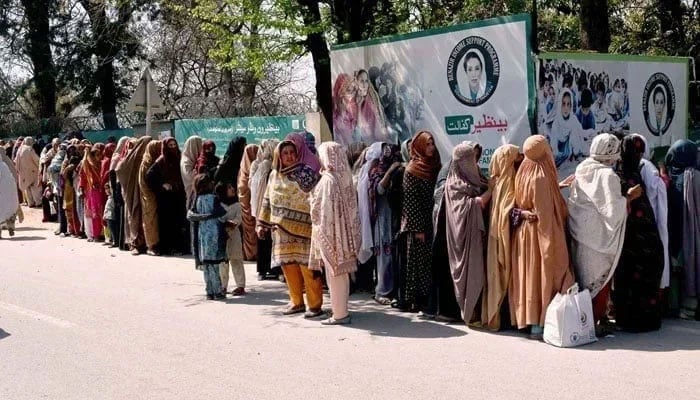
The Benazir Income Support Programme (BISP), launched in July 2008 and named after late PM prime minister Benazir Bhutto, has grown into Pakistan’s largest social protection initiative. Established to provide financial assistance to poor and vulnerable households, particularly women, the programme now supports millions of families across the country. Its expansion reflects both the scale of poverty and the increasing need for social protection amid recurring economic challenges.
At a time when inflation, unemployment, and rising living costs continue to burden households, BISP remains a critical lifeline for low-income families. For many women-led households, it provides essential support for meeting basic needs. Yet as the programme expands, an important question arises: can Pakistan sustainably reduce poverty through cash transfers alone?
The federal government has allocated nearly Rs716 billion for BISP in the 2025-26 budget, making it one of the country’s largest social sector expenditures. Around ten million families currently receive assistance under the Benazir Kafalat programme. Allocations have increased sharply from approximately Rs250 billion in 2021-22 to more than Rs700 billion today, reflecting worsening economic conditions, persistent inflation, and rising poverty pressures.
No doubt, BISP has played a significant short-term role during times of crisis. During the Covid-19 pandemic and recent inflationary shocks, cash assistance helped vulnerable households purchase food, medicines and other necessities. International institutions, including the World Bank, have also acknowledged Pakistan’s progress in digital cash transfers, biometric verification and women-focused financial inclusion.
However, while short-term relief is essential, the long-term sustainability of an expanding welfare model deserves sincere consideration. Pakistan continues to face slow economic growth, rising public debt, weak industrial development and limited investment in human capital. Despite increasing welfare expenditures, spending on health and education remains low, restricting opportunities for sustainable poverty reduction.
This raises a fundamental policy question. Is Pakistan investing enough to help people permanently escape poverty, or is it primarily financing survival from one year to the next?
One of the key challenges is the limited focus on graduation pathways. Many beneficiaries remain enrolled in the programme for years without opportunities to transition towards economic independence. While cash assistance reduces immediate hardship, it does not automatically generate sustainable income or build resilience against future shocks.
Global evidence shows that cash transfer programmes are effective in reducing poverty and improving household welfare. However, their impact is often greater when combined with employment opportunities, skills development, entrepreneurship support and asset-building initiatives. Without such complementary measures, vulnerable households may continue facing recurring economic insecurity.
Most BISP transfers are understandably spent on essential needs such as food, utility bills, transport, healthcare, education and debt repayment. These expenditures are necessary and often lifesaving. Yet consumption support alone rarely enables households to build productive assets or move permanently out of poverty.
Questions regarding targeting efficiency and governance have also remained part of the public debate. Audit observations and parliamentary discussions have periodically highlighted concerns about outdated poverty data, inclusion errors, and exclusion of deserving households. Although BISP has significantly improved transparency through digital payment systems and biometric verification, continued efforts are needed to strengthen accountability and public confidence.
More importantly, Pakistan cannot rely solely on consumption-based welfare while unemployment and economic stagnation persist. Every year, thousands of young people enter the labour market with limited employment opportunities. Rural communities continue struggling with declining agricultural incomes, climate-related shocks and inadequate industrial development. Women, despite being the primary beneficiaries of BISP, still face barriers in accessing decent jobs, financing, markets and vocational training.
With annual allocations now exceeding Rs700 billion, Pakistan has an opportunity to strengthen the developmental impact of its social protection system. While the core cash assistance function of BISP should remain intact, complementary economic empowerment initiatives can be integrated into the programme.
Women-led cottage industries, stitching centres, embroidery enterprises, handicraft production, food processing, technical and vocational training and dairy value chains could provide sustainable income opportunities for beneficiary households. Since most recipients are women, such initiatives could help transform beneficiaries into active contributors to local economies while strengthening household resilience.
Similarly, investments in agro-processing and small rural enterprises could promote both employment and food security. Support for poultry farming, honey production, fruit processing, livestock value chains and kitchen gardening can generate livelihoods while contributing to domestic production. Partnerships with the private sector and financial institutions could further improve training, market access and microfinance opportunities.
Pakistan can also connect social protection with emerging sectors such as the digital and green economies. Young people from BISP households could receive training in freelancing, artificial intelligence, e-commerce, digital marketing and other technology-based skills. Likewise, climate-related employment programmes involving recycling, solar technologies, urban greening, water conservation and climate-resilient agriculture could create jobs while addressing environmental challenges.
At the policy level, BISP should gradually evolve from a cash-transfer programme into a broader economic empowerment framework. Financial support should continue for vulnerable households, but it should increasingly be complemented by vocational training, financial literacy, entrepreneurship support and employment linkages. A portion of future social protection investments could be directed towards livelihood generation and community-based economic initiatives. Stronger graduation mechanisms, periodic beneficiary reassessments and transparent monitoring systems would further improve programme effectiveness.
Social protection remains indispensable in a country where millions continue to face economic insecurity, inflationary pressures and climate-related vulnerabilities. Yet welfare alone cannot serve as Pakistan’s long-term poverty reduction strategy. Sustainable progress will depend on enabling people to build skills, access productive employment and create sustainable livelihoods.
"The objective should be not merely to provide a fish, but to teach people how to catch one. Lasting poverty reduction comes from equipping individuals with the skills, opportunities, and resources needed to earn sustainable livelihoods”.
The true measure of success for any social protection programme is not simply the number of beneficiaries it supports, but the number of people it helps achieve economic self-reliance. As BISP enters its next phase, policymakers have an opportunity to complement income support with investments in jobs, skills, entrepreneurship and productive livelihoods. Doing so would transform social protection from a mechanism of survival into a pathway towards lasting economic empowerment.
The writer is affiliated with the Systems Research Group (SRG) at the Sustainable Development Policy Institute (SDPI). The views expressed are solely his own and do not necessarily reflect the official position of SDPI.