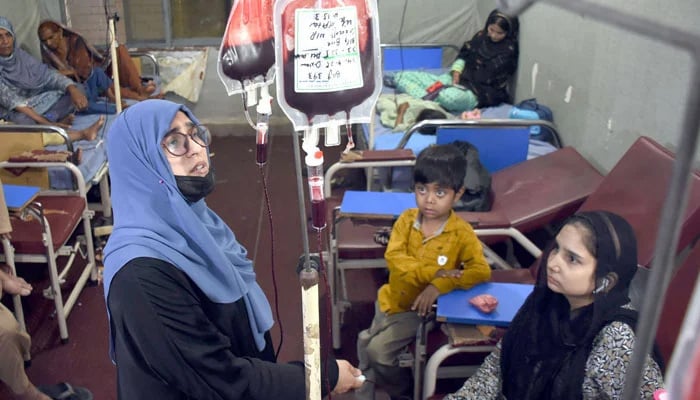
KARACHI: Hamdard University Vice Chancellor Prof Dr Imran Amin has said that thalassemia remains a serious and life-threatening disease, and its complete treatment is currently not available in Pakistan at either government or private healthcare facilities. However, he expressed optimism that gene therapy could emerge as an effective treatment option in the future.
He made these remarks while addressing a seminar held at Hamdard University in connection with International Thalassemia Day 2026, marking the conclusion of a two-day awareness programme. The seminar was chaired by Chancellor of Hamdard University and President of Hamdard Foundation, Ms Sadia Rashid (HI).
As part of the awareness programme, a blood screening and blood donation camp was organized on the first day at the Faculty of Eastern Medicine in collaboration with Saylani Welfare International Trust. Students, faculty members and staff actively participated in the screening and blood donation activities.
Addressing the seminar, Dr Imran Amin said several non-governmental organizations were playing a vital role in supporting thalassemia patients across Pakistan, with Saylani Welfare being among the leading contributors in this field. He also appreciated the research project “IROCHEL,” conducted by Dr Tabeeba Saima Ghias, Chairperson of the Pakistan Association of Eastern Medicine and a faculty member at the Faculty of Eastern Medicine, and emphasized the need to expand the initiative.
The vice chancellor further announced that an artificial intelligence-based healthcare data project being developed in collaboration with Saylani Welfare would soon be completed to enhance support systems for thalassemia patients.
Speaking on the occasion, Dr Ghulam Rasool, Project Director of the Thalassemia Programme at Saylani Welfare International Trust, revealed that approximately 10,000 children are born with thalassemia annually in Pakistan, while more than 100,000 children are currently living with the disease. He added that the prevalence of thalassemia carriers in Sindh ranges between five and nine percent of the population.
Dr Rasool noted that thalassemia patients often struggle throughout their lives and stressed the importance of preventive measures. He said countries that adopted early prevention strategies had achieved remarkable success in controlling the disease. Citing examples, he claimed that Iran had not reported a single thalassemia birth in the past 18 years, while Saudi Arabia had reduced its carrier rate from 19 percent to three percent.
He explained that Chorionic Villus Sampling (CVS) testing during the first 14 weeks of pregnancy can help diagnose thalassemia and added that, in cases of major thalassemia, termination of pregnancy within the prescribed period is permissible under legal and religious guidelines. He emphasized the role of religious scholars, the media and social organizations in spreading awareness and suggested that awareness campaigns be conducted through Friday sermons in mosques nationwide.
Dr Rasool also pointed out that although the Sindh Assembly passed a thalassemia prevention law in 2016, the legislation describes screening as voluntary rather than mandatory. He urged lawmakers to amend the law to strengthen preventive measures.
Dr Saima Ghias proposed that NADRA-issued national identity cards should include a column indicating thalassemia screening status, similar to blood group information. She also recommended that Nikah Nama forms include mandatory disclosure of thalassemia screening results. According to her proposal, marriage registrars should not solemnize marriages where screening requirements have not been fulfilled, with penalties for violations including fines and suspension of licences.
Earlier, Dr Hakim Shiraz Siddiqui of the Faculty of Eastern Medicine delivered the welcome address. An exhibition of awareness posters prepared by students was also organized and received appreciation from participants.
At the conclusion of the seminar, Chancellor Sadia Rashid and Vice Chancellor Dr Imran Amin distributed commemorative shields among guests and certificates among students. Participants said the event played an important role in promoting awareness, preventive measures and the need for stronger legislation to combat thalassemia in Pakistan.