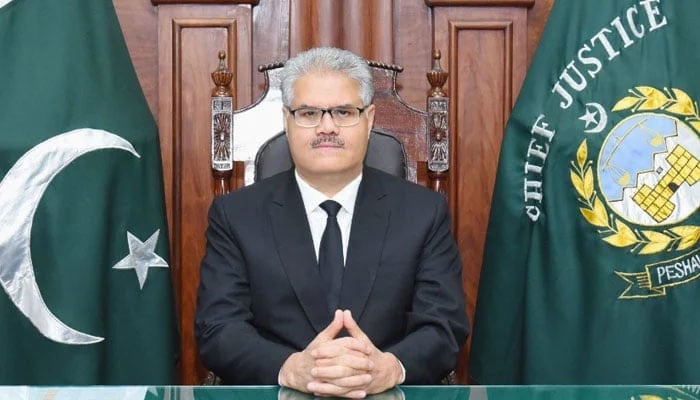
PESHAWAR: Peshawar High Court Chief Justice SM Attique Shah on Thursday expressed dissatisfaction over the non-implementation of the high court’s larger bench decisions and directives regarding the criminal justice system, warning that action would be taken against officials who fail to perform their duties.
Hearing a contempt of court petition, the chief justice remarked that if any government officer was not performing his duties, the court would order action against him.
He said directives had already been issued to strengthen the prosecution system, adding that “this province belongs to 40 million people and it is burning, yet no one is there to take responsibility.”
The chief justice observed that southern districts, including Dera Ismail Khan, Karak and Tank, were affected by terrorism and were not even safe to travel to. He noted that he himself intended to visit Dera Ismail Khan but was denied security clearance.
“This is not how things will work. If there is political interference, tell us,” he said, adding that it was shameful that the province lacked a forensic laboratory and DNA samples were being sent to Lahore at a cost of Rs1.1 million per test.
He directed the authorities to submit a concrete progress report on reforms and adjourned the hearing until July 1, seeking a detailed report from the chief secretary within one month.
The contempt petition was heard by a two-member bench comprising Chief Justice SM Attique Shah and Justice Ijaz Khan.
During the hearing, Advocate General Shah Faisal Utmankhel, Khyber Pakhtunkhwa Chief Secretary Shahab Ali Shah, Secretary Home Usman Mehsud, Secretary Finance Kamran Afridi, Secretary Administration, Secretary Law, Director General Prosecution Muhammad Rafiq Mohmand, and Deputy Secretary Home Qayum Khattak appeared before the court.
The chief justice questioned the CS over non-compliance with the larger bench’s judgment, saying that the submitted report lacked substance.
He said the court had directed the strengthening of the prosecution department, but implementation was still pending. He further noted that while a female district and sessions judge was performing duties in Karak under difficult conditions, other officers were reluctant to serve in sensitive areas.
Referring to systemic issues, he highlighted that families were allegedly being forced into extreme poverty, even selling their children due to hardships and questioned the state of governance.
The CS and AG informed the court that a supplementary report had been submitted and steps were being taken in light of the court’s directions. They said reforms in the criminal justice system were underway, including proposed amendments to laws, the establishment of a forensic science laboratory under the Annual Development Programme and coordination with NESPAK.
They also said that a Rs550 million PC-1 had been prepared, AI-based systems and data labs were being developed, and witness protection and victim protection mechanisms were being introduced.
The CS requested two to three weeks to review the matter further and assured that a comprehensive report would be shared with the court.
The chief justice granted one month for compliance, reiterating that non-performing officers should be removed from service and that corruption would not be tolerated.
He again raised concern over the absence of a forensic DNA facility in the province, stating it was unacceptable for samples to be sent outside at high cost and emphasized the need for urgent reforms in the criminal justice system.
The bench also directed the Inspector General of Police to submit a report regarding proper registration of FIRs and compliance with court orders and adjourned further proceedings until July 1.