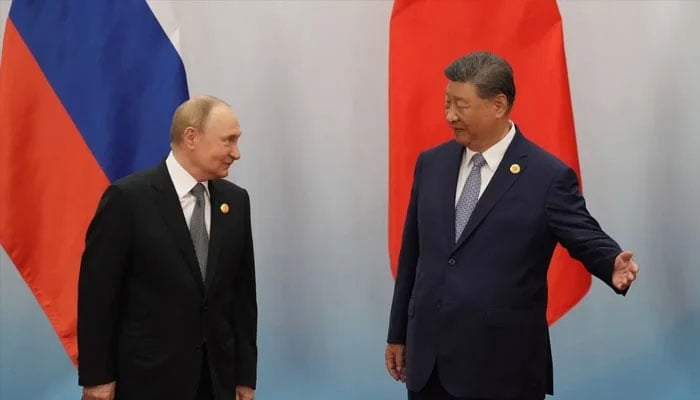
Just a few days after US President Donald Trump’s visit to China concluded, Russian President Vladimir Putin arrived in Beijing to mark the 25th anniversary of bilateral friendship. The back-to-back visits of two of the world’s most influential leaders to China offer a powerful reminder of how rapidly the global balance of power is shifting from the West to the East.
When Ibn-e-Insha travelled to China in the 1960s, the country was widely perceived as underdeveloped. China remained largely isolated from the international system. The global attention of that era focused on the cold war rivalry between the US and the Soviet Union. For many ordinary Chinese citizens of that era, China’s connection with the outside world was limited only to Pakistan.
However, if Ibn-e-Insha were alive today, he would witness a transformation almost unimaginable in his own time. The great Chinese nation he once described in his travelogue has evolved from poverty and isolation into one of the defining economic, industrial, technological and geopolitical powers of the 21st century. Today, world leaders no longer just observe China; they travel to Beijing seeking support, cooperation and influence.
In the early cold war days, the newly established People’s Republic of China under Mao Zedong became one of the closest allies of the Soviet Union. Moscow played a pivotal role in China’s early industrial development by providing necessary technical expertise, infrastructure support and financial assistance. Both neighbours also aligned to resist US-led Western influence on several international issues, including the Korean War.
Yet, ideological similarities did not guarantee permanent unity. Over time, conflicts emerged on several issues. These disagreements eventually led to the Sino-Soviet Split during the 1960s. For years, international media reported on aggressive rivalry, border disputes, and confrontations between the two neighbouring communist states.
Interestingly, the collapse of the USSR in the 1990s fundamentally changed regional geopolitics. Russia entered a critical period marked by economic instability and strategic uncertainty. On the other hand, China accelerated economic reforms and integrated swiftly into the global economy.
When Vladimir Putin became president of the Russian Federation, Moscow focused on improving bilateral ties with its Chinese neighbour. This effort culminated in July 2001, when Russia and China signed the landmark Treaty of Good-Neighbourliness and Friendly Cooperation. Undoubtedly, that historical agreement established a long-term framework for cooperation in defence, trade, energy, technology, border security, culture and international affairs. It emphasised mutual respect for sovereignty, territorial integrity, non-interference in domestic affairs, peaceful coexistence, and most importantly, resistance to unilateral dominance in world politics.
Under Chinese President Xi Jinping, relations with Moscow entered an even deeper phase of strategic partnership. President Putin has repeatedly described China as a key pillar of Russia’s foreign policy, while Xi has referred to Putin as a close, old and trusted friend. Over the past decade, the two leaders have met dozens of times.
Today, 25 years after the friendship treaty, China has become Russia’s largest trading partner. Their strategic coordination rapidly extends into defence, regional security and technological development. During periods of Western sanctions, China emerged as a major buyer of Russian oil, gas and raw materials. Energy projects such as the Power of Siberia pipeline symbolise the scale of bilateral cooperation. When a leading Chinese telecommunications company faced restrictions in the US, Moscow opened its market to create opportunities for deeper commercial cooperation.
Viewed in this broader context, Putin’s latest visit to Beijing reflects the continued strengthening of Sino-Russian strategic cooperation, the growing shift of the balance of power toward Asia, and the emergence of a more multipolar world order.
China’s amazing journey from the pages of Ibn-e-Insha’s travelogue to the centre of world diplomacy in the 21st century also illustrates an important lesson for us: in the modern era, influence is shaped by economic strength, internal stability, technological advancement, trade connectivity and strategic patience. Countries committed to long-term national goals may eventually find the world arriving at their own doorstep.
The writer is a member of the National Assembly and patron-in-chief of the
Pakistan Hindu Council. He tweets/posts @RVankwani