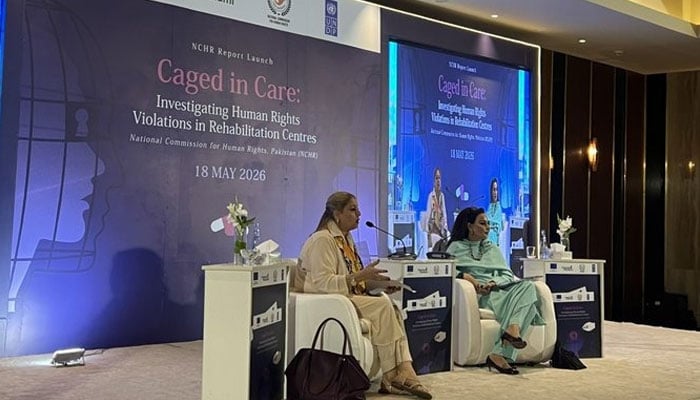
Islamabad : The National Commission for Human Rights (NCHR) has launched an investigative report revealing widespread human rights abuses in rehabilitation and psychiatric centres across Pakistan, exposing a system that enables violence under the pretext of care.
Launched under a project Huqooq-e-Pakistan II, funded by the European Union (EU) and the United Nations Development Programme (UNDP), the report “Caged in Care: Investigating Human Rights Abuse in Rehabilitation Centers,” documents facilities operating without psychiatric oversight, due process, or accountability.
Drawing on testimonies from former and current patients, as well as an analysis of institutional and legal frameworks, the report identifies systemic gaps in oversight, regulation, and accountability within rehabilitation centres.
The launch brought together government representatives, development partners, civil society stakeholders, and legal experts to encourage evidence-based dialogue on strengthening safeguards and improving accountability in institutional care systems.
The investigation found women unlawfully detained, denied contact with families, sedated without medical justification, and assigned fabricated diagnoses.
The findings show that women from diverse backgrounds, professionals, mothers and students were often confined not because of medical need, but following family disputes, resistance to forced marriage or attempts to exercise personal autonomy.
The report documents forced “involuntary pickups,” in which individuals were physically restrained or sedated and transported to facilities without consent.
Once admitted, patients frequently lacked legal recourse, complaint mechanisms, or periodic medical review. Several cases revealed women detained for months despite being medically fit for discharge, often following domestic conflicts or property disputes.
Investigators recorded degrading living conditions, including unhygienic kitchens, expired medicines, overcrowded sleeping spaces and intrusive surveillance in bedrooms and bathrooms.
The Commission noted that such practices violate constitutional guarantees and Pakistan’s international human rights commitments, particularly protections against arbitrary detention, torture and discrimination against women and children.
“At the heart of this report are individuals who were placed in care but instead found themselves without adequate protection, voice, or recourse,” said NCHR Chairperson Rabiya Javeri Agha.
“This is not about isolated cases, it is about a system that has allowed control to take the place of care, particularly in the lives of women. The incidents investigated for this report are indicative of systemic regulatory failure shaped by institutional neglect and entrenched social biases. At its core, this crisis reflects broader patterns of patriarchal control and the misuse of mental health frameworks to silence dissent, particularly among women.”
The report findings point to recurring challenges in monitoring and enforcement, including gaps between licensing frameworks and implementation on the ground. It also highlights concerns regarding limited access to complaint mechanisms and legal safeguards for individuals admitted to such facilities.
The report also draws attention to the gendered dimensions of institutional care, including heightened risks faced by women, concerns regarding involuntary admission in certain cases, restricted contact with families and treatment practices that may not always be aligned with medical justification.
According to testimonies documented in the report, some women were reportedly admitted in the context of family disputes, resistance to forced marriage or attempts to exercise personal autonomy rather than clear clinical grounds.
The report shows that in Islamabad alone, there are 300 such centers with 25 rehabilitation clinics registered. The registration costs approximately Rs5,000, enabling facilities to operate from converted residential properties while advertising advanced treatment for conditions ranging from substance dependence to loosely defined behavioral issues. The investigation highlighted a stark gap between advertised services and on-ground realities.
“Strengthening trust in institutional care requires not only clear standards, but also effective implementation, monitoring, and accessible mechanisms for redress”, said Van Nguyen, Deputy Resident Representative, UNDP Pakistan.