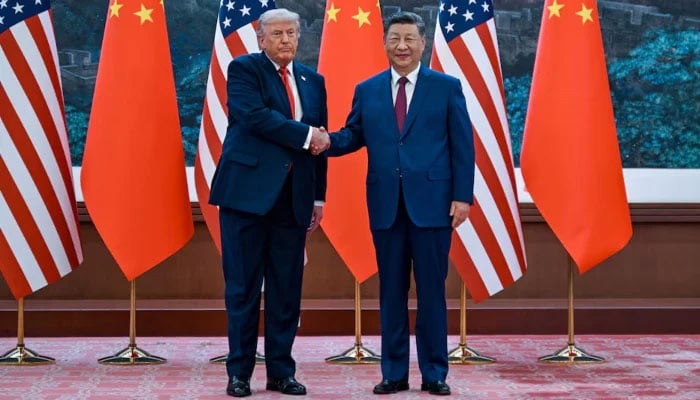
The visit of US President Donald Trump to Beijing has once again drawn global attention to the evolving relationship between the US and China. At a time when global politics is passing through a turbulent phase marked by wars, economic uncertainty, inflation, technological rivalry and energy crises, the interaction between the leaders of the world’s two largest economies obviously carries historic significance.
Calling President Xi Jinping “a great leader” and describing friendship with China as an honour indicates a clear attempt to project diplomatic flexibility despite years of strategic competition and trade disputes. In response, the Chinese president also adopted a broader and realistic approach, emphasising that bilateral cooperation is more valuable than confrontation. According to him, both sides must work together rather than treat each other as rivals.
In recent years, relations between the two countries have been marked by significant turmoil. Trade wars, tariffs, technology restrictions, semiconductor disputes, military tensions in the Indo-Pacific region and controversial human rights issues have all contributed to growing mistrust.
Even before the visit started officially, the Chinese Embassy in Washington emphasised its “four red lines". This reveals Beijing’s confidence regarding sovereignty and non-interference as well as its determination to protect core national interests. The US, as per some media reports, remains concerned about China’s expanding economic influence, technological dominance and military rise in the Indo-Pacific region.
The Iran factor has also added the most critical dimension to the US-China dialogue. American Secretary of State Marco Rubio, who is also part of the delegation, openly urged China to pressure Iran over the Strait of Hormuz crisis. This call itself indicates that Washington acknowledges Beijing’s growing influence in the Middle Eastern region and recognises China as a necessary stakeholder in maintaining global stability.
Trump is fundamentally a businessman who focuses on economic interests to make America great again. Similarly, China has always placed extraordinary importance on bilateral trade and economic cooperation. Despite China’s strategic disputes and regional competition, Beijing has maintained significant trade relations with most places. This is why there is a strong reason to believe that when both world leaders prioritise business interests and engage in serious dialogue, they will eventually find ways to understand each other and end misunderstandings.
The presence of senior top leadership from prominent American companies, including Apple, Tesla, NVIDIA and Boeing, in the Trump-led US delegation also endorses my stance that business interests favour engagement over confrontation during the ongoing superpower summit. Even though bilateral trade has declined from its previous peak, economic links between the two countries remain among the largest in the world.
The Trump administration also finally understands that China’s influence over several prominent global issues has increased in recent years. Washington is therefore seeking cooperation from Beijing as a necessary stakeholder in resolving global crises. This marks an important shift in international diplomacy, in which even rival powers are cooperating on common issues that threaten world peace and regional stability.
From a Pakistani perspective, this evolving interaction between the world’s two largest powers also has direct implications for world peace, regional stability, economic recovery, energy markets and the future balance of power in the region. In my view, the world is rapidly transforming from a unipolar order dominated by a single superpower toward a more complex multipolar system where influence is distributed among several powers.
In fact, such diplomatic signaling is a very encouraging sign for Islamabad, as our foreign policy traditionally seeks cordial relations with both China and the US. Trump’s visit will definitely shape the future world order. Therefore, we must wisely prepare for both the opportunities and risks emerging from this new development. I believe that reducing tensions during the superpower summit would create fresh breathing space for world peace.
The writer is a member of the National Assembly and patron-in-chief of the Pakistan Hindu Council. He tweets/posts @RVankwani