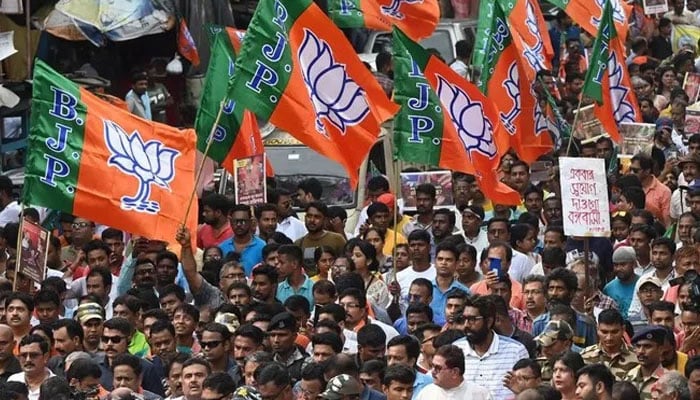
The fall of West Bengal in the 2026 assembly elections signals the surrender of a secular bastion to the tide of saffron hegemony.
For decades, Bengal stood as an intellectual and cultural roadblock against the monochromatic vision of the BJP, where the syncretic Ganga-Jamni culture resisted communal binaries. The BJP’s conquest of Kolkata marks the culmination of a century-long struggle to ‘purify’ the region, a project with ideological roots in the 1905 Partition of Bengal. While the British sought to fracture Bengali unity along religious lines to weaken nationalism, the BJP has achieved what the colonisers could not: the systemic disenfranchisement of the Muslim minority to secure electoral dominance. India’s ruling party, leveraging the Special Intensive Revision (SIR) to purge nearly nine million voters, around ten per cent of the electorate.
History suggests that the marginalisation of Bengal’s Muslims is a recurring tragedy, often disguised as administrative necessity. When Lord Curzon partitioned Bengal in 1905, he claimed efficiency as his motive, though the real aim was to isolate the Muslim-majority east from the politically active Hindu west. Though annulled in 1911, the partition sowed deep suspicion. Since 1947, West Bengal’s Muslims have been forced to constantly prove their patriotism. Today, the BJP has weaponised this insecurity, labelling Bengali Muslims as ‘infiltrators’ and ‘pollutants’ while targeting voter deletions in districts such as Murshidabad and Malda.
The human cost of this political conquest became agonisingly clear in the immediate aftermath of the 2026 results. Reports from cross-border observers and independent human rights monitors highlight a chilling pattern of violence: mosques desecrated, Muslim localities besieged and families who have lived on that soil for generations now living in fear of being ‘taught a lesson’ in the same brutal manner as the residents of Gaza.
The rhetoric of the new leadership is not that of a unifying government but of an occupying force. When a sitting chief minister compares his own citizens to a blockaded population in a war zone, the mask of constitutional democracy has not just slipped it has been discarded. The Bengal that once produced Nobel laureates like Rabindranath Tagore is being systematically remodelled into a laboratory for majoritarian extremism, where the identity of a citizen is defined by their religious utility to the ruling party.
The fall of Mamata Banerjee, who lost her stronghold of Bhabanipur by a suspicious margin of 15,000 votes after holding 70 per cent of the vote just years prior, signals the death of organised opposition in India’s periphery. The Trinamool Congress’s accusations of an unethical dirty game by the Election Commission are a desperate warning about the erosion of institutional integrity. If the very mechanism of voting can be ‘purified’ to exclude those who disagree with the Hindutva project, then the ‘world’s largest democracy’ is operating in name only.
This is no longer about one state or one election. It is about a blueprint being perfected in Bengal to be exported across the country. The systematic purging of 90 lakh voters provides a terrifyingly efficient model for ensuring that the BJP’s third-term transition into a perpetual reign remains unchallenged by the ‘inconvenience’ of minority voices.
As the dust settles over the charred remains of Bengali pluralism, one must ask if the international community and indeed the silent majority within India will continue to be a silent spectator to this unravelling. Can a nation truly claim to be a global power while it treats its largest minority as an internal enemy? Is India prepared for the long-term instability that comes when millions of its people are told they no longer have a stake in the land of their ancestors?
The ‘New Bengal’ being built today is not founded on development or peace, but on the exclusion of the Other. If this trajectory continues, the question is not whether the BJP will win the next election, but whether there will be anything left of the Indian Union to govern.
The writer is a freelance contributor and writes on issues concerning national and regional security. She can be reached at: [email protected]