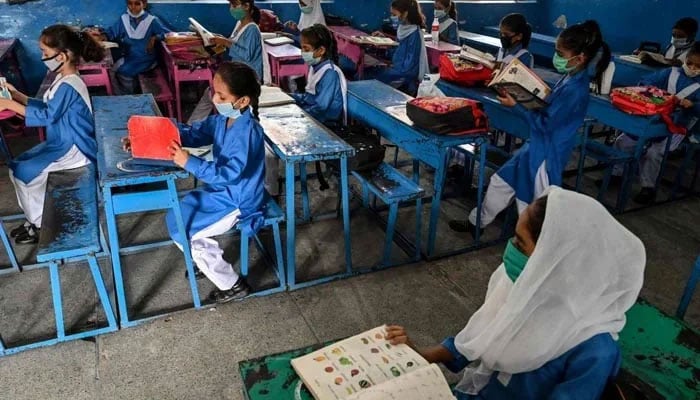
Punjab’s schooling crisis is not only a matter of access or political commitment. It is also a matter of how the system works from day to day. Repairs take too long. Vacancies stay open. Funds arrive late or are too limited to solve the problem at hand. Supervision often records compliance more easily than it improves teaching.
This is the machinery of public education: the ordinary chain of decisions, timelines, responsibilities and consequences that determines whether public commitments become functioning schools or remain promises with uneven effects. When that machinery works, schools are stable enough for learning to build over time. When it does not, children remain enrolled on paper while drifting out in practice, small failures harden into permanent conditions and administration becomes easier to sustain than outcomes.
As these systems age, they lose the luxury of beginning again. They have to govern through what they have inherited. Punjab’s public education system was never built as a single coherent design, with authority, accountability and support aligned from the outset. It evolved by accumulation. New reforms were added to answer specific problems, but older routines were rarely removed.
Assessment reform, for instance, meant adding bodies such as the Punjab Examination Commission (PEC); teacher development was reorganised through institutions such as the Quaid-e-Azam Academy for Educational Development (QAED). These were not irrational moves. They addressed real needs. But each addition also left the system more layered, requiring institutions built at different times and for different purposes to work together despite blurred responsibilities, uneven capacity, and incentives that do not naturally align.
The consequence of this evolution is not simply ‘too many instruments’. It is a system that becomes highly competent at survival tasks – forms, approvals, compliance, reporting – because those are the behaviours each layer demands and rewards. At the same time, it becomes slower at the actions families experience as schooling: repairing, staffing, supervising and teaching reliably. Those require coordination across layers built at different moments for different purposes, with incentives that don’t naturally align. That is why governance solutions in Punjab cannot be treated as clean blueprints imposed on a blank slate. They have to be designed for an accumulated institution – one where reform succeeds only when it reshapes incentives, clarifies authority, and makes responsibility land where delivery actually happens.
A useful way to keep the conversation honest is to describe the problem in verbs, rather than in values. Values tell us what we want: rights, equity, dignity. Verbs tell us what the system repeatedly does: it hires on time or it hires late; it fixes routine breakdowns quickly or it lets small damage become permanent; it supervises teaching or it supervises attendance registers. A system is not what it promises; it is what it repeatedly does.
This is also why the familiar split – ‘infrastructure problems’ versus ‘human resource problems’ – misses the point. Physical delivery is downstream of human coordination. A boundary wall is not built by concrete; it is built by aligned roles: a headteacher who can raise the need, a School Management Council (SMC) that can decide, a budget line that exists and arrives on time, a usable purchasing mechanism, and oversight that closes the loop without paralysing action. When those human mechanisms are weak, physical resources sit idle, budgets remain underused or are used defensively, and basic problems linger long enough to feel like the natural condition of public schooling.
Punjab is not operating with zero school-level fiscal mechanisms. The province’s Non-Salary Budget (NSB) programme explicitly provides school-specific funds to SMCs for recurrent costs and learning support. It frames this as a means of strengthening local accountability by empowering communities and headteachers to plan and manage spending based on real needs. That is an important reality check: the bottleneck is not simply ‘procurement doesn’t exist’. It is more often some combination of whether the envelope is adequate for real needs; whether money arrives predictably enough to plan; and whether school leadership has the capability and confidence to convert available discretion into timely improvements rather than paperwork.
Capacity and agency matter because discretion is not automatically empowering. Discretion without support often becomes symbolic. Headteachers with little financial management exposure learn to minimise risk rather than maximise impact: avoid decisions that might trigger audit trouble, choose the safest possible expense, delay until guidance arrives, or simply let funds sit. PESRP’s framing itself implicitly recognises this, noting the need to build council capacity through policy orientation, awareness content and digital tools to improve utilisation. Even when money is pushed down, the system still needs people who can use it.
But machinery is not only about funds and repairs. It is also about what the system chooses to measure, and how it turns measurement into accountability. Metrics are not neutral, they create incentives. If the system rewards what is easy to count – presence, files, and compliance – schools will optimise for those. Thomas Sowell, an economist and longtime senior fellow at the Hoover Institution, has spent years arguing that public education systems often fail for reasons that sound almost mundane: incentives that reward paperwork over outcomes, layers of bureaucracy that dilute accountability, rules that make it hard to remove persistently ineffective staff, and an institutional tendency to protect routine even when results are poor.
Whether one agrees with all of Sowell’s politics is beside the point; his administrative critique travels well because it forces a basic question: what does the system reward and what does it ignore? The hard truth is that many education systems end up with an accountability regime that is heavy on monitoring and light on improvement: problems are observed, noted, reported upward, and then normalised.
This is where Punjab’s recent institutional reshuffle becomes relevant to the ‘machinery’ argument. In March 2025, Punjab established PECTAA by merging three key bodies – the Punjab Curriculum and Textbook Board, QAED and the PEC – aiming to centralise policymaking and improve coordination across curriculum, teacher training, and student assessment. Whether one agrees with every future decision PECTAA makes is beside the point.
The consolidation reflects an important diagnosis: fragmented systems produce fragmented accountability. When training sits in one silo, curriculum in another, and assessment in a third, reforms become incoherent – teachers are trained toward one set of priorities while exams pull schools toward another. A single apex authority is at least an attempt to reduce that fragmentation and align what gets taught, how teachers are supported, and what learning is actually measured.
The deeper point is not that Punjab lacks good people or good intentions. The point is that those accumulated institutions that train behaviour. Staff learn what keeps them safe: which decisions attract scrutiny, which signatures are likely to bounce a file back, and which actions can be defended later if something goes wrong. Over time, that tends to privilege process protection over problem-solving.
The system doesn’t have to be malicious to behave this way; it only has to reward caution more reliably than it rewards results. That is why context-responsive governance is not a buzzword; it is the only serious approach. You cannot govern an accumulated system as if it were a new device fresh from the factory. You have to govern the system you have – its routines, bottlenecks, workarounds, capacity gaps, and political economy – so that the machinery starts producing schooling as families experience it: reliable, usable, and oriented towards learning.
The writer is a Lahore-based educational counsellor, teacher and researcher. He can be reached at: [email protected]