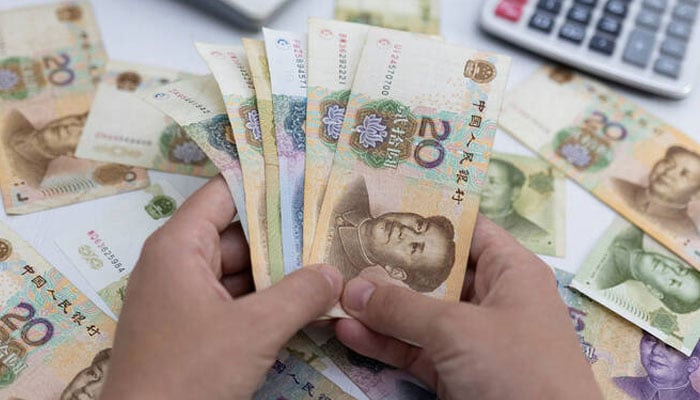
Pakistan has completed its first-ever yuan-denominated sovereign Panda Bond sale in China's onshore capital market, raising $250 million in yuan equivalent bonds in the first phase, Adviser to the Finance Minister Khurram Schehzad said on Thursday.
"The inaugural Panda Bond is a 3-year fixed-rate instrument, making it Pakistan’s first-ever RMB-denominated sovereign issuance in China’s onshore capital market,” Schehzad wrote in a post on X.
Pakistan had appeared on the radar screen of international investors when it launched Eurobond last month to raise $750 million. Islamabad also raised an additional $3 billion in deposits from Saudi Arabia and also returned $3.4 billion to the United Arab Emirates. Pakistan also received $1.3 billion from the IMF as well after getting approval of EFF and RSF tranches.
The development comes a day after Federal Minister for Finance and Revenue Muhammad Aurangzeb left for China to participate in the issuance ceremony of Pakistan’s inaugural Panda Bond.
In the statement, Schehzad said that the landmark Panda Bond issuance of RMB 1.75 billion (equivalent to US$250 million) attracted overwhelming investor demand of over RMB 8.8 billion (approximately $1.26 billion), resulting in an oversubscription of more than 5 times.
He further said: "Importantly, demand for the inaugural tranche alone exceeded Pakistan’s entire planned Panda Bond programme size of RMB 7.2bn (US$1 billion equivalent) — a powerful reflection of growing international investor confidence in Pakistan’s economic outlook and reform trajectory.
“The strong order book enabled highly competitive pricing (2.5% coupon), demonstrating the market’s positive assessment of Pakistan’s improving macroeconomic fundamentals, external stability, disciplined fiscal management, and sovereign repayment capacity.”
The advisor said that issuance was more than a financing transaction as it marked Pakistan’s entry into China’s capital market and strengthened Pakistan-China financial cooperation.
"The success of the Panda Bond sends a powerful signal to global investors that Pakistan’s economic recovery is gaining international recognition. It reflects confidence in the country’s reform agenda, improving fiscal and external indicators, successful debt management, and commitment to sustainable growth," he added.
"This milestone marks the beginning of a new chapter in Pakistan’s economic and financial engagement with the world," Schehzad concluded.
Pakistan secured a $7 billion IMF Extended Fund Facility in 2024 following a near-default the previous year, and has since enacted fiscal reforms, though it remains dependent on continued IMF disbursements and bilateral creditors to meet its external financing needs
Foreign exchange reserves stood at $21.3 billion as of May 8, not yet reflecting a further $1.3 billion IMF disbursement received on May 12.
Moody's rates Pakistan Caa1 with a stable outlook, while Fitch rates it B+, both still sub-investment grade.
— with additional input from Reuters