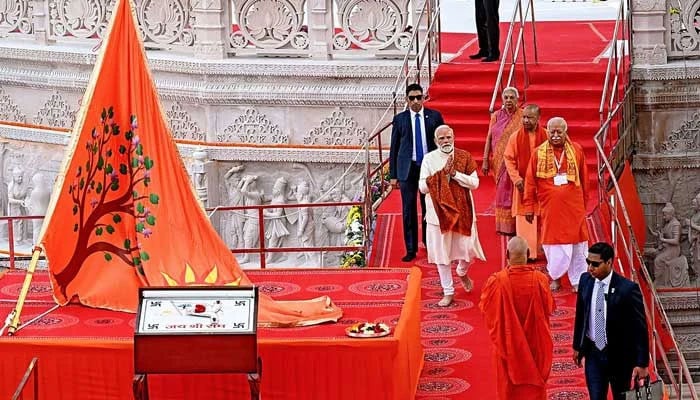
The US Commission on International Religious Freedom (USCIRF) has once again recommended that the US government designate India as a ‘country of particular concern’ in its 2026 Annual Report. This can hardly come as a surprise to those who have been following the plight of India’s religious minorities since the rise to power of current Prime Minister Narendra Modi and his BJP. Firm believers in the Hindutva ideology, the prime minister and his party have gone about oppressing and persecuting religious minorities, particularly Muslims, since 2014, reversing the image of India as the tolerant, pluralist and colourful largest democracy in the world. The report says that, in 2025, Hindu nationalist mobs across several states harassed, incited, and instigated violence against Muslims and Christians with impunity, with violence erupting in Maharashtra after a hardline Hindu nationalist group called for the removal of the tomb of Mughal emperor Aurangzeb. Muslims were also reportedly killed in Karnataka and Uttar Pradesh in alleged hate crimes following the Pahalgam attack, which most observers and analysts say was a false-flag attack. Arguably more dangerous than the targeted violence itself is the way in which the authorities have tolerated these vigilante attacks. This points to a systematic effort to marginalise religious minorities and strip them of their protections.
Alongside the violence, several Indian states have undertaken efforts to introduce or strengthen anti-conversion laws to include harsher prison sentences and Indian authorities also facilitated widespread detention and illegal expulsion of citizens and religious refugees, as per the report. The government also continued to target houses of worship in an attempt to bring them further under state control. The message for India’s Muslims, Christians, Buddhists and Jains is loud and clear: You may live in India, but you are not truly ‘Indian’. Indeed, as the report states, Indian authorities have reached the point where they are even deporting minority citizens, expelling hundreds of Bengali-speaking Muslims from Assam to Bangladesh in July. ‘Second-class citizen’ is not quite the term to describe this treatment. Increasingly, it feels that minorities, particularly Muslims, are perceived as an encumbrance by the Indian state, one that must be dealt with violence and suspicion and that the country might be better off without.
Almost as shocking and disappointing as the persecution itself is how long it has been allowed to continue. In fact, Modi and the BJP do not appear to have been successful despite this treatment of religious minorities so much as because of it. Recent state elections have seen the BJP expand into West Bengal, emerging victorious there for the first time. Several critics have pointed to the Election Commission of India’s controversial revision of electoral rolls, which reportedly removed millions of names from voter lists across several states, including West Bengal, where nearly 12 per cent of the electorate was removed. However, there is no getting around the fact that the BJP’s anti-immigrant and anti-Muslim messaging resonated in West Bengal, a state with a significant Muslim population. The BJP’s bigoted brand of politics has been endorsed by millions of ordinary Indians over and over again and only seems to be getting stronger. As for the rest of the world, while the West has not shied away from calling out India’s hateful turn, doing something about it is a different matter. There is little reason to believe the US government will actually heed the USCIRF’s recommendation this time, even though the peak of US-India bonhomie has now passed. In this situation, there are few places for India’s religious minorities to turn to for help. And a more hateful India is also a danger to its neighbours, as the events of last year showed. While India might have lost that war, the trajectory it is currently on does not bode well for peace.