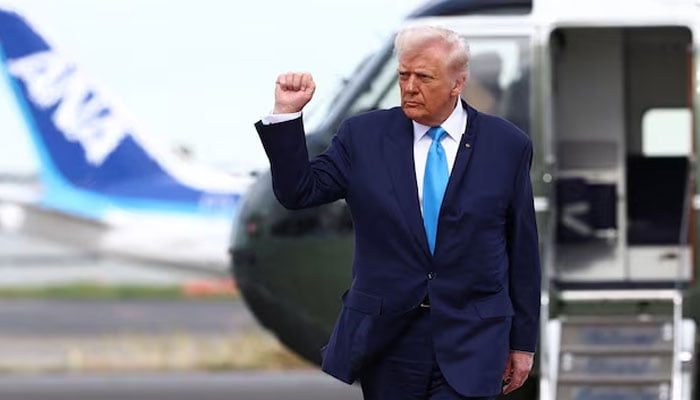
President Trump’s expected visit to China has sparked discussion among policymakers and experts. They are speculating about possible outcomes and developing scenarios by analysing current state of affairs, including economy, security, development, bilateral relations, and mutual dependencies. They are also debating a wide range of questions, such as what will be on the agenda — economy, security, or development? What can or will Trump offer to de-escalate trade, technology, and rare earth conflicts? Is United States reconsidering its desire for unipolar dominance and signaling a willingness to coexist peacefully in a multipolar world? Can the world expect a win-win outcome that could reduce conflicts and pave the way for sustainable development?
However, an analysis of current situation and ambitions suggests economic and security issues will be top priorities, with economy leading the agenda. At present, United States is facing serious challenges on both fronts. America’s economic indicators are in disarray. Inflation has started rising again, particularly after US-Israel attack on Iran. Despite President Trump’s rhetoric and threats, Federal Reserve is unwilling to lower interest rates or significantly alter monetary policy because inflationary pressures persist. The primary reason behind these economic difficulties is that America’s production base is not expanding rapidly enough to regain its former position in global manufacturing — which has declined from 30pc in 1970 to 17pc in 2020s.
The CHIPS and Science Act helped strengthen production base, but it also created new challenges. Manufacturing investment has not generated many jobs because most factories are adopting artificial intelligence and automation. The shortage of skilled human capital is another issue. Nearly 67pc of industrialists report they cannot find workers with required skills. Finally, competitiveness remains a major challenge for American companies, even in sectors such as electric vehicles, chips, and semiconductors.
Farmers are also under pressure. Since 2020, farmer bankruptcies have risen by 60pc. The main reasons are the trade war with China, higher input costs, mounting debt, and regulatory burdens. The farming community fears if tensions with China continue, remaining in business will become increasingly difficult.
In contrast, China has successfully completed its 14th development plan and achieved all its targets. Its manufacturing base continues to expand and now accounts for 30pc of global economy. Over the past decade, China has emerged as a major centre of innovation and technological advancement. It has also consolidated its diplomatic, economic, and security influence worldwide. Moreover, China has developed a strong ability to absorb economic shocks. For example, Trump’s Trade Wars 1 and 2 have largely backfired. Since the first trade war, China’s trade surplus and America’s trade deficit have both increased. China has also diversified its trade and economic partnerships. Through initiatives such as Belt and Road Initiative (BRI), China is helping less-developed countries in Africa, Asia, and Latin America strengthen their economies and trade positions. Under BRI, China has already invested nearly $1.39 trillion. Furthermore, technology war has failed to produce desired results for United States, as China continues advancing in nearly every technological field, including semiconductors. American sanctions are now beginning to hurt US itself.
Against this backdrop, can President Trump offer President Xi something meaningful to de-escalate tensions, or can he still rely on threats of sanctions? The discussion above suggests Trump has little to offer and few effective threats remaining. The question then becomes whether President Xi can offer solutions that would help United States overcome its challenges. The answer is yes. China has the capacity to offer special concessions, and President Xi has consistently favoured cooperation over confrontation. He has launched several initiatives to promote global cooperation, including BRI, GDI, GSI, GCI, and Community with a Shared Future initiative, all aimed at building a peaceful and prosperous world.
China can therefore provide multifaceted opportunities, including access to its massive market for American farmers, especially soybean and corn producers. These farmers urgently need new market opportunities because many are on the verge of losing their businesses and livelihoods. In addition, Chinese market could offer special programmes for American companies and significant financial resources for investment in US economy, helping them improve competitiveness and expand market share.
However, for such cooperation to succeed, United States would need to reconsider its hegemonic policies and “my-interest-first” mentality. This mindset was reflected in the policy outlined by Foreign Secretary Marc Rubio at Munich Security Conference. He praised Western hegemony and dominance over global affairs during past five centuries. Drawing upon history and past power, he sought to revive ambitions for future dominance. In doing so, he glorified colonialism, exploitation, bloodshed, slavery, superiority complexes, and undermining of other cultures and values. He openly emphasised America’s intention to prevent rival nations from developing.
This mentality has already created major challenges for United States and is likely to create even more serious ones in the future. For instance, President Trump reportedly wants to use Strait of Hormuz as leverage against China. However, this strategy could backfire in the same way Russia-Ukraine war backfired on Europe. Although the war was intended to weaken Russia, European economies instead suffered severe economic strain. Similarly, any prolonged disruption in Strait of Hormuz would be disastrous for US and its Middle Eastern allies. Their economies would come under intense pressure, reducing their ability to invest trillions of dollars in America as previously planned. This would further damage US economic and social development — something the country can ill afford.
For China, confrontation with United States would also affect its economy, development plans, and international initiatives such as BRI. However, the impact would likely be temporary because China has already diversified — and continues to diversify — its energy imports. In recent years, China has invested heavily in Central Asia to secure energy supplies through land routes. Russia can also provide substantial energy resources due to surpluses created by European sanctions. Moreover, over the past decade, China has made remarkable progress in renewable energy, installing 2,200GW of renewable capacity. Of this total, solar and wind energy account for 1,800GW. The rapid expansion of electric vehicles is also helping China reduce its dependence on imported fossil fuels. China plans to further expand its renewable energy sector and continue reducing reliance on imported fuels.
Two major points emerge from this discussion. President Trump must abandon hegemonic strategies. A mutually beneficial deal would serve the interests of both countries. A win-win outcome is possible because both nations need stability and a functioning global economy. However, achieving such an outcome requires United States to step back from hegemonic ambitions and its “my-interests-first” mindset, while demonstrating a genuine commitment to peaceful and cooperative coexistence.