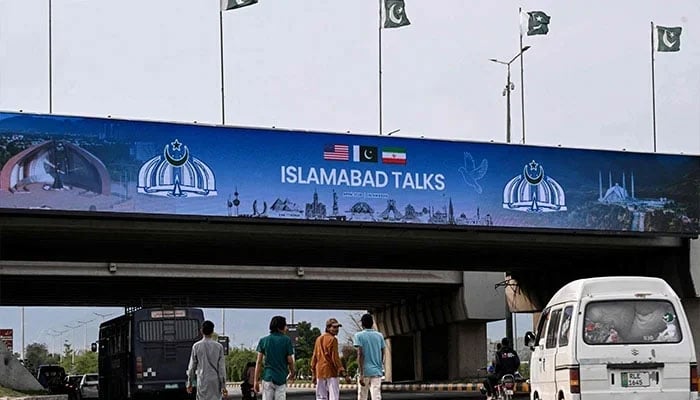
Prime Minister Shehbaz Sharif on Sunday confirmed that Pakistan has received Iran's response to United States proposal aimed at ending the war in the Middle East.
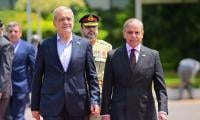
Addressing an event to mark the first anniversary of Marka-e-Haq in Islamabad, the prime minister said that he was briefed about receiving Iran's response to the US proposal to end the war.
"Right now, the Field Marshal [Asim Munir] informed me that [we have] received Iran's response. I cannot go further into details," he said.
PM Shehbaz's confirmation came shortly after Iranian media reported that Tehran has sent its response to a US proposal to begin peace talks.
According to state broadcaster IRIB, Tehran's response, passed to Pakistani mediators, focuses on ending the war "on all fronts, especially Lebanon" — where Israel has kept up its fight with Iran-backed Hezbollah — as well as on "ensuring shipping security".
US President Donald Trump had said he was expecting Iran's reply by Friday, but as the wait dragged on, the ceasefire in the Gulf came under increasing strain.
"We will never bow down to the enemy, and if there is talk of dialogue or negotiation, it does not mean surrender or retreat," Iranian President Masoud Pezeshkian said on X Sunday.
Tehran's military chief Ali Abdollahi, meanwhile, met the country's supreme leader Mojtaba Khamenei and received "new directives and guidance for the continuation of operations to confront the enemy", according to Iranian state television.
The United Arab Emirates said that its territory had also come under attack, and called out Iran by name.
"UAE air defence systems successfully engaged two UAVs launched from Iran," the defence ministry said, in a social media post.
Iran's neighbour Kuwait also reported an attempted attack.
"At dawn today, the armed forces detected a number of hostile drones in Kuwaiti airspace, which were dealt with in accordance with established procedures," the military posted.
In Seoul, defence ministry spokesman Park Il told reporters that a South Korean cargo vessel had been hit on Monday and was damaged by fire before making its way to port in Dubai.
"On May 4, two unidentified aircraft struck the outer plate of the port-side ballast tank at the stern of the HMM Namu at roughly one-minute intervals, causing flames and smoke," he said.
Iran has choked off the Strait of Hormuz — a vital route out of the Gulf for oil, gas and fertiliser, seeking to wield economic leverage over the United States and its allies.
The US Navy, meanwhile, is blockading Iran's ports, at times disabling or diverting ships heading to and from them.
Iran has set up a payment mechanism to extract tolls from shipping crossing the strait, but US officials have stressed it would be "unacceptable" for Tehran to control what had been an international waterway and the route of a fifth of the world´s oil exports.