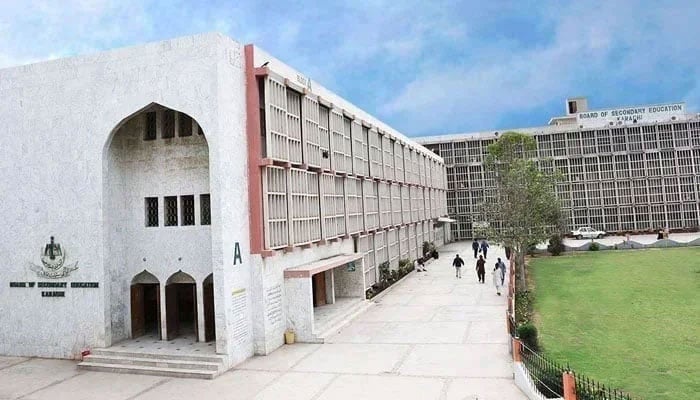
The Sindh government has introduced new recruitment rules for educational boards across the province, revising the age limits and appointment procedures for key posts after securing formal approval from the provincial cabinet.
Under the new rules, appointments to the posts of chairman, secretary, controller of examinations, audit officer and other senior positions will be made through a transparent and merit-based mechanism aimed at improving governance and restoring public confidence in the examination system.
According to the approved framework, all appointments in Grade 17 and above will be processed through a high-level Appointment and Promotion Committee, while a separate committee will deal with posts in Grade 16 and below. Final approval for appointments will rest with the controlling authority.
The rules provide that the chairman of an education board (BPS-19/20) will now be appointed through open advertisement on a three-year contract, extendable on the basis of performance. Candidates must possess at least a first-division master’s degree or 16 years of education from an HEC-recognised university along with 15 years of senior administrative experience in the public or private sector. The upper age limit for the post has been reduced from 62 to 60 years.
Similarly, the secretary of a board (BPS-19) will also be appointed through direct recruitment for a three-year term. Applicants will be required to have 16 years of education and a minimum of 12 years’ experience in administrative and financial management. The age bracket for the post has been fixed between 35 and 50 years.
The rules further state that in case of delay in the recruitment process, an additional secretary or an officer in Grade 18 or 19 may be assigned temporary charge of the office. For the post of controller of examinations(BPS-19), candidates must possess a master’s degree or 16 years of education in educational management, public administration, management sciences or information technology, along with 12 years’ experience in examination systems and administration. The age limit for the post has also been fixed at 35 to 50 years, and appointments will be made through advertisement.
The post of audit officer (BPS-18) will require an MBA in Finance, M.Com, ACCA or an equivalent qualification, besides five years’ experience in auditing or accounting. The appointment may either be made through direct recruitment or from among assistant secretaries. The maximum age limit has been set at 50 years.
Senior posts such as inspector of institutions, additional controller of examinations and additional secretary will be filled through promotion. Candidates for these positions must have either seven years’ service in the relevant grade or a total of 12 years’ service, with appointments to be made on the basis of seniority-cum-fitness.
The rules also propose promotional appointments for the posts of deputy controller of examinations and deputy secretary. For deputy controller, a minimum of five years’ service as assistant controller or secrecy officer will be mandatory.
Half of the posts of secrecy officer (BPS-17) will be filled through direct recruitment and the remaining 50 per cent through promotion. Applicants must possess 16 years of education, three years’ relevant experience and fall within the age bracket of 24 to 32 years.
The post of director of physical education (BPS-18) will now be filled through direct recruitment. Candidates must have a master’s degree or 16 years of education in physical education, at least five years’ administrative experience and be aged between 25 and 35 years.
For the post of assistant secretary (research)/research officer (BPS-17), candidates will require 16 years of education, three years’ teaching or research experience and an age between 24 and 32 years. Half of these posts will be filled through direct recruitment and the remaining through promotion.
Likewise, the posts of assistant secretary and assistant controller of examinations (BPS-17) will also be filled through a 50pc quota for direct recruitment and 50pc through promotion. Candidates must possess at least 16 years of education and be between 21 and 28 years of age.
According to the presentation given to the provincial cabinet, implementation of the new rules would improve governance in educational boards, ensure transparency in appointments and help restore public trust in the examination system.
Officials informed the cabinet that in the past, service rules of educational boards were approved only by boards of governors and were not presented before the cabinet, contrary to legal requirements. The new rules, they said, were drafted after consultation with the law department and the Services, General Administration and Coordination Department.