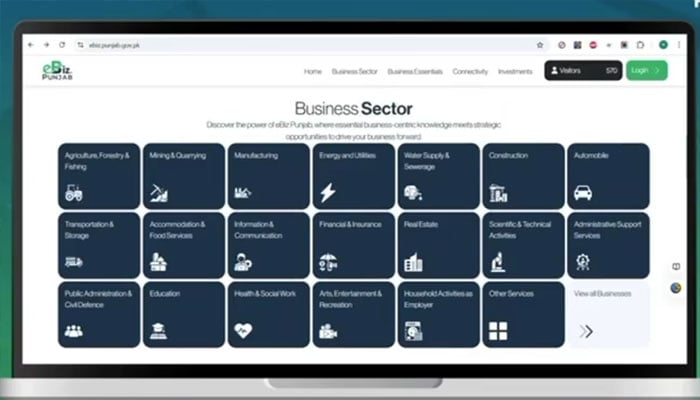
LAHORE: The Punjab government has operationalised its flagship “eBiz” portal, a comprehensive digital platform aimed at transforming the way businesses interact with the state by consolidating approvals, eliminating manual procedures and ensuring time bound service delivery.
The initiative led by the chief minister and Chief Secretary Zahid Akhter Zaman and his team represents a shift from conventional departmentdriven governance to a business centric model that places ease, efficiency and transparency at the core of regulatory processes.
At present, the platform hosts 280 business related services drawn from a wide spectrum of departments. A significant share comes from the Food Safety and Consumer Protection Department with 121 services, followed by 34 services from the Industries, Commerce and Investment Department and 26 from the Forest and Wildlife Department. Other key contributors include the Mines and Minerals Department with 16 services, Livestock and Dairy Development with 11, District Administration with 10, Agriculture with nine, and Irrigation with eight. Additional services span sectors such as tourism, transport, energy, environment, communications and works, fisheries, housing and urban development, health, excise and taxation, finance and special education.
Officials say the scale of integration reflects an unprecedented effort to unify disparate regulatory frameworks under a single digital interface, effectively breaking down long-standing institutional silos.
The rationale for introducing eBiz was rooted in persistent challenges faced by the business community. Entrepreneurs often struggled with unclear regulatory requirements, the need to obtain multiple no-objection certificates (NOCs), and the burden of visiting several offices. These fragmented processes not only caused delays but also created opportunities for discretionary practices and dependence on intermediaries. Earlier digitisation efforts, officials concede, were limited in scope and failed to provide a cohesive, business-oriented solution.