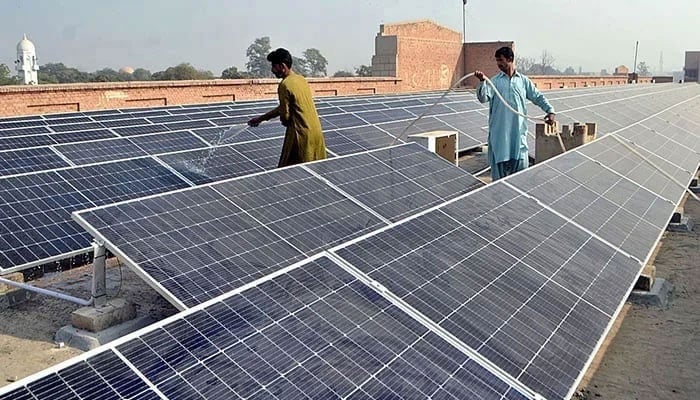
The lesson hit home for many. Hundreds of thousands of Pakistanis – middle-income households, shopkeepers and small business owners – invested in rooftop solar power on a simple promise. They would be able to offset their investment by providing surplus electricity to the national grid through net metering, a unit-for-unit exchange. It was a win-win.
Then the government floated the idea of shifting to a net-billing regime, under which households could still sell excess electricity to the grid but at a much lower rate – effectively asking them to foot the bill for an inefficient system. Outrage and loss of trust followed. People felt the deal they had signed up for was being changed after they had paid for it. The government clarified that the new regime would apply only to future installations. But the signal had been sent: commitments to existing investors were negotiable.
The conclusion was clear. Even if you follow the policy, the policy may not hold. Even if you sign contracts, those contracts may not be honoured. No business can function on this basis.
Consider the debate over independent power producers.
IPPs are increasingly described as ‘rent seekers’, as if they are extracting value from a system they do not serve. It is an odd conclusion in a country still grappling with power outages. These plants were built because the public sector could not meet demand. They produce electricity. They have reduced loadshedding. They are the reason the lights stay on. First the rhetoric turned against them; then their contracts were ‘voluntarily’ amended or terminated. Those who responded to policy signals and set up power plants were recast as the problem.
The message was clear: policy in Pakistan is not a commitment, but a position – subject to revision when circumstances or politics change.
Prime Minister Shehbaz Sharif has spoken of a Charter of Economy, a long-term framework to ensure economic stability by giving investors policy consistency and predictability. It is an admirable aspiration. But the problem is more immediate.
Take Pakistan’s two LNG import terminals. Established through international tenders in line with global practice, they represent an infrastructure investment of about $1 billion. They enabled Pakistan to import natural gas at scale for the first time. The government procures the gas; these privately-owned terminals make its delivery possible. Most Pakistanis experience this invisibly – as gas pressure in the kitchen, as a factory running, as a power plant staying online.
The Economic Coordination Committee, led by Ishaq Dar and the federal cabinet of then-Prime Minister Nawaz Sharif, approved the LNG terminal contracts. Those same contracts fuel the government-owned power plants set up by then-CM Shehbaz Sharif in Punjab. The same political leadership that took those decisions remains in office today.
Yet the petroleum minister has called these contracts “flawed” and potentially “mala fide”, and has questioned whether LNG itself is even required. This begins to look like policy being disowned by its own authors. Meanwhile, the power minister has stated that the current spell of loadshedding has only ended because LNG finally reached our shores after a month-long suspension.
There is a risk that rarely features in policy discussions: inconsistency. A framework that signals openness but behaves defensively deters new entrants and unsettles existing ones. Investors do not object to rules. They object to rules that change after the fact. Markets can absorb bad policy and adapt to rigid policy. What they cannot price is policy that shifts midstream – promising one thing and delivering another, inviting capital in and then moving the goalposts once it arrives.
Consistency is not an abstract virtue. It is an economic one. It lowers risk, attracts capital and allows infrastructure to perform its function without friction. In capital-intensive sectors like energy, it is the difference between a system that merely exists and one that actually works.
Pakistan does not suffer from a lack of ideas in energy. It suffers from a lack of continuity. The impulse to revisit, renegotiate and reframe is constant and costly. Policy inconsistency erodes credibility, the one asset that cannot be quickly rebuilt once spent.
The lesson from solar, IPPs and LNG is the same. If the state asks citizens and investors to commit capital on the strength of its word, it must be prepared to stand by that word. Otherwise, the next time it asks, fewer will listen – and those who do will demand a higher price. That price travels down the chain into electricity tariffs, industrial costs and ultimately the monthly bills of the same middle-income households, shopkeepers and small business owners who once believed the promise was real.
The writer is the chief executive of Pakistan GasPort Consortium Limited, which owns and operates one of the country’s two LNG import terminals.