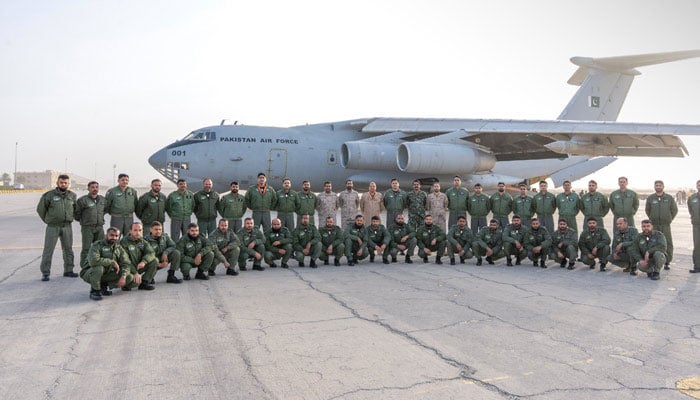
There are moments in history when nations do not merely respond; they rise, sharpened by adversity, defined by resolve. For the Pakistan Air Force, the past few years have not been a gradual ascent but a powerful surge.
No longer confined by the arithmetic of numbers, the Shaheens have carved their presence into the skies of South Asia with a signature that speaks of discipline, foresight, and quiet strength. At the centre of this resurgence stands Marka-e-Haq, a moment when theory met trial, and preparation met purpose. It was here that the PAF did not simply defend airspace; it redefined the very grammar of modern aerial warfare.
The night it unfolded was thick with tension. A larger adversary advanced with confidence, seeking to tip the balance through sheer force of arms. But what it encountered was not haste, nor hesitation but clarity. The Shaheens rose, not in chaos, but in orchestration. Every movement deliberate, every decision anchored in years of unseen preparation. This was no coincidence. It was the manifestation of a vision. Under the bold leadership of Air Chief Marshal Zaheer Ahmed Baber Sidhu, the PAF shed its rigidity as a platform-driven force and evolved into a living, breathing ecosystem of integrated power. Fighters were part of an invisible web, linked with surveillance eyes, electronic shields, cyber guardians and space-enabled sentinels. Together, they formed a seamless organism of warfighting precision.
Marka-e-Haq became the proving ground for this transformation. It was where doctrine stopped being words on paper and became instinct. Where innovation, once nurtured in labs and simulators, roared into life under combat skies. It was here that the philosophy of ‘quality over quantity’ was weaponised. For decades, the Shaheens had lived in the shadow of disparity. A larger foe, deeper pockets, broader inventories. But instead of yielding, the PAF absorbed that reality and forged it into doctrine: if you cannot match numbers, outmatch the mind. And so, they invested where it mattered – in precision, in connectivity, in foresight. Indigenous systems, secure data links, unmanned capabilities and long-range strike options became the arteries of a force reborn. Pilots did not fight alone; they fought as part of a unified consciousness. Sensors whispered, systems responded, commanders decided – all within a heartbeat.
The engagements themselves were swift, sharp and unforgiving. Beyond Visual Range duels, multi-axis manoeuvres, electronic deception, it was a symphony of modern warfare. And in that symphony, the illusion of technological supremacy was shattered. Systems once hailed as invincible faltered under the weight of cohesion and clarity. It became evident that dominance is not granted by machines alone, but by the minds that wield them.
Yet, the true measure of power was revealed not in the clash, but in the calm that followed. With the advantage secured, the Shaheens held the line and chose restraint. In a region where a single misstep can ignite uncontrollable escalation, this decision spoke louder than any missile ever could. It was a message: Pakistan seeks peace, but not at the cost of dignity.
Behind the headlines and the heroics lay the silent backbone of victory. The engineers who toiled through sleepless nights, the controllers who guided with unshaken focus, the planners who envisioned the unseen – all stood as equal architects of success.
The medals that followed were not mere decorations; they were echoes of sacrifice, discipline and relentless pursuit of excellence. Beyond the confines of bases and command rooms, a nation watched and believed. The Shaheen once again became more than a symbol of airpower; it became a reflection of national spirit.
Marka-e-Haq teaches that true strength lies not in aggression, but in control. That superiority must be governed, not flaunted. And above all, that vision at the top can transform an institution from within.
In the contested expanse of South Asia, where uncertainty often clouds the horizon, one truth now flies clear: the Shaheens do not merely defend the skies, they command them.
The writer is a freelance contributor.