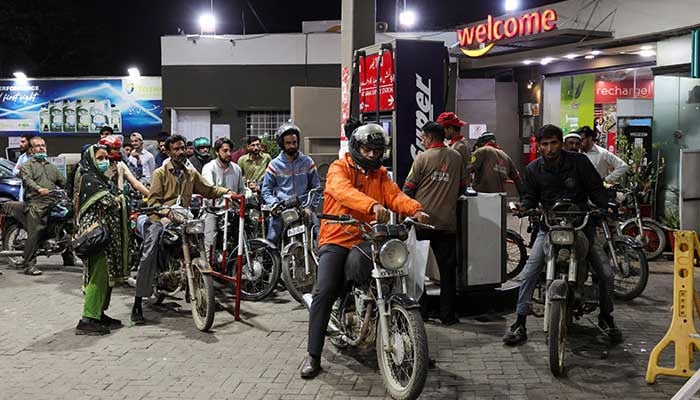
With petrol and high-speed diesel both close to Rs400 a litre, Pakistan, like many other fuel-importing developing countries, has entered a difficult phase of economic management.
The State Bank of Pakistan’s increase in the policy rate to 11.5 per cent has added another layer of pressure, felt equally by citizens and the government of Pakistan. While citizens are bearing the brunt of inflation, the government is risking its political capital by making unpopular decisions. Pakistan is not alone in making such decisions.
The IMF’s April 2026 MENAP (Middle East, North Africa, Afghanistan and Pakistan) Regional Economic Outlook is quite disturbing. It says the war in the Middle East is affecting MENAP by disrupting energy production, exports, imports, logistics, air traffic and financial markets. It also warns that prolonged hostilities would keep energy prices elevated, deepen trade disruptions, compress confidence and further erode limited fiscal space for many countries.
Pakistan’s exposure to the Gulf is multidimensional. Besides expensive energy shipments, a slowdown in Gulf construction, tighter regional financial conditions or delayed hiring due to the ongoing war can hit Pakistan through workers’ income as well as capital flows.
The IMF’s oil-price sensitivity measure is a stress test for the economy. For the average MENAP emerging-market oil importer, a 10 per cent increase in the average annual oil price lowers GDP output by about half a percentage point and raises inflation by about one percentage point. For Pakistan, the same shock worsens the current-account balance by about 0.3 percentage points of GDP and the fiscal balance by about 0.1 percentage points.
Pakistan’s nominal GDP for fiscal year (FY)2024-25 was around Rs114.7 trillion. On that base, if crude were to average around $100 per barrel, roughly 40 per cent above the prewar baseline, the ‘full-year’ stress would be equivalent to about Rs1.38 trillion on the current account and Rs459 billion on the fiscal side. These figures describe a twelve-month stress scenario. Pakistan’s fiscal year begins on July 1, and the war began late in the year. Part of the cost will appear in the closing months of FY2025-26, while a larger share could fall in FY2026-27 if oil prices, freight charges and insurance premiums stay elevated.
April inflation already showed the pressure. The headline consumer price index rose to 10.9 per cent year-on-year (compared to April 2025), from 7.3 per cent in March. That number should not be treated as the war’s full incremental cost. It reflects several forces: war-related energy prices, earlier tariff decisions, food prices, domestic transport costs, exchange-rate expectations and base effects. Still, the conflict has pushed an already fragile inflation outlook back into more dangerous territory.
The external shock is large by historical standards. The closure of the Strait of Hormuz and the Iran war have caused the largest oil-supply disruption on record, measured by daily output lost. Peak losses have exceeded 12 million barrels per day, equal to about 11.5 per cent of global oil demand. Earlier oil shocks were usually centred on crude. The current disruption has affected crude, natural gas, refined fuels and fertiliser.
Asia carries much of this exposure. Eighty per cent of the energy passing through the Hormuz is destined for Asia. Higher freight, insurance and logistics costs are on top of the crude price.
The global commodity outlook has also turned more difficult. The World Bank expects overall commodity prices to increase by 16 per cent. Fertiliser prices are projected to rise 31 per cent, driven by a 60 per cent jump in urea prices. Fortunately, we have sufficient urea stocks for the next crop (rice and cotton), but if the gas supply remains restricted, then managing nitrogenous fertiliser for the next wheat crop will be a challenge. If fertiliser affordability weakens, the inflation problem will move from fuel to food. That shift would be harder to reverse and politically more damaging.
The State Bank’s rate increase was therefore understandable. Its Monetary Policy Committee raised the policy rate by 100 basis points, citing the prolonged Middle East conflict, higher global energy prices, freight charges, insurance premiums and supply-chain disruption. The energy basket may have a modest statistical weight in CPI, but it has a large economic reach through transport, food distribution, power costs and expectations.
The IMF’s MENAP outlook advises countries with limited buffers to avoid generalised subsidies and price controls and instead rely on narrowly targeted, temporary measures. In our case, we don’t have the fiscal cushion to begin with. But even if the government decides to give a broad fuel subsidy, it would create pressure elsewhere. Such a subsidy will weaken the fiscal position and the value of the rupee.
We should keep in mind that blanket subsidies of the past have accumulated as higher arrears, forcing tougher adjustment now. It is appreciated that the federal and provincial governments seem to be drifting away from the ‘dole out now, charge later’ policy – at least in the energy sector – and are responding with targeted protection.
Energy security now belongs at the centre of economic policy. Solar expansion can reduce dependence on imported fuel. Grid investment, connectivity, battery storage, and lower distribution losses can cut waste and improve reliability. Public transport can lower diesel demand in cities. Better LNG contracting can reduce exposure to price spikes. Together, these steps lower the dollar cost of growth and reduce the risk that any other disruption turns into a fiscal crisis.
The government is finalising the federal budget for the next fiscal year, while an IMF mission is expected shortly for pre-budget consultations. Relief will still be needed, but the amount of the relief and the source of such relief, whether through reducing non-developmental expenditures or increasing revenue, must be honestly reflected in the budget.
Besides the importance of solar energy, another lesson Pakistan must learn from the Middle East crisis is that fuel costs should not be pushed into circular debt, unpaid bills or pressure on the rupee. The Gulf crisis has arrived at a time when Pakistan is already paying heavily for debt, imports and past delays. The next budget should not add another hidden bill to that burden.
The writer heads SDPI, chairs the board of the National Disaster Risk Management Fund, and serves on the ADBI’s Advisory Board. He posts on LinkedIn @Abidsuleri