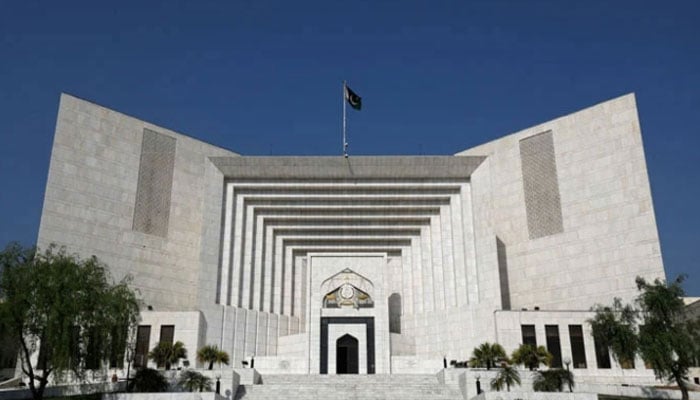
ISLAMABAD: The Supreme Court (SC) on Monday accepted the appeal of convict Muhammad Asif alias Kattu, an important member of the Muttahida Qaumi Movement (MQM), who had been sentenced to death in a case registered under the Anti-Terrorism Act (Section 7) related to the 2015 killing of four police officials and a robbery in Karachi’s Korangi area.
A three-member bench headed by Justice Hashim Khan Kakar, and comprising Justice Salahuddin Panhwar and Justice Ishtiaq Ibrahim while hearing the appeal of the convict converted his death sentence into life imprisonment.
The court remarked that the death sentence could not be upheld on the basis of the existing weak evidence; therefore, it was commuted to life imprisonment.
During the course of hearing, Additional Prosecutor General Sindh argued that the convict, along with his accomplices, had killed four police officials — ASI Aqeel Ahmed and constables Muhammad Anwar, Jameel Ahmed, and Muhammad Akhtar — in broad daylight at a “Nehari House” in Korangi, and had looted their weapons and official vehicle.
He further submitted that the laboratory report was also positive. However, the defence counsel argued that the accused’s appearance and name did not match the case record, and that he was picked up from jail and falsely shown as arrested in this case, while he had already been acquitted in other cases. The court subsequently disposed of the case after converting the death sentence of the convict into life imprisonment.
Meanwhile, the same bench hearing another appeal ordered the release of Muhammad Safdar, a convict who had murdered his own father, on the basis of reconciliation (compromise).
A three-member bench headed by Justice Hashim Khan Kakar, and comprising Justice Salahuddin Panhwar and Justice Ishtiaq Ibrahim, heard the jail petition of the convict.
The defence counsel argued that the case dates back to 2013, whereas the amendment act came into force in 2017; therefore, the new law does not apply to this case. However, under the new law, the court may still maintain the sentence despite a compromise.
He further submitted that there are multiple Supreme Court judgments on this issue and that reconciliation is also encouraged in the Holy Quran. Justice Hashim Khan Kakar remarked that although the court would have preferred to punish a person who killed his father, it is necessary to act in accordance with the law; therefore, the compromise deed is being accepted.
It is pertinent to mention here that Muhammad Safdar, a resident of Jalalpur, had killed his father in 2013 over a land dispute. The trial court had sentenced him to death, which was later commuted to life imprisonment by the Lahore High Court.
Meanwhile, the Supreme Court (SC) on Monday dismissed the jail appeals filed by Ghulam Rasool alias Chhotu, the notorious dacoit, murderer, robber, and kidnapper and head of the “Chhotu Gang” operating in the riverine (Katcha) area of district Rajanpur on the Punjab–Sindh border, along with his accomplices Ishaq and Khalid, against their six counts of death sentences awarded by the Lahore High Court.
The court upheld their death sentences, while maintaining life imprisonment sentences for other convicts. A three-member bench headed by Justice Hashim Khan Kakar, and comprising Justice Salahuddin Panhwar and Justice Ishtiaq Ibrahim, heard the case.
During the hearing, Justice Salahuddin Panhwar remarked that the gang had effectively become the “ruler” of its area, and due to their fear, police had even shut down their stations.
The Additional Prosecutor General Punjab, Rai Akhtar, informed the court that during an operation against the Chhotu Gang, when police ran out of ammunition, the accused abducted 24 police personnel.
He submitted that the Pakistan Army had to be called in to secure their release. Counsel for the accused argued that the police personnel had returned on their own by boat, to which Justice Salahuddin responded, “Were the abducted policemen out on a recreational trip?” The lawyer further claimed that not even a scratch was inflicted on any of the police personnel, prompting Justice Salahuddin to remark sarcastically, “That must be due to the kindness of your clients.”
The defence counsel also argued that both the real names and aliases of the accused were mentioned in the FIR, questioning how the police knew their aliases. The Additional Prosecutor General clarified that the accused had prior criminal records with the police, which is why their aliases were included in the FIR.
It is pertinent to mention here that in 2016, an FIR was registered at a police station in Rajanpur against the Chhotu Gang under terrorism charges, including the killings of 6 police personnel, injury to 7 others, kidnapping of 24 police officials for 8 hours, and recovery of explosives.
After the charges were proved, the trial court sentenced 20 out of 22 accused to death, while 2 minors were given life imprisonment.
Later, during appeals, the High Court acquitted 8 accused due to flaws in the identification parade. It upheld six death sentences each for Ghulam Rasool alias Chhotu, Ishaq, and Khalid, while commuting death sentences of other convicts to life imprisonment.
In the latest ruling, the Supreme Court has upheld the six death sentences each awarded to Ghulam Rasool alias Chhotu, Ishaq, and Khalid, and maintained life imprisonment for the remaining convicts.