The Lahore High Court Bar Association (LHCBA) on Thursday challenged the transfer of three Islamabad High Court (IHC) judges in the Supreme Court through a petition filed by senior counsel Hamid Khan.
The petition, filed under Article 183(3) of the Constitution, contends that the transfer of judges is contrary to Article 2A and lacks transparency.
It further argues that no reasons were provided for the transfers, raising serious concerns over the legality and fairness of the process.
The plea names the Centre and the Judicial Commission of Pakistan (JCP) as respondents, maintaining that transferring three IHC judges to different high courts is unconstitutional. It asserts that the process adopted for the transfers does not meet constitutional standards and undermines established judicial norms.
The petition also challenges provisions introduced through the 27th Constitutional Amendment, arguing that abolishing Article 184(3) and amending Article 175(2) are unconstitutional. It further states that the authority of the Supreme Court cannot be transferred to a federal constitutional court, insisting that such a shift would be inconsistent with the constitutional framework.
According to the application, the transfers were carried out after amendments to Article 200 under the 27th Constitutional Amendment. It adds that the federal constitutional court, established under the same amendment, cannot hear the case, as its jurisdiction remains disputed.
The development follows a decision by the Judicial Commission of Pakistan, which was approved by majority vote, the transfer of three IHC judges to other high courts in a meeting chaired by Chief Justice of Pakistan Yahya Afridi.
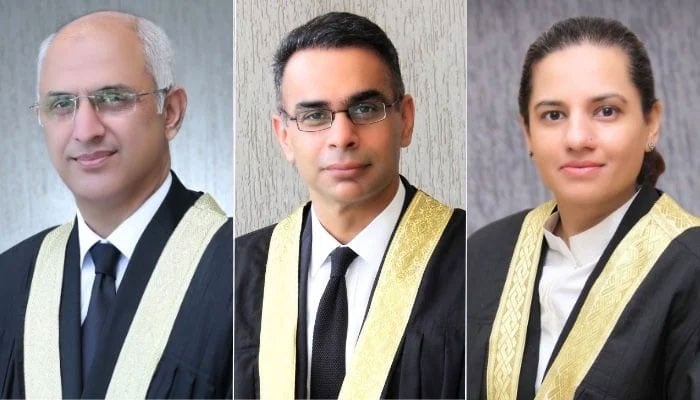
Under the decision, Justice Mohsin Akhtar Kayani was transferred to the Lahore High Court, Justice Babar Sattar to the Peshawar High Court, and Justice Saman Rafat Imtiaz to the Sindh High Court. The proposal for the transfers had been initiated by IHC Chief Justice Sardar Sarfraz Dogar, who had sought a meeting of the commission to deliberate on the matter.
The issue had earlier triggered debate within judicial circles. In a written response to the IHC chief justice, Chief Justice Afridi had observed that convening a commission meeting for a specific purpose was not feasible, citing constitutional and institutional concerns. He had warned that transferring judges without clear justification could be “tantamount to punishment” and risk undermining judicial independence and autonomy.
The chief justice had also emphasised that the Constitution provides a clear mechanism under Article 209 for action against judges, and that administrative transfers without sufficient grounds could be inconsistent with constitutional provisions.
The JCP, in its statement, also noted that proposals to transfer Justice Arbab M. Tahir from IHC to the Balochistan High Court and Justice Khadim Hussain Soomro to the Sindh High Court were withdrawn by members who had requisitioned the meetings.
Following the commission’s decision, the Ministry of Law and Justice issued a notification confirming that the president had approved the transfers on the recommendation of the JCP under Article 200 of the Constitution. The notification formally implemented the transfers of the three judges to their respective high courts.