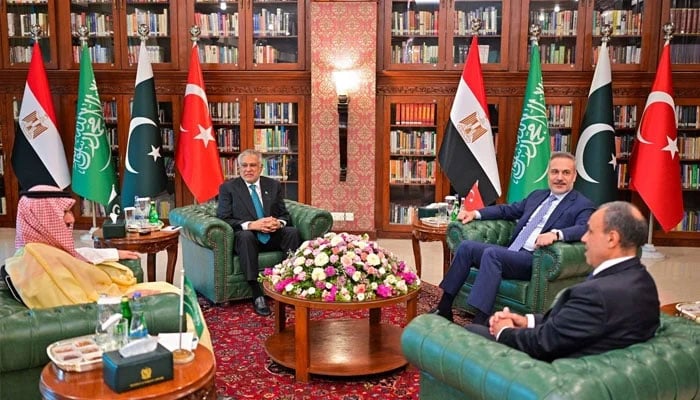
Turkiye’s convening power is real. The Antalya Diplomacy Forum felt like Davos of Asia, except the gravitational centre wasn’t old Europe. It was Turkiye, Pakistan, Saudi Arabia and Egypt. In a world sliding toward disorder, the room kept returning to these four capitals because they are increasingly the ones forced to solve problems.
These ‘Middle Earth’ states were once bystanders to decisions made elsewhere. That era is ending. Like Tolkien’s Middle Earth kingdoms – pulled into alliance not by romance but by necessity – they are beginning to pool capabilities: quietly, pragmatically and with a sharper sense that standing alone will increase disorder and chaos.
Zoom out and the macro picture becomes clearer. The world is not splitting into neat blocs. It is reorganising into layers: small, agile states that can move fast; great powers that can coerce at scale; and a thick middle that carries population weight and regional burdens but lacks the luxury of domination on its own.
Turkiye, Pakistan, Saudi Arabia and Egypt sit in the middle. They are pivotal because they are large enough to matter, close enough to the fault lines to be exposed and capable enough to shape outcomes – if they choose to act together.
Pakistan’s role in this quartet is often misunderstood. It is not only a security state but also a connector state. It maintains working lines across rival capitals, from Washington and Beijing to Riyadh and Tehran, because its geography and economics don’t allow for the comfort of a single camp. Pakistan sits as connective tissue between the Gulf, Central Asia and South Asia.
Pakistan also brings hard assets. It is nuclear power. It has mineral potential of $4 trillion and roughly 52 million acres under agriculture. As a top-ten agricultural producer, Pakistan can be a serious food partner for the Middle East. Add the dimension of the Pakistan–Saudi relationship – labour exports, defence ties, religious diplomacy and crisis support – and you get a durable alignment and accumulated financial, diplomatic and military capacity.
Turkiye brings a high-end manufacturing ecosystem and access to the world’s largest single market. EU–Turkiye goods trade hit a record 210+ billion euros in 2024. Egypt holds a global artery: UNCTAD estimates the Suez Canal carried roughly 12 per cent of world trade in 2023, and Egypt is anchored into Africa’s integration through the Africa Continental Free Trade. Saudi Arabia brings energy, capital and the ability to underwrite scale.
Together, these four countries have half a billion people and roughly $3.4 trillion in output with outsized influence through energy, capital and geography.
What makes them distinctive isn’t just scale. It’s responsibility. Unlike small states, ‘Middle Earth’ states must provide for huge populations, manage internal pressures and live with neighbours they can’t escape. Yet they also carry real military capability and regional reach. That mix of burden plus influence makes them consequential.
Seen through this lens, Antalya looks like early architecture. Most alignments are built against a threat; when the threat fades, the coalition fades. Capability-based alignments are rare and different. If these four coordinate on investment, production, standards and technology – backed by serious defence capacity – this becomes a scalable platform that can shape the next world order.
The real test is whether Antalya moves beyond foreign ministers’ communiques. A real bloc is built by finance ministers, central bank governors, sovereign funds, regulators and industrial zones. This shows up as joint investment vehicles that co-finance industrial capacity; interoperable customs and digital rules that cut friction; and shared sandboxes in regulated sectors – defence, energy, fintech, AI – where trust and security are designed upfront, not negotiated after a crisis. It is not just a military alliance, but an integrated platform for investment, production and influence.
Saudi Arabia’s Vision 2030 is a relevant case study here. It’s a sovereignty project: diversify, localise capability and reduce dependency. Riyadh’s target of 50 per cent localisation of military spending by 2030 requires partners who can build, not just sell. Turkiye can co-produce in defence and move goods at scale; Pakistan can add manpower and training depth. Saudi capital can accelerate this triangle by funding joint ventures that transfer know-how.
History has a warning. The Suez crisis showed that chokepoints pull great powers into the region and smaller states get squeezed when they stand alone. The answer is coalitions with economic connectivity and credible institutions.
If ‘Middle Earth’ fails to organise, the vacuum is filled with chaos: bigger powers will override smaller ones, disputes settled by coercion and rules rewritten through faits accomplis. AI, drones, cyber disruption and narrative warfare lower the cost of intervention – so the strong can act more often and the weak can disintegrate faster.
Read Antalya as an opening move. If these four governments turn diplomacy into coordinated state action, they won’t need to ask where they fit into the new order. The Middle Earth states will be among the ones shaping it.
Malik Ahmad Jalal is based in Karachi and Ussal Sahbaz in Istanbul. They are Harvard graduates and work in technology policy and venture investing.