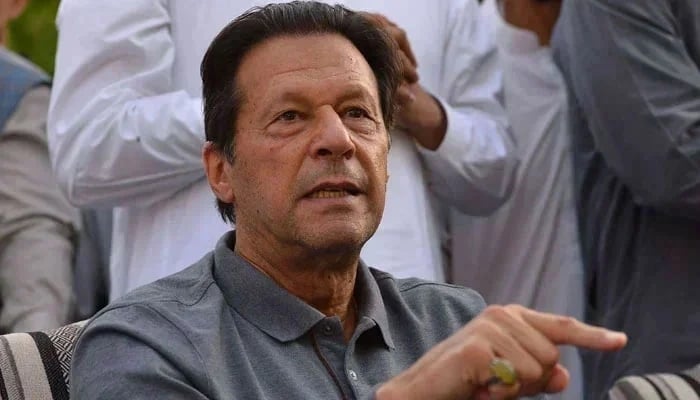
Pakistan’s largest opposition party appears increasingly consumed not by its contest with the government, but by a contest within itself. The latest episode – triggered by public criticism from a family member of Imran Khan and a sharp rebuttal from a PTI office-holder, followed by a hurried clarification from the Tehreek-e-Tahafuz Ayin-e-Pakistan (TTAP) – is more a symptom of a deeper issue: a party struggling to define authority, coherence and direction in the absence of its central figure. At one level, the disagreement is understandable. Imran Khan’s family, particularly his sisters, have consistently raised concerns about his health and the opacity surrounding his legal proceedings. Their urgency stems from personal anguish. But politics, especially at a moment of heightened regional sensitivity, cannot be driven by this alone. The decision to postpone the April 9 protest – symbolically tied to the 2022 Pakistani vote of no-confidence – was, by most accounts, a pragmatic one. With high-stakes diplomatic engagements underway, an escalation on the streets could have complicated an already delicate situation.
Yet the fact that such a decision triggered public dissent within the PTI does point to a troubling disconnect for some. A political party cannot afford competing centres of authority – family members, official leadership, legal representatives and an often unrestrained social media base – each pulling in different directions. What should have been an internal discussion has repeatedly spilt into the public domain, eroding the party’s credibility. More worrying is the environment the PTI’s own leaders now find themselves in. They face a paradox: moderation invites accusations of betrayal from within, while confrontation invites pressure from without. This double bind has paralysed decision-making and fostered a culture of reaction rather than strategy. The result is a party that oscillates between aggression and retreat, without a clear political roadmap. Recent incidents reflect this drift. Public disagreements among senior leaders and even rebukes from Imran himself – such as branding party members ‘Mir Jaffar’ and ‘Mir Sadiq’ – have deepened internal fissures. Loyalty tests conducted in full public view usually end up weakening parties by breeding resentment and insecurity. In fact, for a party that once prided itself on discipline and messaging, the current disarray is striking.
The political consequences are already visible. Following the February 2024 elections, the PTI retained significant popular support and had an opportunity to mount sustained pressure on the government, particularly amid allegations of electoral irregularities. But that momentum has been squandered. A series of missteps, coupled with infighting, has now diluted its ability to act as an effective opposition. And yet, amid this internal churn, one issue must not be lost: the rights of the incarcerated. It has been months since Imran Khan and his wife have reportedly had meaningful access to family, legal counsel and party colleagues. Concerns about their health, particularly eye-related ailments, only heighten the urgency. Regardless of political affiliations, the denial of such access does raise serious questions about due process and humane treatment. The PTI’s internal discord may be self-inflicted, but the state’s responsibilities remain unchanged. A weakened opposition does not absolve the government of its obligations under law and democratic norms. If anything, it places a greater onus on the state to act with restraint and fairness. For the PTI, however, the immediate challenge lies within. A party that cannot resolve its internal contradictions cannot hope to shape the national conversation.