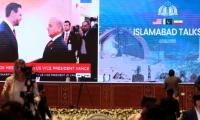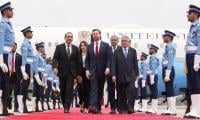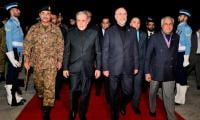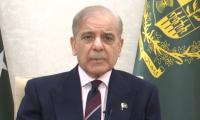
Sixty years ago, Pakistan went to Tashkent as a combatant. Today, it is trying to act as a convener in Islamabad. That is the most revealing way to think about the peace talks between the US and Iran, and about how Pakistan’s diplomatic role has evolved since the Tashkent Declaration of January 10th 1966.
Then, Pakistan was one of two exhausted rivals summoned to accept the terms of post-war disengagement after the 1965 conflict with India. Now, at least for a moment, it is presenting itself as a state able to host adversaries from beyond South Asia and to help create space for a wider de-escalation. The distance between those two roles is not absolute or neat, but it is real. The current talks (starting at the time this article goes to press) are delicate enough to discourage easy celebration. Pakistan helped secure a temporary ceasefire and bring Washington and Tehran into direct negotiations in Islamabad.
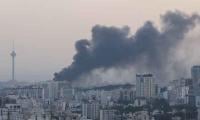
Yet it is clear that the ceasefire is already under severe strain, with Israeli strikes on Lebanon prompting conflicting interpretations about whether Lebanon falls within its scope. Pakistan is therefore not hosting a settled peace conference but an argument inside a pause, and a highly unstable one at that. That matters because South Asia is more vulnerable to Middle Eastern disorder than it sometimes likes to admit. The region imports oil, exports labour, depends on remittances and lives uneasily with the possibility that any disruption in the Gulf can feed inflation, currency pressure and fiscal pain at home.
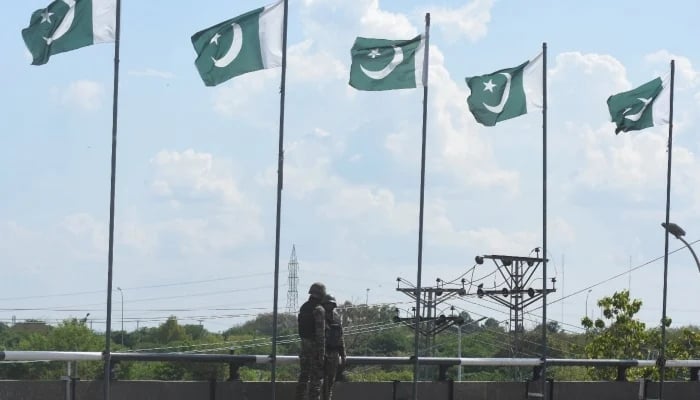
For Pakistan, the risks are sharper still. It shares a border with Iran, sits close to vital sea lanes and has little economic cushion for a prolonged spike in energy costs or regional instability. Its interest in calming tensions between America and Iran is therefore not lofty idealism. It is national self-interest in a diplomatic suit. The Tashkent comparison helps show how much and how little has changed. The Tashkent Declaration followed the 1965 war between India and Pakistan. Hosted by the Soviet Union, it brought together Lal Bahadur Shastri and Ayub Khan to formalise a post-ceasefire understanding after the UN-backed halt in fighting.
Pakistan did not come to Tashkent as a mediator or facilitator. It came as one half of the dispute, constrained by military realities, diplomatic pressure, and the basic fact that it needed an exit from a costly war. Tashkent was important, but it was not a moment of Pakistani diplomatic authorship but of Pakistani diplomatic dependence. Shimla in 1972 sharpened that pattern. Signed on July 2, 1972 after the 1971 war and the break-up of Pakistan, the Simla Agreement between Zulfikar Ali Bhutto and Indira Gandhi again placed Pakistan at the table as a defeated or weakened party trying to salvage political space after military disaster.
Unlike Tashkent, Shimla was bilateral rather than superpower-hosted, and its enduring significance lay in committing both sides to resolve differences by peaceful means and through bilateral channels. Yet for Pakistan, it was still a reactive diplomacy, not a shaping one. Tashkent showed Pakistan seeking a way out of war under Soviet auspices. Shimla showed it trying to rebuild room for manoeuvre after an even greater national trauma. In both cases, Pakistan was negotiating because events had cornered it. The Geneva track on Afghanistan offers a third stage in this evolution.
The negotiations that culminated in the Geneva Accords of April 14, 1988 were designed to settle the situation relating to Afghanistan and to provide the framework for Soviet withdrawal. Pakistan was not merely a victim or a defeated party there. It was a frontline state, a principal stakeholder and a formal participant in the diplomacy, with Afghanistan as the signatory on the other side and the US and Soviet Union acting as guarantors. Even if the process was driven by cold-war realities, Pakistan had moved beyond the posture of Tashkent and Shimla. It was no longer simply receiving terms after a war with India.
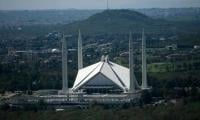
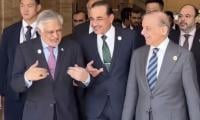
It was helping structure the diplomatic endgame of a regional conflict that had transformed the Subcontinent. Saturday’s Islamabad talks suggest a still more ambitious posture. Pakistan is trying to host talks between a superpower and a regional power whose conflict threatens shipping, energy flows and the wider Middle East. Venue is never just geography. To host is to signal access, usefulness – and at least a minimum of confidence from both sides. That places Pakistan in a role very different from the one it occupied in Tashkent or Shimla.
It is no longer merely arriving at a table arranged by others. For now, it is the address at which the table has been set. Yet this is not an entirely new role. Pakistan acted as an intermediary in the opening between America and China around 1970 and 1971. The famous landmark remains Henry Kissinger’s secret trip from Pakistan to Beijing in July 1971, but the channel was active earlier. Official American records show Pakistani interlocutors discussing Pakistan’s usefulness as a backchannel with Kissinger in late 1969, while Nixon’s October 1970 meeting with Yahya Khan reinforced the idea that Pakistan could help open direct contact with Beijing.
Pakistan’s mediation was therefore not a sudden flourish in 1971. It was a sustained diplomatic function taking shape by 1970. That episode resembles today’s in an important way. Pakistan’s value lay not in raw power, but in access and discretion. It could speak to Washington. It could speak to Beijing. It was trusted enough to carry messages and useful enough to provide political cover. In that sense, Pakistan’s greatest diplomatic utility has often come when it has positioned itself as a hinge between larger actors. That was true in the US-China opening, and it is true again, in more fragile and dangerous circumstances, in the US-Iran talks.
But the differences are just as important. The China opening took place within the structured geometry of the cold war. The Geneva process, too, belonged to a recognisable strategic order, with two superpowers managing an imperial retreat. Today’s Middle East is far messier. The ceasefire is partial. Lebanon remains under attack. Hormuz remains sensitive. Iran’s terms and Washington’s demands are still far apart. Pakistan is not lubricating a grand strategic thaw. It is trying to prevent a wider fire from breaking through the containment line. There is another continuity, though not a flattering one.
Pakistan’s moments of greatest external usefulness have often coincided with periods when its domestic politics were weak, distorted, or heavily shaped by the military. Tashkent came under Ayub Khan. The China channel ran through Yahya Khan. The Afghan endgame unfolded under Ziaul Haq. The current diplomacy is again unfolding in a Pakistan where the military remains central to strategic decision-making. The country’s external relevance has repeatedly exceeded the quality of its internal order. That does not negate diplomatic skill. But it does suggest a persistent imbalance. Pakistan is often useful abroad before it is stable at home.
Even so, the long comparison is revealing. Tashkent represented a Pakistan that needed mediation. Shimla represented a Pakistan trying to recover from defeat through bilateral statecraft. Geneva showed a Pakistan participating in the diplomatic management of a regional war tied to superpower rivalry. The US-China opening showed a Pakistan able to serve as a discreet channel between giants. Islamabad in 2026 contains elements of all four stories. Pakistan is exposed to the conflict’s consequences, as in earlier crises, but it is also trying to function as a bridge between larger powers. That is not quite power. But compared with Tashkent in 1966, it is a different kind of presence altogether.
The writer is dean of the faculty of liberal arts at a private university in Karachi. He tweets/posts @NaazirMahmood and can be reached at: [email protected]