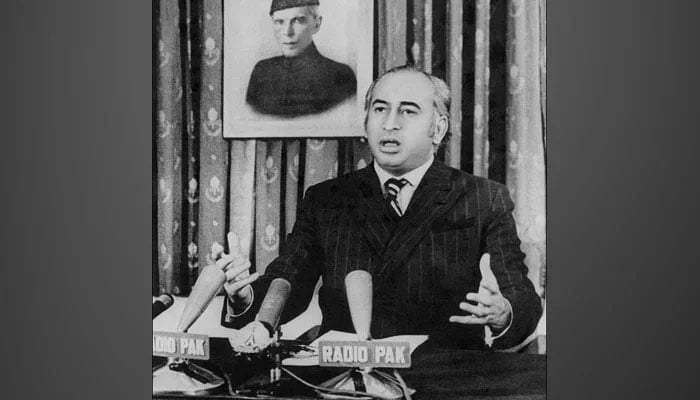
In the early hours between the 4th and 5th of April 1979, Pakistan did not just lose a former prime minister. It lost something far more enduring: the sanctity of justice itself.
Shaheed Zulfikar Ali Bhutto was led to the gallows in the darkness of night, away from the gaze of a nation that loved him and the family that was denied a final farewell. There was no public reckoning, no closure, no dignity. Only silence. A silence that has echoed for decades.
History has since named that moment for what it was: judicial murder. The trial that led to Shaheed Zulfikar Ali Bhutto’s execution remains one of the most contested in Pakistan’s legal history. A split verdict, questions of due process and the overwhelming shadow of a military regime combined to produce a decision that many have long regarded as a grave miscarriage of justice. It was a moment that altered the moral trajectory of the state.
For decades, that wound remained unaddressed at the institutional level. It was only on April 2, 2011 that President Asif Ali Zardari filed a presidential reference under Article 186 of the constitution, asking the Supreme Court to revisit the circumstances surrounding Shaheed Zulfikar Ali Bhutto’s conviction and execution. Years later, on March 6, 2024, the Supreme Court delivered its opinion, unequivocally holding that Shaheed Zulfikar Ali Bhutto had not been given a fair trial. It was a moment of institutional reckoning, long delayed, yet deeply significant.
Yet even as the law struggled to catch up with history, Bhutto’s presence never receded. He was not merely a leader; he was a phenomenon. His bond with the people was emotional, instinctive and enduring. He gave voice to their aspirations and dignity to their struggles. That is why, decades after his execution, the sentiment still echoes across generations: ‘Bhutto aaj bhi zinda hai’. He lives on in the legacy of what he delivered for Pakistan and in the enduring bond he forged with its people.
He gave Pakistan the 1973 Constitution, the most celebrated and resilient framework of the federation. It remains the anchor in times of political turbulence, a document that continues to bind the state to its democratic promise.
And he made a decision that would define Pakistan’s place in the world. In the aftermath of 1971, Shaheed Zulfikar Ali Bhutto understood that national security could not rest on hope alone. His resolve to make Pakistan a nuclear power was rooted in a clear understanding of sovereignty and survival. As he asserted, “A great power does not compromise on its sovereignty”. That conviction continues to define Pakistan’s strategic posture today. Today, that decision stands vindicated.
The ongoing tensions between the US and Iran have once again pushed the region into uncertainty. At the same time, the recent escalation with India, marked by aerial engagements and the downing of aircraft, has reminded us how fragile peace can be. In such moments, deterrence is not theory but the barrier that prevents conflict from crossing into catastrophe.
This is Shaheed Zulfikar Ali Bhutto’s legacy in its most tangible form.
There is a profound irony that history cannot ignore. The very vision that strengthened Pakistan’s sovereignty may have been seen as his greatest transgression. His insistence on independence, his refusal to compromise on national dignity and his unmatched connection with the masses made him both indispensable to his people and unacceptable to those who feared his strength.
As we mark another anniversary of that dark night, the questions it raises remain urgent: what does justice mean if it can be shaped by forces beyond the law? What does democracy demand if its strongest voices can be silenced through the misuse of legal process?
These are not questions of the past alone. They are questions that define the present and shape the future. Shaheed Zulfikar Ali Bhutto walked to the gallows alone, but the weight of that moment has been carried by Pakistan ever since. His life was taken, but his idea of Pakistan endures. A Pakistan that is sovereign, democratic, and rooted in the will of its people.
To remember him is not merely to recount a tragedy. It is to reaffirm a principle: that justice must remain above all else, that democracy must be protected not just in words but in practice and that the will of the people must never again be subdued by the misuse of power.
Because some leaders do not fade with time. They become part of a nation’s conscience. And in that conscience, Shaheed Zulfikar Ali Bhutto still lives.
The writer is a member of the National Assembly. She holds a PhD in Law, and serves on the National Assembly’s Special Committee on Kashmir.