Islamabad:Revitalising Waqf and Zakat requires institutional reform, technological integration, and a return to the principles of Maqasid al-Shariah. It also calls for greater emphasis on transparency, skill development, and entrepreneurship to address socio-economic inequalities, while positioning these institutions as ethical alternatives to prevailing market-driven development paradigms.
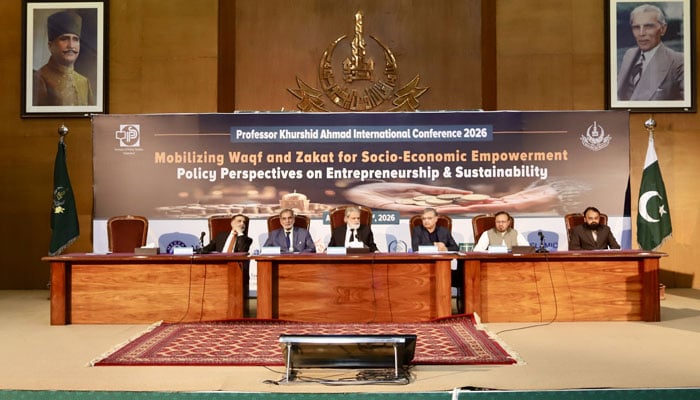
These reflections emerged on the first day of the Professor Khurshid Ahmad International Conference 2026, jointly organized by the Institute of Policy Studies (IPS) and Allama Iqbal Open University (AIOU) under the theme ‘Mobilizing Waqf and Zakat for Socio-Economic Empowerment: Policy Perspectives on Entrepreneurship and Sustainability.’
The two-day conference brings together leading national and international scholars, researchers, policymakers, regulators, and practitioners to explore innovative policy solutions and practical frameworks for leveraging Waqf and Zakat as structured instruments for sustainable and inclusive development.
Speakers included Prof. Dr. Nasir Mehmood, vice chancellor AIOU; Prof. Dr. Anis Ahmad, vice chancellor Riphah International University; Prof. Dr. Iqbal Khan, vice chancellor Shifa Tameer-e-Millat University (STMU); Prof. Dr. Mohyuddin Hashmi, dean, AIOU; Khalid Rahman, chairman IPS; Prof. Dr. Atiquzzafar Khan, HoD, STMU; Dr. Ghazala Ghalib, Faculty of Shariah & Law, IIUI; Prof. Dr. Kabir Hassan, The University of New Orleans, USA; Omar Mustafa Ansari, secretary general, Accounting and Auditing Organization for Islamic Financial Institutions, Bahrain; Prof. Dr. Mehmet Asutay, Durham University, UK; Dr. Tariq Naseem, Securities and Exchange Commission of Pakistan; Dr. Toseef Azid, University of Management and Technology; Dr. Fazal ur Rehman, Zakat Foundation of America; and Dr. Salman Syed Ali, former research lead, Islamic Development Bank.
They emphasised that several Muslim-majority countries, such as Türkiye, Malaysia, Indonesia, and Kuwait, have attempted to revitalize Waqf and Zakat through institutional reforms, integrating financial technologies and artificial intelligence to improve transparency, efficiency, and outreach.
These global experiences offer valuable lessons for Pakistan, particularly in designing frameworks to address poverty and other socio-economic challenges through structured and sustainable mechanisms, according to them.
It was underscored that Islam offers a comprehensive framework for life, encompassing economic, social, and moral dimensions. In this context, any Islamic financial model must be developed holistically, taking into account the socio-political realities and systemic limitations within Pakistan. The ongoing evolution of Islamic banking and finance in the country requires careful alignment with broader developmental objectives, ensuring that such models contribute meaningfully to inclusive growth.
The speakers noted that Islamic jurisprudence inherently promotes a balanced and integrated view of society, supporting the circulation of wealth through institutions such as Waqf and Zakat. Despite the availability of resources globally, persistent inequalities, including poverty and widening socio-economic divides, indicate the failure of existing systems to ensure equitable distribution. In this regard, revitalizing these institutions can serve as a viable pathway to bridge such gaps. Moreover, beyond financial assistance, there is a growing need to equip beneficiaries with skills and entrepreneurial capabilities, aligning welfare mechanisms with sustainable development goals and long-term economic empowerment.
The speakers also reflected on the intellectual legacy IPS chairman Khalid Rahman highlighted that rising geopolitical tensions and economic uncertainties have heightened the need for alternative development para-digms that prioritize collective well-being.