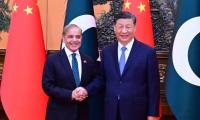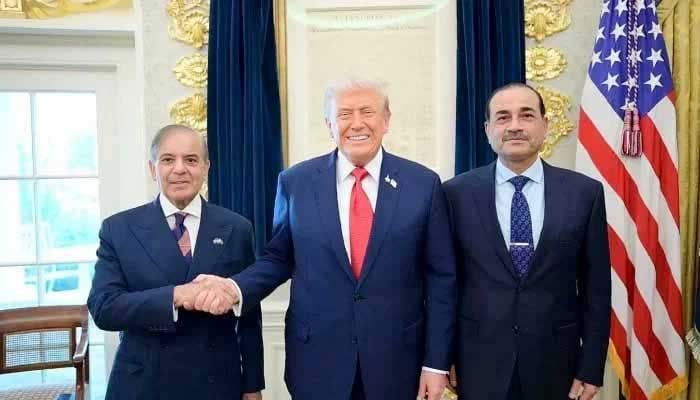
ISLAMABAD/ WASHINGTON: Pakistan is positioning itself as the lead mediator trying to broker an end to the US’s and Israel’s war against Iran, the Financial Times reported on Monday.
Chief of Defence Forces (CDF) and Chief of Army Staff (COAS) Field Marshal Asim Munir spoke with US President Donald Trump on Sunday, Reuters quoted the newspaper that cited two people briefed on the call.
It also reported that senior Pakistani officials were back-channelling communications between Tehran, Steve Witkoff and Jared Kushner.
US President Donald Trump’s announcement to halt further military strikes on Tehran is seen as a direct result of Islamabad’s strategic diplomatic efforts.
Meanwhile, Axios reported, citing a US source, that Pakistan, Turkiye and Egypt have been passing messages between the United States and Iran in recent days in an effort to de-escalate the conflict,
Senior officials from the three countries held separate talks with White House envoy Steve Witkoff and Iranian Foreign Minister Abbas Araghchi, the source said.
“The mediation is ongoing and making progress… the discussion is about ending the war and resolving all outstanding issues,” the source said, adding: “We hope to have answers soon.” Pakistan, Turkiye and Egypt have been working desperately to buy time before that ultimatum was set to expire later on Monday, Axios reporter Barak Ravid Ravid said, according to Time of Israel.
Pakistan Turkiye and Egypt’s foreign ministers spoke with Iran’s Foreign Minister Abbas Araghchi and, separately, with Trump’s envoy Steve Witkoff. They reportedly discussed not only seeking a solution regarding the Strait of Hormuz, but also ending the war.
US and Iranian representatives may meet in Islamabad, the capital of Pakistan, as early as the end of this week, Barak Ravid reported.
According to the journalist’s source, Ghalibaf and other representatives will attend from Tehran, while Witkoff, Kushner, and possibly vice president JD Vance will represent the United States.
Earlier on Monday, President Trump said that Tehran wants to make a deal, and that it could happen within five days or sooner. He emphasised that the latest talks with Iran took place on Sunday night.
When asked who the US administration had been negotiating with, Trump said that Iran had representatives.
He said that over the past two days, Washington and Tehran had held “very productive and constructive talks” on resolving the conflict.
However Iranian Foreign Ministry Spokesperson Esmaeil Baghaei denied on Monday that any talks with the United States had taken place, contradicting US President Donald Trump’s earlier statements that Steve Witkoff and Jared Kushner had met with Iranian officials on Sunday, the Jerusalem Post reported.
“We have had very, very strong talks. We’ll see where they lead. We have points, major points of agreement, I would say, almost all points of agreement... we’ve had very strong talks, Mr Witkoff and Mr Kushner had them,” Trump said.
In a statement to Iranian media, Baghaei said that although some friendly nations had sent messages indicating that the United States had requested talks, Iran did not respond.
However President Donald Trump dismissed formal denials from Iran’s foreign ministry regarding peace negotiations, asserting that back-channel talks led by Jared Kushner and Steve Witkoff have reached ‘almost all points of agreement’ to end the conflict, Fox News reported.
Trump said he had given orders to postpone for five days the attacks he had threatened against Iranian power plants.
Iran has effectively closed the key Strait of Hormuz, through which about a fifth of global oil and liquefied natural gas flows.
Trump wrote early in the morning on his Truth Social platform that the US and Iran had had “very good and productive” conversations over the past two days about a “complete and total resolution of hostilities in the Middle East”.
He later told reporters that his special envoy Steve Witkoff and son-in-law Jared Kushner, who had been negotiating with Iran before the war, had had discussions with a top Iranian official into the evening on Sunday, and would continue on Monday.
“We have had very, very strong talks. We’ll see where they lead. We have major points of agreement, I would say, almost all points of agreement.”
“All I’m saying is, we are in the throes of a real possibility of making a deal,” he told reporters before departing Florida for Memphis.
He declined to say who the US was speaking to in Iran but said it was not Khamenei, who was wounded in the Israeli attack at the start of the war that killed his father and predecessor, Ayatollah Ali Khamenei, according to Washington.
“We’re dealing with the man who I believe is the most respected and the leader,” Trump said.
An unnamed Israeli official and a source familiar with the matter told Reuters that Qalibaf, increasingly influential, was representing Iran and that talks on ending the war could be held in Islamabad as soon as this week.
Pakistan’s Foreign Ministry also confirmed contact stating that Deputy Prime Minister/Foreign Minister Ishaq Dar held a telephone conversation with the Araghchi.
“They discussed recent regional developments. The DPM/FM emphasised the importance of dialogue and diplomacy to promote peace, security and stability in the region and beyond,” said the Foreign Ministry in a statement.
Both sides agreed to remain in close contact on the evolving situation.
Meanwhile, DPM/ FM Dar held a telephonic conversation with Deputy Prime Minister/Foreign Minister of Iraq Fuad Hussein on the prevailing regional situation.
Both the leaders expressed deep concern over the ongoing regional escalation and its wider implications, a Foreign Ministry statement said.
Dar underscored the need for collective efforts to de-escalate tensions and prevent further instability, emphasising that dialogue and adherence to international law remain essential for ensuring peace, security and stability in the region and beyond.
The two leaders also exchanged Eid greetings.
DPM Dar also spoke with Foreign Minister of Türkiye Hakan Fidan on the evolving regional situation.
Both the leaders reviewed the latest developments in the region, including the recent announcement by the US President regarding a temporary halt in hostilities.
The DPM/FM stressed the importance of continued diplomatic engagement to ensure peace and stability in the region and beyond.
They agreed to remain in close contact on the evolving situation.
Meanwhile, Prime Minister Shehbaz Sharif extended Eid-ul-Fitr and Nowruz greetings to the Iranian President Masoud Pezeshkian and the brotherly people of Iran.
The feelings were warmly reciprocated by the Iranian president, who also conveyed his best wishes for the people of Pakistan.
As a neighbouring brotherly country of Iran, the prime minister conveyed Pakistan’s solidarity with the brave Iranian people in the wake of the ongoing hostilities. He expressed deep condolences over the loss of precious lives and prayed for early recovery and safety of those injured and displaced.
The prime minister also conveyed his serious concern over the dangerous ongoing hostilities in the Gulf region. In view of this grave situation, Shehbaz underscored the urgent need to work collectively for de-escalation and a return to dialogue and diplomacy amongst all the neighbouring countries to settle their differences. He stressed upon the critical importance of unity in the ranks of the Ummah, that was required more than ever before.
While sharing with the Iranian president the diplomatic outreach efforts of Pakistan’s leadership, the prime minister assured the Iranian leadership that Pakistan would continue to play a constructive role in facilitating peace in the region.
Muhammad Saleh Zaafir adds: Acting US ambassador in Pakistan Natalie A. Baker, who is the Chargé d’Affaires (CDA), here has returned to Islamabad amid the strong speculation that Pakistan’s federal capital could be rendezvous for talks between Iran and the US. The embassy in Islamabad is now open from Monday to Friday. The emergency services for US citizens are available. The Embassy is processing immigrant visas, though high demand and staffing shortages have resulted in lengthy wait times. Due to safety risks, some personnel were ordered to leave Karachi and Lahore consulates early this month but this did not alter the operational status of the Islamabad embassy.