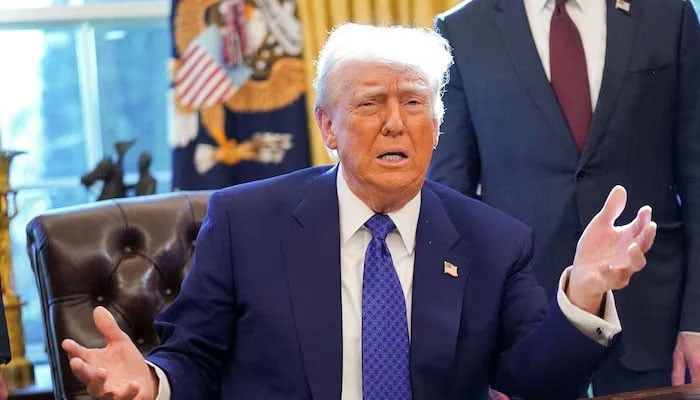
TEHRAN: Iran on Sunday vowed to “irreversibly” destroy key infrastructure across the Middle East if US President Donald Trump acted on his threat to knock out the Islamic republic’s power plants unless the Strait of Hormuz was swiftly reopened.
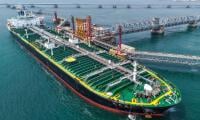
Iran also vowed to fully close the strait if Trump followed through on the ultimatum, choking off what little traffic has continued to transit the vital shipping lane for oil and gas.
The tit-for-tat threats came as the war that has reverberated across the Middle East entered its fourth week, with alarm mounting over energy and water facilities, and over strikes around nuclear sites.
Trump, under pressure due to rising fuel prices, said the US would “obliterate” Iranian power plants if Tehran did not end its de facto blockade of the strait within 48 hours, or by 23:44 GMT on Monday, according to the time of his Truth Social post.
“If the United States’ threats regarding Iran’s power plants are carried out... the Strait of Hormuz will be completely closed, and it will not be reopened until our destroyed power plants are rebuilt,” the military’s operational command Khatam Al-Anbiya said in a statement carried by state TV.
The military said it would also strike Israel’s “power plants, energy, and information and communications technology (ICT) infrastructure”, along with power plants in regional countries hosting US bases and companies with US shareholders.
Iran’s powerful parliament speaker Mohammad Bagher Ghalibaf said vital infrastructure across the region “will be considered legitimate targets and will be irreversibly destroyed” if its own plants are attacked.
Iran’s energy minister said US-Israeli strikes had already inflicted “heavy damage” on the country’s water and energy infrastructure since the start of the war on February 28.
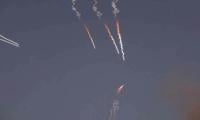
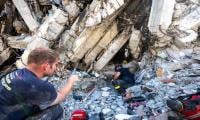
Iran’s defiance came a day after its missiles evaded Israel’s much-vaunted air defences and struck two southern towns, including Dimona, which houses a nuclear facility. The projectiles injured more than 100 people. “We thought we were safe,” Galit Amir, a 50-year-old care provider, told AFP in Dimona. “We didn’t expect this.”
Prime Minister Benjamin Netanyahu vowed to pursue senior commanders of Iran’s Revolutionary Guards “personally” as he inspected the damage in Arad, the other town struck by an Iranian missile.
Iran’s attacks on Israel indicated that its arsenal still poses a threat across the region, even after Trump and Netanyahu claimed to have decimated Tehran’s forces.
Dimona hosts what is widely believed to be the Middle East’s only nuclear arsenal, although Israel has never admitted to possessing nuclear weapons, insisting the site is for research.
The missile fell about five kilometres (three miles) from the nuclear facility, according to rescuers. Iran said the strike on Dimona was in response to an earlier attack on its nuclear site at Natanz.
Asked about Natanz, the Israeli military said it was “not aware of a strike”.
“The war in the Middle East has reached a perilous stage” with the strikes on Natanz and Dimona, World Health Organisation chief Tedros Adhanom Ghebreyesus said on X.
“I urgently call on all parties to exercise maximum military restraint and avoid any actions that could trigger nuclear incidents.”
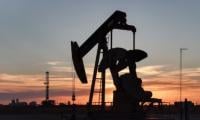
Iran’s chokehold on the Strait of Hormuz, which typically carries around a fifth of the world’s crude oil and liquefied natural gas, has rattled markets and sent fuel prices soaring. North Sea Brent crude is now trading above $105 a barrel, feeding fears about higher inflation and weaker global growth.
In recent days, Iran has allowed some vessels from countries it considers friendly to pass, while warning it would block ships from countries it says have joined the “aggression” against it.
Iran’s parliament is mulling imposing tolls on shipping through the strait, with parliament speaker Ghalibaf saying maritime traffic would “not return to its pre-war status”.
Patrick Pouyanne, the head of French oil giant TotalEnergies, said the economic outlook would worsen the longer the conflict dragged on. “If it’s more than six months, we will have some real impacts. All the economies of the world will be damaged,” he told Chinese broadcaster CGTN.
The impact from the war continued to be felt across the region. Early on Sunday, AFP journalists in Jerusalem heard blasts and air raid sirens as Iran launched a fresh barrage of missiles at Israel, while Israel said it was striking Tehran in response.
Iran also kept up retaliatory attacks on Gulf nations it accuses of serving as a launchpad for US strikes.
Saudi Arabia said Sunday it detected three ballistic missiles around the capital Riyadh. One was intercepted, and two fell in uninhabited areas, the defence ministry said. The United Arab Emirates said it responded to new missile and drone attacks from Iran.
Pope Leo XIV said Sunday he was following the situation in the Middle East “with dismay”.
Meanwhile, US Treasury Secretary Scott Bessent said the United States may need to “escalate” its attacks against Iran to be able to wind down the war.
“Sometimes you have to escalate to de-escalate,” he told NBC’s “Meet the Press”, after President Donald Trump gave seemingly contradictory trajectories for the military campaign.
The World Health Organisation warned that strikes around nuclear sites in Iran and Israel had pushed the Middle East war to a “perilous stage”. “I urgently call on all parties to exercise maximum military restraint and avoid any actions that could trigger nuclear incidents,” WHO chief Tedros Adhanom Ghebreyesus said on X.
Israel’s military said Iran had fired more than 400 ballistic missiles at Israel since the start of the Middle East war, with around 92 percent of them intercepted.
Qatar on Sunday confirmed four of its military personnel and three Turkish nationals, including one serviceman, were killed on board a helicopter that crashed in Qatar´s territorial waters.
While Qatar has been targeted by several Iranian strikes since the start of the Middle East war, no connection has been made between the chopper and the conflict triggered by US-Israeli attacks on Iran.
At least six overnight attacks targeted a US diplomatic and logistics centre at Baghdad’s International Airport, two Iraqi security officials told AFP.
“Eight separate attacks, carried out until dawn with rockets and drones targeted the US centre,” a senior security official told AFP, while a second security official said there had been six strikes.
Saudi Arabia’s defence ministry said three ballistic missiles were detected around the capital Riyadh, while the UAE said it responded to Iranian missile and drone attacks.
The Israeli military said its forces launched a wave of strikes on Tehran, hours after Iranian missile fire hit two cities in southern Israel.
The Strait of Hormuz remains open to all shipping except vessels linked to “Iran’s enemies”, Iranian media reports published on Sunday quoted Iran’s representative to the UN maritime agency as saying.
Turkish Foreign Minister Hakan Fidan discussed steps to end the war between Iran, the United States and Israel with counterparts from Iran and Egypt, as well as US officials and the European Union, a Turkish diplomatic source said on Sunday. The source said Fidan had held separate calls with Iranian Foreign Minister Abbas Araqchi, Egyptian Foreign Minister Badr Abdelatty, European Union foreign policy chief Kaja Kallas, and US officials, without elaborating further.
UK minister Steve Reed on Sunday said one missile launched by Iran targeting a joint UK-US military base in the Indian Ocean “fell short” while another missile was “intercepted”.
“Our assessment is that the Iranians certainly targeted Diego Garcia,” a military base some 4,000 kilometres (2,500 miles) away from Iran, Reed told the BBC.
“As we understand it, one missile fell short, failed, the other was intercepted and prevented,” said the housing minister, who was representing the government on the Sunday morning shows. “But I don’t think it’s a surprise this has happened, Iran has been recklessly firing missiles around the region,” he added.
Eight overnight attacks targeted a US diplomatic and logistics centre at Baghdad’s International Airport, an Iraqi security official told AFP on Sunday. Several waves of departures from the US facility occurred on Saturday from the airport, according to another Iraqi security source, speaking on condition of anonymity due to the sensitivity of the matter.
A second security official said there had been at least six strikes, with a police source saying a rocket launcher was discovered in a Baghdad district near the airport.
Blasts were heard and air raid sirens sounded in Jerusalem on Sunday, AFP journalists said, after the Israeli military warned of incoming missile fire from Iran.
Sri Lanka raised fuel prices by 25 percent on Sunday, the second increase in two weeks, as the country prepared for more impact from the war in the Middle East.
Regular petrol was increased to 398 rupees ($1.30) per litre, up from 317 rupees, while diesel, the fuel commonly used for public transport, rose by 79 rupees to 382.
Japan’s foreign minister said Sunday that one of two Japanese nationals detained in Iran has been released.
A projectile caused an explosion near a bulk carrier off the coast of the United Arab Emirates, a British maritime monitor said on Sunday, noting there were no injuries reported.
Top envoys for the Group of Seven advanced economies and the European Union on Saturday urged an “immediate and unconditional” end to Iran attacks against allies in the Middle East.
Iran’s Revolutionary Guards said on Saturday they had targeted an Israeli F-16 fighter jet over the country’s centre.
“An F-16 hostile enemy fighter jet belonging to the Zionist regime was struck at 3:45 am in central Iran,” the Guards said on their Sepah News website.
The Israeli military earlier said a surface-to-air missile had been launched at an Israeli aircraft during “an operational activity” in Iran, without specifying the type of jet.
It added that “no damage was caused to the aircraft”.
More than 20 countries on Saturday said they would contribute to efforts ensuring safe passage in the Strait of Hormuz, condemning Iran’s closure of the vital waterway.
“We condemn in the strongest terms recent attacks by Iran on unarmed commercial vessels in the Gulf, attacks on civilian infrastructure including oil and gas installations, and the de facto closure of the Strait of Hormuz by Iranian forces,” said the 22 countries, mostly European but also including the UAE and Bahrain.
Saudi Arabia on Saturday ordered an Iranian diplomat and three members of his team to leave the country, as the kingdom and its Gulf neighbours face Iranian strikes in retaliation for US-Israeli attacks.
Gas resumed flowing from Iran, Iraq’s electricity ministry said Saturday, after a strike on an Iranian facility caused a three-day stoppage.
Thousands of Iranians held Eid al-Fitr prayers on Saturday to mark the end of the Ramadan fast, as Tehran reported a strike on its nuclear enrichment plant and Israel threatened intensified bombardment.
Iran’s supreme leader traditionally leads Eid prayers but Ayatollah Mojtaba Khamenei, who came to power earlier this month after his father was killed in a US-Israeli strike, has remained out of the public eye.
Instead, the head of the judiciary, Gholam Hossein Mohseni Ejei, attended prayers at central Tehran’s Imam Khomeini grand mosque, which was filled to overflowing, with worshippers flooding the streets outside.
Iran’s key ally Russian President Vladimir Putin sent greetings to Khamenei, “wished the Iranian people strength on overcoming these severe trials and emphasised that during this difficult time, Moscow remained a loyal friend and reliable partner of Tehran”.
US President Donald Trump on Friday ruled out reaching a ceasefire agreement with Iran, as more Marines headed to the Middle East in a possible sign of a coming ground operation.
Iran’s supreme leader Mojtaba Khamenei said on Friday the country had dealt its enemies a “dizzying blow” in the war with the US and Israel.
Iranians have “dealt him (the enemy) a dizzying blow so that he now starts uttering contradictory words and nonsense,” Khamenei said in a written message for Nowruz.
“At the moment, due to the particular unity that has been created between you our compatriots -- despite all the differences in religious, intellectual, cultural and political origins -- the enemy has been defeated,” Khamenei said in the message.
The statement of defiance came as Iranians marked a muted Nowruz with the war now approaching its fourth week.
Meanwhile Mojtaba Khamenei in a statement called on Afghanistan and Pakistan to improve ties, offered help, Reuters reported.
Iran is ready to cooperate with the International Maritime Organisation to improve maritime safety and protect seafarers in the Gulf, the Iranian representative to the U.N. maritime agency said, the semi-official Mehr news agency reported on Sunday.
Ali Mousavi said the Strait of Hormuz remains open to all shipping except vessels linked to “Iran’s enemies”, adding that passage through the narrow waterway was possible by coordinating security and safety arrangements with Tehran.
“Diplomacy remains Iran’s priority. However, a complete cessation of aggression as well as mutual trust and confidence are more important,” Mousavi said, adding that Israeli and U.S. attacks against Iran were at the “root of current situation in Strait of Hormuz”.—Agencies