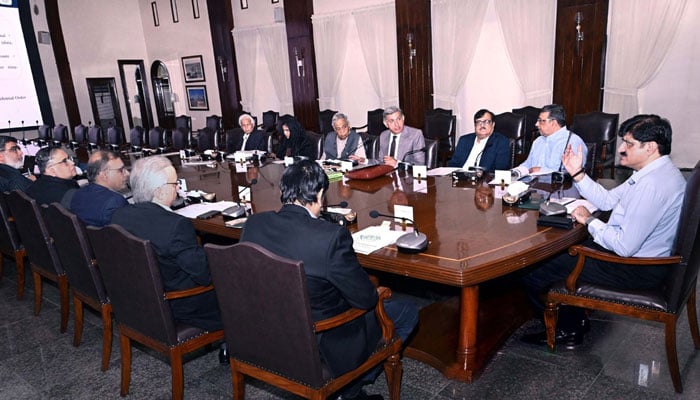
Sindh Chief Minister Syed Murad Ali Shah on Thursday reviewed the performance and future roadmap of the Sindh Revenue Board (SRB), highlighting its central role in driving the province’s fiscal recovery in 2025-26 after a challenging economic period.
The review noted that the SRB has delivered strong revenue growth, including record recoveries in arrears, positioning it as a key pillar of Sindh’s financial stability. Shah directed the SRB to further broaden the tax base, intensify action against tax evasion, and accelerate digital reforms to consolidate recent gains in revenue collection and enhance transparency.
SRB Chairman Wasif Memon said the board recorded strong revenue growth this February, driven by an unprecedented recovery of Rs9.5 billion in arrears after long and persistent efforts.
The total collection of Rs34.86 billion last month reflects a 41 percent growth over the Rs24.664 billion collected last February. The cumulative collection of Rs225.653 billion during July-February exceeds last year’s collection of Rs182.605 billion for the same period by 24 per cent.
Memon said during the meeting at the CM House that the SRB had recorded historic collections of Rs306.6 billion, including Rs284.4 billion from Sindh Sales Tax on Services (SST) in 2024-25. The figure represents a 29.5 percent increase compared to the Rs237 billion collected the previous year.
The meeting was also informed that June 2025 had recorded the highest monthly collection in the SRB’s history, exceeding Rs40.5 billion, the highest since the board began operations 15 years ago. Shah appreciated the SRB’s performance, and stressed the need to facilitate taxpayers, who are the major stakeholders.
According to the briefing, the ports and terminals, telecommunication, banking, franchise, insurance and contract execution sectors remained among the top contributors to provincial revenue.
The port, airport and terminal operators sector remained the largest contributor, generating Rs40.2 billion, followed by telecommunication with Rs24.2 billion. Other strong performers included the banking sector (Rs20.34 billion), franchise services (Rs17.53 billion) and insurance (Rs14.56 billion).
The meeting was informed that the top 10 sectors collectively contributed Rs155.6 billion, while 27 additional service sectors generated more than Rs1 billion each, indicating a broad and diversified tax base.
Several sectors recorded exceptional growth during the year. Software and IT consultancy services grew by 49 per cent, goods transportation by 50 per cent, and technical and engineering consultancy by 44 per cent.
The funds and asset management sector entered the list of top contributors for the first time, posting a 162 percent growth and generating Rs5.76 billion, driven by expansion in Pakistan’s asset management industry and improved macroeconomic conditions.
Regional offices also showed strong performance. The Hyderabad Commissionerate collected Rs20.9 billion, registering a 38 percent growth, while the Sukkur and Larkana commissionerates jointly collected Rs11 billion, reflecting a 41 percent growth.
Memon said the increase was due to improved monitoring of high-risk sectors, expanded taxpayer facilitation, recovery drives and enhanced digital utilisation. The meeting was informed that Rs48.42 billion was collected through withholding agents during 2024-25, compared to the Rs37.43 billion the previous year.
Automation of the SST deductions through the Financial Accounting & Budgeting System and SAP platforms at government accounts offices has significantly improved transparency and compliance.
The meeting was told that collections under the Sindh Workers Welfare Fund (SWWF) and the Sindh Workers Participation Fund also recorded strong growth. The SWWF wing collected Rs22.25 billion in 2024-25, surpassing the revised target of Rs20.2 billion and showing a 55 percent growth despite legal and regulatory challenges.
The meeting was briefed about major institutional reforms, including the establishment of a dedicated Intelligence, Investigation and Prosecution Wing, making the SRB the first provincial revenue authority in Pakistan to create a specialised enforcement unit to combat tax fraud and fake invoicing.
The SRB also strengthened audit systems, digital dashboards, complaint management mechanisms and e-filing platforms, including an Agricultural Income Tax e-filing system. Shah appreciated the SRB’s performance and said the growth in provincial revenue reflects improved governance, transparency and institutional reforms.
“The SRB has demonstrated consistent progress over the years. Crossing the Rs300 billion mark is a significant achievement, and shows the potential of the services sector in strengthening provincial finances.” He directed the SRB to further expand the tax base, bring undocumented service providers into the net, and enhance enforcement against tax evasion.