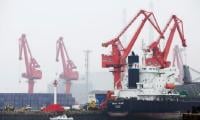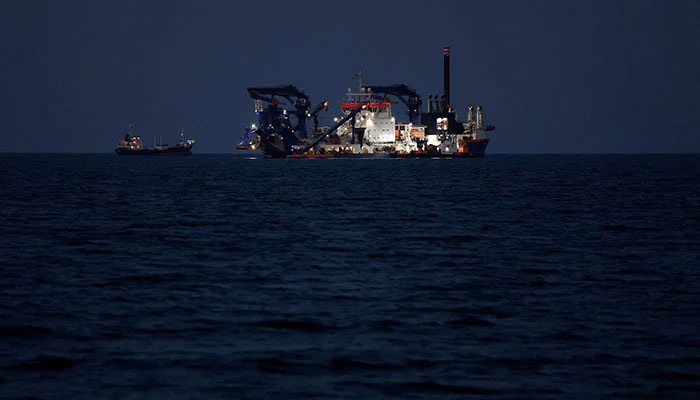
TEHRAN/DUBAI/ LONDON/NEW DELHI: Three cargo vessels were hit by “unknown projectiles” in the Strait of Hormuz, including a Thai-flagged cargo ship headed for India, which was strongly condemned by the Indian ministry of external affairs.
According to a BBC report, Iran later admitted it was behind the attack, saying the ship’s crew ignored warnings.
Separately Citigroup and Standard Chartered have begun evacuating their Dubai offices, telling staff to work from home instead, sources said on Wednesday, as banks step up precautions after Iran threatened Gulf banking interests linked to the US and Israel.
The incident comes amid heightened tensions in the Middle East, with growing concerns about security for ships passing through the Strait of Hormuz, a key global shipping route.
The MEA said targeting commercial shipping and civilian crew amid the escalating Middle East conflict is unacceptable and called for safeguarding vital global maritime routes as the Thai-flagged cargo vessel Mayuree Naree was attacked in the Strait of Hormuz, The ship had left Khalifa Port in the UAE and was on its way to Kandla Port in Gujarat, when the incident occurred.
Iran is taking advantage of its dominance in the Strait of Hormuz. The country’s oil producers are loading more crude onto tankers than before the war started, while the rest of the world’s oil has been stuck on tankers in the Persian Gulf for more than a week. Iran has placed 2.1 million barrels of oil onto ships over the past six days, which is slightly more than the 2 million barrels it averaged before the war broke out, according to Homayoun Falakshahi, lead crude research analyst at Kpler. The Wall Street Journal was first to report the development.
In a related development, U.S. Central Command said its forces “eliminated” 16 minelayers, along with multiple naval vessels, near the Strait of Hormuz, a key waterway through which 20% of the world’s oil passes.
The CENTCOM also issued a new warning advising civilians to stay away from ports near the Strait of Hormuz. The warning, also posted to CENTCOM’s Farsi-language and Arabic-language pages on X, reads in part: “Iranian dockworkers, administrative personnel, and commercial vessel crews should avoid Iranian naval vessels and military equipment,” adding that ports along the strait, including civilian ports, are now considered “legitimate military targets under international law” as a result of their usage by the Islamic Revolutionary Guard Corps (IRGC) throughout the ongoing US-Israeli war with Iran. In its reaction, Iran’s armed forces have threatened to target ports and docks across the region if the country’s own ports are attacked. In remarks reported by Iranian media Wednesday, senior military spokesman Abolfazl Shekarchi said: “If Iran’s ports are threatened, all ports and docks in the region will be our legitimate targets.”
Trump also said he didn’t believe Iran had successfully laid any mines in the Strait of Hormuz and that the US had taken out “just about all” of their mining ships. “We took out just about all of their mine ships in one night,” he said, suggesting as many as 60 Iranian boats had been struck. “Just about all of their navy is gone.”
Trump also encouraged oil tankers to traverse the Strait of Hormuz, insisting it’s safe despite attacks on three vessels in the waterway earlier in the day. Iran claimed responsibility for attacking at least two of those ships. “I think they should use the strait,” Trump said. He told reporters traveling with him on Wednesday in Ohio that the war with Iran is both a war and an “excursion.” “You just said it is a little excursion, and you said it is a war. So which one is it?” a reporter asked. “Well, it’s both,” the president responded. “It’s an excursion that will keep us out of a war, and the war is going to be, I mean for them — it’s a war. For us, it’s turned out to be easier than we thought,” Trump continued.
Trump warned that the US could inflict additional significant damage to Iran’s infrastructure, suggesting that the US could “take them out … within an hour.” Asked what more needs to be done militarily for the war with Iran to end, Trump told reporters at the White House: “More of the same.” He pointed to losses for Iran’s navy, air force, anti-aircraft apparatus, and leadership. He continued: “We’re leaving certain things that if we take them out, or we could take them out by this afternoon, in fact, within an hour. They literally would never be able to build that country back.” Trump later touted the operation and previewed more to come. “We have hit them harder than virtually any country in history has been hit, and we’re not finished yet,” he said
The President also said he was not worried about Iran-backed attacks on U.S. soil, as the Federal Bureau of Investigation warned of Iranian drones potentially striking the U.S. West Coast, ABC News reported. In response to U.S. and Israeli strikes that killed top Iranian officials, Tehran has carried out attacks of its own. When asked on Wednesday if he was worried that Iran may increase its retaliation to include strikes on U.S. soil, Trump told reporters, “No, I’m not.”
ABC News later reported the FBI had last month warned police departments in California that Iran could launch drones at the West Coast from an unidentified vessel off the coast. “
The US embassy in Baghdad warned that Iran and Tehran-backed Iraqi armed groups might target US-owned oil facilities in Iraq.
Several oil fields and facilities in Iraq have been hit by drones since the Middle East war began on February 28.
United Nations humanitarian chief Tom Fletcher warned. the conflict in the Middle East is threatening supply chains and straining humanitarian operations worldwide.
A senior commander in Iran’s Islamic Revolutionary Guard Corps claimed Iran has missiles that can be launched from underwater and suggested they could be used in the coming days. “We have missiles that are launched from underwater, and their speed is 100 meters (328 feet) per second. We may use them in the coming days,” Iranian official media quoted Ali Fadavi, a senior IRGC commander, as saying. He also claimed that only Iran and Russia possess the technology for such weapons. Maersk said that operations at the Port of Salalah in Oman have been halted until further notice.
Iran is capable of targeting “any location it chooses,” the speaker of the Iranian parliament insisted Wednesday, as he dismissed US claims that the country’s missile capabilities had been destroyed. In a post on X, Mohammad Bagher Ghalibaf said previous missile launches by Iran since the war started had been intended to “blind enemy radars and defense systems” and that as a result Iran could now “target any location it chooses with fewer missiles.”
Meanwhile, at least 25 Iranian attacks have targeted US sites or locations housing US military personnel in the Middle East since the start of the war, according to an AFP analysis. Of these attacks, recorded between February 28 and March 11 at 1500 GMT, four targeted US embassies or consulates in Saudi Arabia, Kuwait and Iraq. The other 21 Iranian missiles or drone attacks targeted 13 different military sites housing American personnel.
Meanwhile, nearly 30 attacks have targeted energy infrastructure in the Middle East between the start of the conflict and March 11, more than half of which were carried out by Tehran. AFP counted 16 Iranian strikes targeting oil and gas fields or complexes in seven different Gulf states. Among the targets was the United Arab Emirates industrial zone that includes the Ruwais refinery, one of the largest in the world, which was closed on Tuesday as a precaution.
The strike on an Iranian girls’ school that killed scores of children may be the result of U.S. use of outdated targeting data, two sources familiar with the matter told Reuter. One of the sources, who spoke on the condition of anonymity, said officials responsible for creating targeting packages appeared to have used out-of-date intelligence. The second source confirmed that out-of-date intelligence appears to have been used. Since Reuters’ report on the U.S. likely being responsible for the strike, U.S. President Donald Trump has claimed without evidence that Iran was responsible. But since then, he has said he does not know enough about the strike, that an investigation is ongoing and that he will accept the results of the inquiry.
Meanwhile, Lebanon’s Hezbollah and Iran carried out a joint missile attack on northern Israel in what was the first coordinated attack since the start of the war, a senior Israeli defence official said. Israel said night that it had begun a “large-scale wave of strikes” on Beirut’s suburbs after Hezbollah launched what the Israeli military said were “dozens” of rockets. In another development, sources told CNN Israel is preparing for a potential “significant expansion” of attacks from Iran and Hezbollah tonight. One of the sources said Israel is seeing indications that the Iran-backed Houthis in Yemen may also carry out attacks against Israel.Israeli Prime Minister Benjamin Netanyahu is convening a meeting of Israel’s top political and security officials as the country prepares for a possible expansion of attacks from Iran and Hezbollah, sources have told CNN.
Besides, several Iranian security personnel were killed in drone attacks on checkpoints across the capital, according to reports from Iranian state-linked media. Fars News Agency reported that a number of “security defenders” and members of the Basij paramilitary force were killed in what it described as terrorist drone strikes on multiple locations in Tehran.
The UN Security Council also passed a resolution calling for Iran to immediately halt its attacks on Gulf states, saying they breach international law and pose a “serious threat to international peace and security.” The resolution, passed by 13 votes with two abstentions, “demands the immediate cessation of all attacks by the Islamic Republic of Iran against Bahrain, Kuwait, Oman, Qatar, Saudi Arabia, the United Arab Emirates, and Jordan.”
Thirteen votes were cast in favour of the draft resolution prepared by the Gulf countries. China and Russia were absent during the vote on the resolution condemning Iran’s attacks. Pakistan voted in favour of the resolution against Iran presented by the Gulf countries.
US financial giant Citigroup told its staff to evacuate offices in the Dubai International Financial Centre (DIFC) and Dubai’s Oud Metha neighbourhood, a memo sent to employees which was seen by Reuters shows, telling them to work from home until further notice.
A spokesperson for the bank said it was continuing to take measures to keep staff safe and had contingency plans in place to ensure business continuity.
Britain’s StanChart (STAN.L) has a large presence in the United Arab Emirates, with Dubai now a major financial hub for leading international lenders including JPMorgan (JPM.N), and HSBC, as well as law firms and asset managers.
A spokesperson for StanChart declined to comment.
Separately, HSBC has closed all branches in Qatar until further notice, according to a customer notice, saying the measure was to ensure the safety of staff and customers.
The moves came after a spokesperson for Tehran’s Khatam al-Anbiya military command headquarters said on Wednesday that Iran will target economic and banking interests linked to the US and Israel in the region, after an attack on an Iranian bank.
An administrative building linked to Bank Sepah, one of Iran’s largest public banks and with historical links to the military, was hit overnight in Tehran, the semi-official Mehr news agency reported.
Many staff at foreign and local businesses had already been told by employers to work from home after Iran responded to U.S. and Israeli strikes by firing missiles at targets across the Middle East, causing deaths, damage and travel chaos.
The war in the region has dented Dubai’s sales pitch to international businesses as the region’s most reliable economic hub, prompting concerns of capital flight, layoffs and firms relocating elsewhere, Reuters reported last week. The creation of the DIFC in 2004 kickstarted Dubai’s push to draw financial firms.
By the end of 2025, DIFC hosted more than 290 banks, 102 hedge funds, 500 wealth management firms and 1,289 family-related entities, capping Dubai’s decades-long transition from a modest fishing port into a glittering global financial hub.
StanChart, which makes nearly 6 per cent of its overall income in the UAE according to company filings, has in recent years increasingly based senior executives in the region.
The CEO of its investment bank Roberto Hoornweg is based in Dubai, a StanChart website shows, making him one of the most senior financiers at a global bank to be based in the region.
Hoornweg declined to comment via a bank spokesperson.
HSBC CEO Georges Elhedery said on Monday that the bank’s “conviction in the GCC’s (Gulf Cooperation Council) fundamentals and its future is unchanged”, in some of the first comments from an international bank boss on the growing crisis.
“The safety of our colleagues and customers remain our top priority,” HSBC said in a statement on Wednesday in relation to its Dubai-based staff.
A spokesperson for JPMorgan (JPM.N) declined to comment.
At Goldman Sachs (GS.N) employees across the region are working from home and following local official instructions, a person with knowledge of the matter
told Reuters.
Separately, the son of the president said Wednesday Iran’s Supreme Leader Ayatullah Mojtaba Khamenei is injured but “safe and sound.” The is the first official explanation for why the 56-year-old has not been seen since his appointment at the weekend.
“I heard news that Mojtaba Khamenei had been injured. I have asked some friends who had connections,” Yousef Pezeshkian, who is also a government adviser, wrote in a post on his Telegram channel. “They told me that, thank God, he is safe and sound,” added the son of President Masoud Pezeshkian.