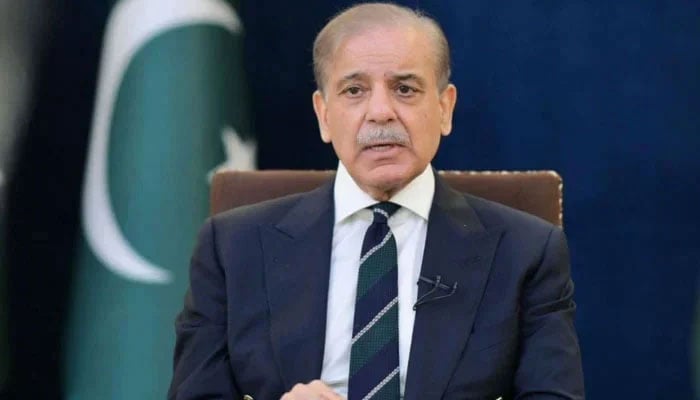
ISLAMABAD: Prime Minister Shehbaz Sharif has written a letter to Mojtaba Khamenei, conveying condolences on the martyrdom of his revered father, the Supreme Leader of the Islamic Republic of Iran, Ayatollah Seyyed Ali Khamenei, while also congratulating him on assuming the responsibilities of the Supreme Leader.
“In his message, the prime minister reiterated the deepest condolences and prayers of the people of Pakistan at this solemn moment for the brotherly people of Iran and the wider Ummah. He noted that the martyrdom of Ayatollah Seyyed Ali Khamenei had deeply saddened the people of Pakistan, who stand in solidarity with the leadership and people of Iran during this difficult time,” the PM Office Media Wing, Tuesday, said in a press release.
While congratulating the Supreme Leader on assuming this onerous responsibility, the prime minister expressed the hope that his leadership would guide Iran towards peace, stability, dignity and prosperity in the years ahead. Shehbaz underscored that relations between Pakistan and Iran were anchored in shared faith, history, culture and language.
He reaffirmed Pakistan’s commitment to continue working closely with the Islamic Republic of Iran to further strengthen bilateral cooperation across all spheres of mutual interest for the benefit of the two brotherly peoples. He also prayed for the good health, well-being and success of Mojtaba Khamenei and for peace, stability and prosperity for the brotherly people of the Islamic Republic of Iran.
President Asif Ali Zardari also conveyed his good wishes to Ayatollah Seyyed Mojtaba Hosseini Khamenei following his election and appointment as the Supreme Leader of the Islamic Republic of Iran. The president noted that the region is facing serious tensions and conflict. He expressed the hope that the situation will stabilise and that conditions will improve for the people of the region.
Meanwhile, chairing a review meeting at the PM House on the implementation of the government’s announced austerity and energy-saving initiatives, the prime minister directed all federal ministries and divisions to strictly implement the government’s austerity and energy conservation measures, emphasising that Pakistan must ensure economic stability. He approved making Friday the weekly additional holiday as part of the broader strategy to conserve energy and reduce government expenditures.
Addressing the meeting, the prime minister said the government was making every possible effort to keep the national economy stable. He stressed that effective implementation of austerity and energy conservation measures was essential to achieving this goal. He informed the participants that a special committee headed by Deputy Prime Minister/Foreign Minister Ishaq Dar had been formed to oversee the implementation of these measures. The committee will review progress on a daily basis and submit reports to the government. Shehbaz also directed that the austerity measures taken by the government departments should undergo a third-party audit to assess their impact and ensure transparency and effectiveness. The prime minister further directed ministries and institutions to send photographs of vehicles that have been taken off the road under the austerity policy to the Cabinet Division. The meeting was also told that ministries would submit daily and weekly reports to the special committee regarding the implementation of energy-saving measures and workforce management. The prime minister additionally asked ministries to send reports to the PM Office on steps taken to make work-from-home arrangements more effective.
Separately, chairing a weekly review meeting on Federal Board of Revenue (FBR) affairs at the PM Office, the prime minister directed the revenue collector to bring maximum productive sectors under automated monitoring systems to enhance tax collection and curb tax evasion. He emphasized the need to further strengthen enforcement mechanisms to increase revenues and ensure transparency in the taxation system.
He further directed that digital services for taxpayers, including the Auto Tax System, Digital Invoicing System, IRIS and other applications, be made available in Urdu and other local languages to improve accessibility and compliance. Officials briefing the meeting said modern monitoring tools such as video analytics, unit counting, barcode scanning, stamping and serialisation are being used to track production. Monitoring systems are already in place at sugar, cement, cigarette and fertiliser factories, which have contributed to an increase in tax collection. Similar monitoring mechanisms are being introduced in textile, leather, paper, automobile and beverage sectors, which are expected to generate billions of rupees in additional tax revenue.
The officials further said amendments had been made to the law governing Alternative Dispute Resolution Committees to enhance transparency and restore taxpayers’ confidence. Through these committees, the government expects to collect around Rs80 billion in taxes by June 30, 2026. The meeting was also informed that tax case decisions between July 2025 and January 2026 resulted in the recovery of Rs102.9 billion for the national exchequer, while pending tax cases are expected to yield around Rs369 billion by June 2026.
The briefing noted that PRAL’s new executive team has become operational and between January and February this year, digital invoices worth Rs800 billion were generated, while the system is expected to achieve a target of Rs3 trillion in digital invoicing by April 2026.
Participants were also told that a modern FBR data center has been completed, while digital cargo tracking systems, including the e-Bilty system, have been introduced to curb smuggling and monitor cargo movement. A coordinated GPS tracking system for petroleum products has also been implemented.
Shehbaz also instructed the Drug Regulatory Authority of Pakistan (DRAP) to complete the serialisation of medicines manufactured in the country at the earliest.
Saleh Zaafir adds: In a related development, Prime Minister Shehbaz Sharif and PMLN President Nawaz Sharif have decided not to visit Saudi Arabia to perform Umrah next week.
Well-placed sources at the Prime Minister’s House told The News that the visit was dropped in the wake of austerity plan. The Saudi embassy in Islamabad was earlier also intimated about the prime minister’s plan to visit. Meanwhile, parliamentary sources told this reporter that a few federal ministers and state ministers had also cancelled their visit to perform Umrah. Interestingly, the ministers and state ministers had planned to proceed to the kingdom on their own expense but in view of the regional situation, they opted not to undertake the visit.
Meanwhile, Pakistan Tehreek-e-Insaf (PTI) rejected outright the prime minister’s austerity announcements, terming them nothing more than cosmetic and eyewash.
PTI Information Secretary Sheikh Waqas Akram contended, “Had the regime been sincere about relief, then, among other things, it would have slashed the levy by at least Rs21 per litre rather than sacrificing the common man at the altar of its own incompetence. These steps announced by the prime minister are aimed at hoodwinking the public and creating a smokescreen to distract from the government’s utter failure to provide genuine relief to a suffocating populace.”
He described the measures as a glaring hypocrisy of a regime that preaches simplicity and austerity to the public while itself indulging in unprecedented royal extravagance and wasteful spending at the taxpayers’ expense. The PTI spokesperson noted that the petroleum levy had already reached historic highs, yet on March 6 it was abruptly increased once again, compounding public miseries manifold.
Sheikh Waqas Akram highlighted reports that the Punjab chief minister undertook an unnecessary and extravagant visit to Vienna, Austria, using a luxury aircraft costing $12,000-$15,000 per hour. He noted that the roughly 14-hour round trip, sharply contradicts the government’s hollow claims of austerity.
He said the irony is that this visit occurs just as the government announces a ban on official foreign tours, proving once again that laws in Pakistan apply only to the weak, while the elite remain above the law. “The current situation is fundamentally an economic challenge, not a public health emergency like Covid-19. Shutting down offices, schools, colleges and universities will not resolve the crisis,” he added.
He reiterated PTI’s demand for the immediate release of their jailed leader and other political prisoners so that he can lead Pakistan through the ongoing crises, restore unity and stability, and provide credible leadership, instead of leaving the nation at the mercy of a shortsighted, self-serving, unelected junta.