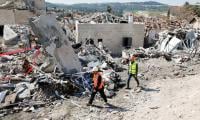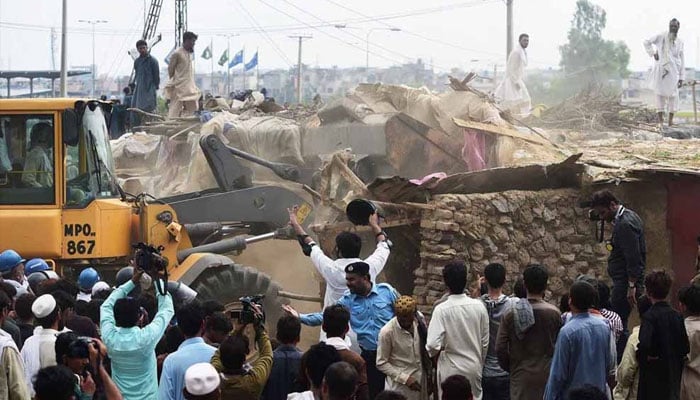
In Islamabad, a certain language of order is spoken. Encroachment operations framed as necessary exercises in urban governance have long shaped how the city manages informality. The recent removal of katchi abadis in various areas of Islamabad fits squarely within this tradition. Bulldozers move through the settlements under the banner of encroachment operations, restoring what the city’s maps insist should have always been empty.
That these settlements are technically encroachments is not in dispute. Cities must regulate land use, and the law cannot be selectively suspended. But legality alone is an incomplete measure of governance. The more difficult, and more necessary, question is what such operations disrupt, and for whom.
For the past year, I have worked with Cities for Children, an organisation engaged in educational programmes in schools attended by children from these settlements. One such programme, ‘Seekho Sikhao Saathi’, uses peer-based learning, with older students, known as bari saathis, training younger children in the classroom. These are students who take on additional responsibility within already constrained circumstances, often balancing school with domestic and caregiving roles.
Some of these Bari Saathis were among those displaced when homes in Bari Imam were affected by the operation. Entire communities have been uprooted in some other places, with the older girls attending government or community schools moving to their village.
The impact of forced displacement on the education of children has been extensively documented and shows increased school dropouts, deterioration in academic achievement, and interrupted school attendance. In Pakistan, where learning poverty and access gaps are already severe, housing insecurity compounds existing vulnerabilities. A child who does not know where she will sleep tonight is unlikely to worry about tomorrow’s lesson.
Girls' educational pathways in Pakistan are influenced by a host of limitations even in stable circumstances: the lack of mobility, unpaid care, early marriage, and societal perceptions of the schooling process as a contingent one, instead of a necessity. Displacement is another instability factor to an already unstable pathway. In cases where a family has to move, girls are first taken out of school, asked to take care of the house, or considered incapable of commuting to faraway classrooms.
There is a deeper irony here. The same state that struggles to retain children in schools is actively destabilising the conditions that allow learning to continue. Education policy speaks of access, retention, and community engagement, yet housing policy proceeds as if children exist independently of their homes, their neighbourhoods, their social worlds. International human rights standards are clear that, where unavoidable, evictions must be accompanied by resettlement planning and safeguards to ensure continuity of essential services, particularly education (UN Committee on Economic, Social and Cultural Rights, General Comment No 7).
This is where comparison becomes unavoidable. While informal settlements are cleared quickly and with visibility, more profitable land violations persist across the city and country. The contrast suggests not simply a commitment to legality, but a hierarchy of enforcement. Urban governance that only disciplines the powerless risks becoming performative rather than principled.
Islamabad does not need fewer poor people to look orderly. It needs policies that recognise that informality is not a moral failure but a symptom of exclusion from affordable housing, secure livelihoods and meaningful urban citizenship.
A city is not just its zoning maps. It is its children, its classrooms, its fragile but persistent attempts at learning under difficult conditions. When we clear land, we should ask: what futures are we also clearing away? And whether the order we are restoring is worth the costs we refuse to count.
The writer is a communications officer at Cities for Children.